Keyman Insurance in India: Assess Business Exposure Before Choosing Cover
Reviewed on 3 October 2026. Prepared by Abhipra Business Protection Desk for professional review.
If one person holds a critical customer relationship, technical approval or operating decision, their sudden absence can disrupt cash flow and service. Keyman insurance may provide money after a covered event, but it cannot replace that person’s knowledge or keep a process running. A sound review considers both financial protection and business continuity.

What keyman insurance is designed to address
LIC describes keyman insurance as cover taken by a business on a key employee’s life to protect the firm against financial losses that may follow the person’s premature death. The exact insured event, benefit, policyholder and claim recipient depend on the policy contract. A life policy should not be assumed to cover disability, illness, resignation or temporary absence unless the policy specifically says so. LIC’s guide to life insurance
The purpose is business protection. It is separate from personal life insurance intended to protect an employee’s family, and it does not itself transfer ownership of a founder’s shares or settle a buy-sell arrangement. Businesses should document who owns the policy, who is insured, who is entitled to a benefit and what the money is intended to support.
Estimate the business exposure before discussing a sum assured
Start with the disruption a business could face if a key person died during the proposed policy term. Depending on the company, relevant questions may include:
- Which decisions, technical approvals, customer accounts or supplier relationships rely heavily on this person?
- What contribution or margin could be delayed or lost while the business stabilises? Gross turnover alone can overstate the exposure.
- What additional recruitment, consulting, training, transition or contract costs might arise?
- Which fixed costs, debt payments or working-capital needs would continue during the transition?
- What liquid reserves, existing policies, other safeguards or successor arrangements already reduce the exposure?
There is no universal cover multiple that answers these questions for every company. An insurer’s published Keyman questionnaire, for example, asks about the likely loss, the time and ability to replace the person, successor training, the person’s shareholding, service arrangements and board authorisation. That is an example of one insurer’s assessment process, not a regulatory checklist or formula for a recommended cover amount. ICICI Prudential’s Keyman questionnaire

For example, a precision manufacturer might depend on one director for final quality approvals and a small number of customer relationships. Its review could map the affected contracts, estimate the time needed to qualify another approver, identify transition costs and test available reserves. The example is illustrative; it does not predict a particular company’s loss or establish an insurance amount.
Follow a business-first review workflow
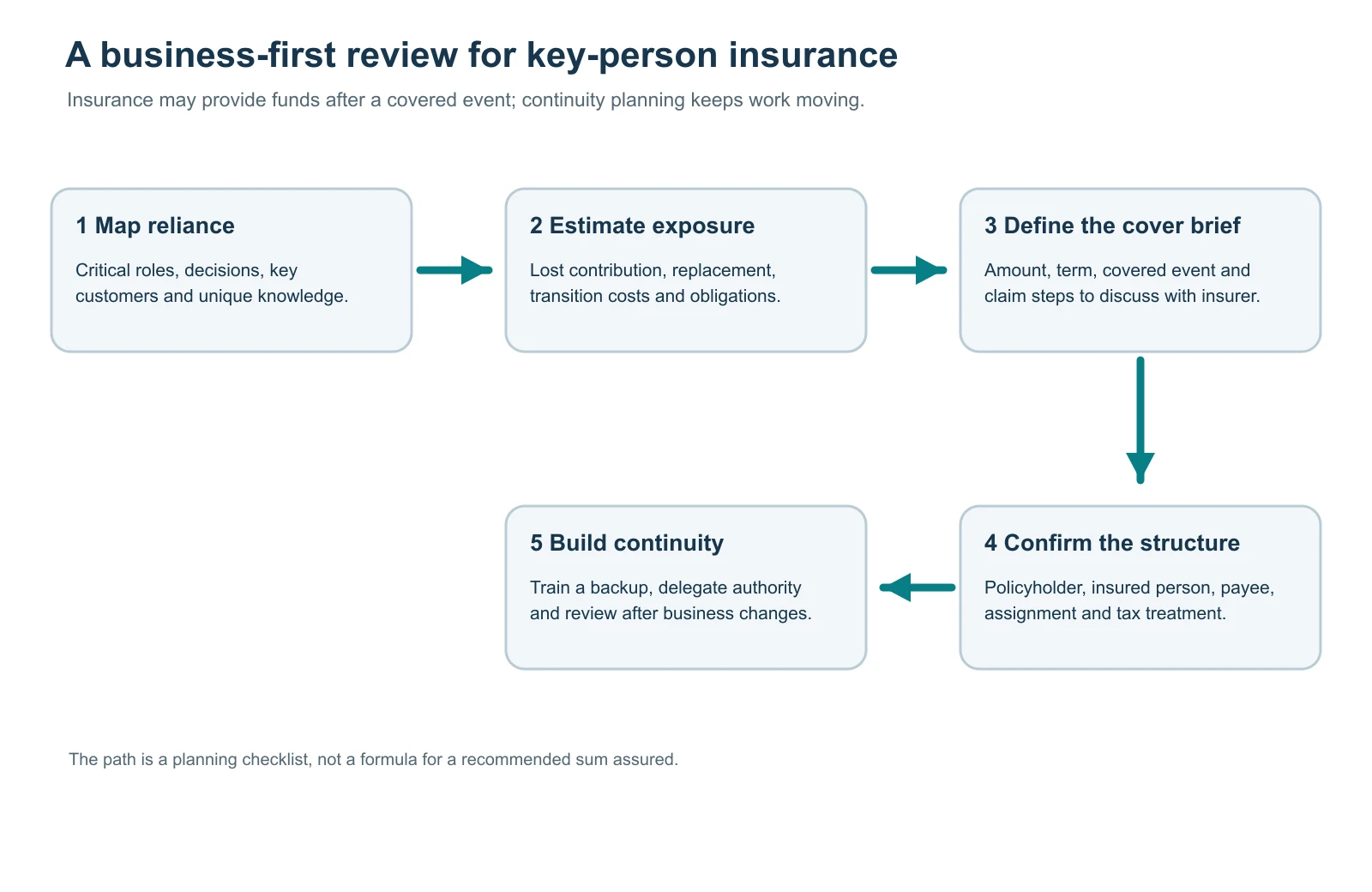
The workflow moves from mapping dependence to estimating the disruption, defining a cover brief, checking policy ownership and tax questions, then preparing a trained backup and review triggers. Its main inference is that insurance and continuity planning solve different parts of the problem: a policy may provide funds after a covered event, while delegated authority and shared knowledge help operations continue. The graphic is a checklist, not a data chart or cover recommendation.
Check the policy structure, claim trigger and tax treatment
Before applying, record the proposed policyholder, insured person, premium payer, beneficiary or claim payee, policy term, covered event, exclusions and claim process. Explain the arrangement to the person being insured and complete the insurer’s disclosure, consent and underwriting steps. If the person is also a promoter or shareholder, review the company’s governance and any separate share-transfer arrangements.
Assignment needs particular care. Section 38 of the Insurance Act, 1938 sets out how an insurance policy may be assigned and the related insurer process. Use the required instrument and obtain the insurer’s acknowledgement where applicable; an internal note alone should not be treated as changing the policy rights. Insurance Act, 1938, section 38
Tax treatment is also not automatic. The Income-tax Act, 2025, as amended by the Finance Act, 2026, defines a Keyman insurance policy to include a policy assigned during its term, with or without consideration. Schedule II expressly excludes Keyman-policy proceeds from the life-policy income exclusion; section 92(2)(d) addresses Keyman-policy sums and bonuses where they are not chargeable under the business or salary heads. Do not assume that assignment makes proceeds tax-free or that a premium is deductible solely because the policy is called “Keyman”. Ask a tax professional to assess the policy, ownership, assignment and timing against the current law. Income-tax Act, 2025, as amended by the Finance Act, 2026
Common mistakes to avoid
- Selecting a cover amount from a generic salary or profit multiple without documenting the business exposure.
- Treating a life policy as protection against illness, disability, departure or business interruption when those events are not stated in its wording.
- Leaving the policyholder, premium payer, claim recipient or intended use of proceeds unclear.
- Assuming the policy automatically funds a share purchase or protects the key person’s family.
- Treating an assignment as a tax-planning shortcut or relying on an internal record instead of the legal and insurer process.
- Depending on one person without training a backup or delegating time-sensitive authority.
A practical company checklist
- List the roles and business relationships that would be difficult to replace quickly.
- Estimate transition costs and possible lost contribution, then subtract available reserves and other safeguards.
- Ask the insurer to explain underwriting requirements, definitions, exclusions, policy term and claim documents in writing.
- Record board authority and the policy’s owner, insured person, premium payer, claim payee and any assignment.
- Keep proposal and policy records securely, with access limited to authorised staff; maintain clear claim contacts.
- Review the arrangement after leadership, ownership, borrowing, customer concentration or business operations change, and at renewal.
For a business-protection discussion, contact Abhipra. A business-specific insurance, legal, succession and tax review should use the company’s actual records and current policy wording.
Related reading
- Insurance Is Protection, Not Investment: Start With What Needs Protecting
- Insurance Planning for Self-Employed Professionals: A Practical Risk Map
- Term Insurance: How Income Earners Can Review Household Protection
Sources
- Life Insurance Corporation of India, “Know Your Life Insurance” — keyman insurance purpose.
- ICICI Prudential Life Insurance, KeyMan Questionnaire — example of insurer information requests; form version shown as June 2021.
- India Code, Insurance Act, 1938, section 38 — policy assignment and transfer.
- Income Tax Department, Income-tax Act, 2025 as amended by Finance Act, 2026 — Keyman definition, exclusion and treatment of proceeds.
Disclaimer
This article is for general business and insurance education. It is not a recommendation to buy insurance, legal or tax advice, or a guarantee that any claim will be paid. Product availability, underwriting, benefits, exclusions, assignment, tax treatment and claims depend on the applicable law, proposal disclosures and policy wording. Review the full policy and consult appropriately qualified insurance, legal and tax professionals before making a decision. The photographs are original illustrative images of fictional people and do not imply endorsement.
Reviewed by Abhipra Research / Compliance Team.