Home Loan Insurance Checklist: What to Review Before You Sign
A home-loan conversation can include several different covers: life insurance linked to the borrower or loan, cover for the building and belongings, and health or accident policies. They do not all insure the same risk, and a policy offered beside a loan is not automatically the right fit. Use this checklist to compare the lender’s written terms, your existing protection and the policy wording.

First ask: what does “home loan insurance” mean here?
Ask for the exact policy name and type. “Home loan insurance” may refer to borrower life cover intended to help repay a debt after a covered death, property insurance for the building, or a package with more than one benefit. Health insurance is separate unless a policy explicitly says it pays a defined loan benefit.
The Reserve Bank of India’s home-loan FAQ describes some loan schemes that ask for a borrower’s life policy assigned to the bank, and advises borrowers to read the scheme terms and seek clarification. RBI’s guidance on banks distributing insurance separately addresses customer choice and voluntary purchase in that distribution context. These materials do not establish one universal insurance condition for every lender or every loan. Ask your lender to identify the current written loan clause, say which covers are conditions versus optional offers, and explain whether an equivalent policy from another insurer can be considered. Keep the response with your loan offer. (RBI home-loan FAQ; RBI guidance on banks’ insurance business)
Compare the cover to the debt and the household
Check who is insured (including each co-borrower), the amount and pattern of cover, policy term, premium payment method and what happens if the loan is prepaid, transferred, refinanced or closed early. If a premium is added to the loan, ask for the revised principal, EMI and total interest cost in writing. Review how an accepted claim would be paid, whether a lender assignment applies, and what amount, if any, would go to the nominee or other beneficiary after a debt is settled. The policy schedule and wording control these details.

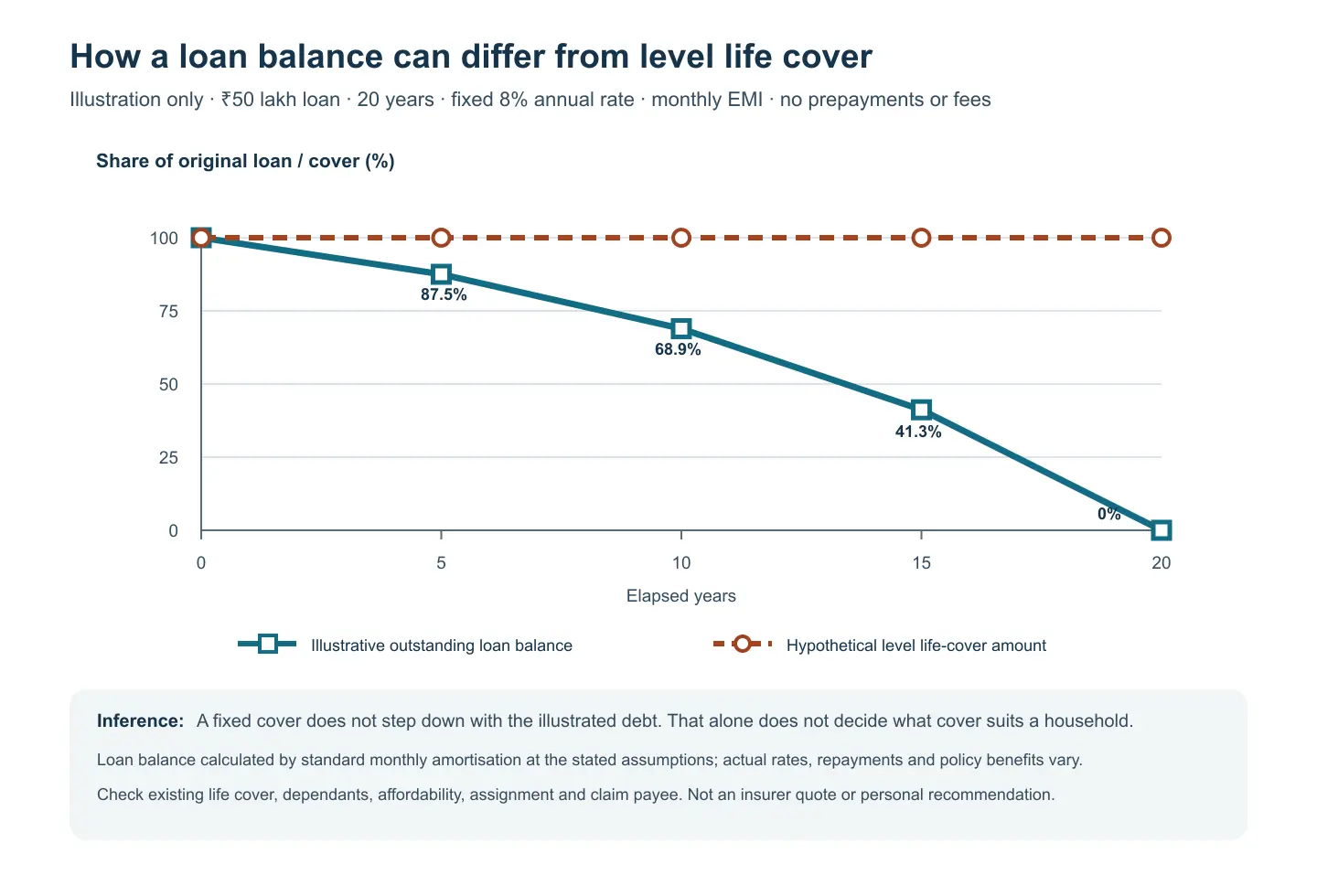
The chart is a mathematical illustration, not current rate data or an insurance quotation. It assumes a ₹50 lakh principal repaid through equal monthly instalments over 20 years at a fixed 8% nominal annual rate, with no fees, prepayments or rate changes. The outstanding balance is calculated using standard amortisation. The other line is a hypothetical fixed life-cover amount equal to the original principal; it is not presented as a lender’s product. The horizontal axis is elapsed loan years and the vertical axis is each amount as a percentage of the starting principal. The model gives 100%, 87.5%, 68.9%, 41.3% and 0% outstanding at years 0, 5, 10, 15 and 20, respectively, while the hypothetical level cover remains at 100%. It shows only that debt and cover can follow different paths. Actual loan rates, repayments, policy benefits, exclusions, assignments and claim payments vary. A larger or level cover is not automatically more suitable.
Keep property protection separate
Ask whether the proposal covers the building, household contents or both, and which perils and exclusions apply. Confirm how the sum insured is calculated: market value and reinstatement value can work differently. IRDAI’s consumer information notes that the basis used should match the policy and that a dwelling’s contents need to be assessed as covered items; the loan amount alone does not establish the right property sum insured. Check limits, deductibles, shared areas, temporary accommodation benefits if any, claim evidence and whether the insurer’s schedule identifies the correct property and owner. (IRDAI general insurance guidance)
Do not treat property cover as a substitute for borrower life cover, or health cover as a loan repayment benefit. Start from the risk you want the contract to cover, then verify it in the policy schedule and wording.
Five steps before accepting an offer
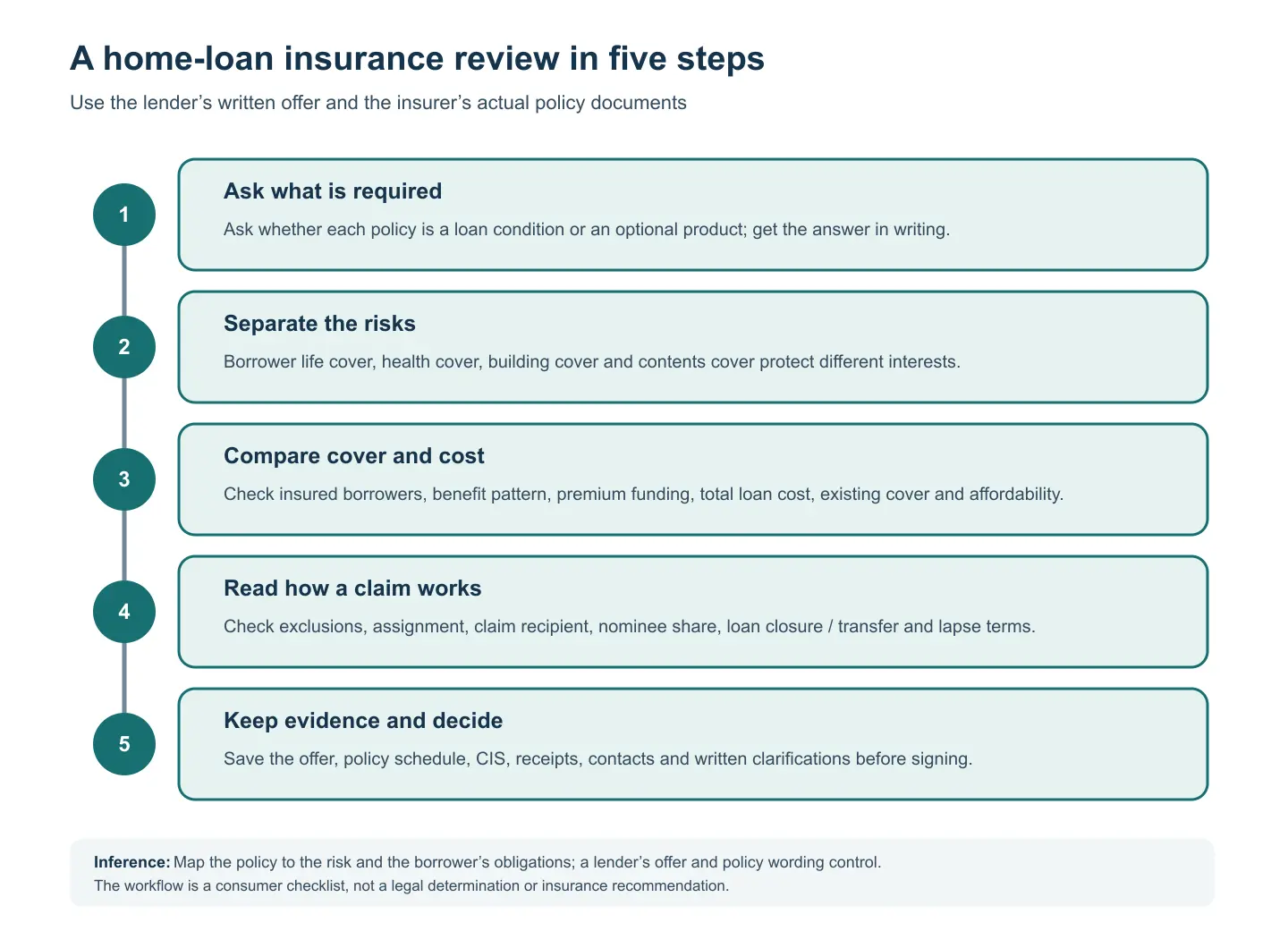
Use the workflow as a final pass: identify the cover, match it to the risk, compare the cost and benefit, understand claim handling, and retain the documents. The five steps are also written here so the workflow information is available without the image.
- Ask what is required. Get the lender’s answer and the relevant loan clause in writing. Separate a credit decision from an insurance sales discussion.
- List existing protection. Include any personal life cover, employer cover, home or contents policy and current health insurance. Check insured people, amounts, terms and exclusions; avoid assuming that two policies have identical benefits.
- Compare the total cost. Get the standalone premium and, if financed, the added loan amount, EMI and full repayment cost. Check whether the premium is single or recurring and what happens on early repayment.
- Read how claims work. Review the Customer Information Sheet (CIS), policy schedule and full wording. IRDAI says life CIS materials include benefits, exclusions and claim/grievance information; its health guidance also describes cover, sub-limits, deductibles and waiting periods. Confirm assignment, claim payee, claim documents and contact routes for the specific product. (IRDAI life product circular; IRDAI health guidance)
- Save and decide. Keep the signed loan offer, policy proposal, schedule, CIS, premium receipt and all written clarifications. Check that names, property details, dates and selected cover match what you agreed to before signing or paying.
Sources and image credits
- RBI, Home Loans: Frequently Asked Questions — lender terms and the need to read and clarify a scheme’s fine print.
- RBI, Entry of Banks into Insurance Business (2015 circular) — requirements applicable to banks distributing insurance, including customer choice and voluntary participation in that context.
- IRDAI, Master Circular on Life Insurance Products (2024) — life policy terms and Customer Information Sheet.
- IRDAI, Health Department — health policy features and CIS.
- IRDAI, Non-Life consumer information — property sum-insured basis and dwelling contents.
- Photos by RDNE Stock project, homebuyer consultation and RDNE Stock project, home discussion—used under the Pexels License. The people shown are illustrative and do not endorse Abhipra, a lender or an insurance product.
This article is for general education, not personal insurance, legal or financial advice. Availability, underwriting, cover, exclusions, claim payments and lender conditions depend on the current written loan terms and the applicable policy wording. Consider your circumstances and consult an appropriately licensed insurance professional before deciding.
Reviewed by Abhipra Insurance Advisory Desk