Claim Settlement Ratio: How to Read It Before Choosing an Insurance Policy
A high claim settlement ratio can look reassuring on a comparison page. But what exactly was counted as a claim, how much was paid, and how long did the decision take? For a household comparing health or life cover, the ratio is a starting point for questions—not a stand-alone verdict on an insurer or policy.

What the claim settlement ratio measures
The phrase usually describes the share of claims settled out of claims reported or registered during a stated period. Always read the source’s exact label and denominator: regulators and insurers may report different business lines, claim cohorts, and measures. A count-based ratio answers how many claims were settled; it does not show the share of rupees paid, the average time taken, or whether a particular claim will be admissible.
The Ministry of Finance, citing IRDAI data, reported a health-insurance claims-paid ratio by number of 85.66% for 2022–23, 82.46% for 2023–24, and 87.50% for 2024–25. The latest figure is an industry aggregate. It is not a rating for an individual insurer or a forecast for a policyholder. The release also lists the three annual values.
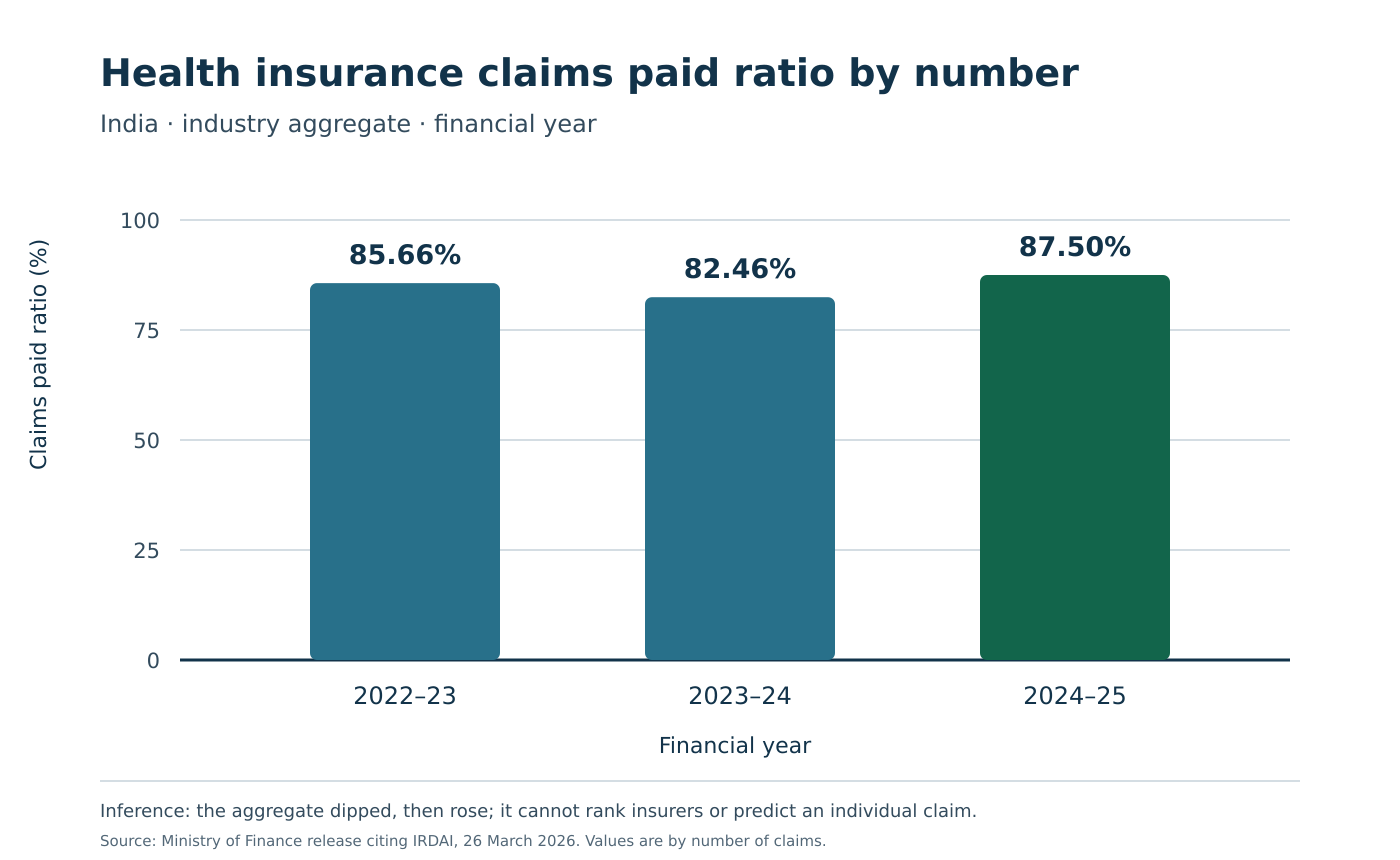
The vertical axis shows claims paid as a percentage by number, from 0% to 100%; the horizontal axis shows financial years. The series fell by 3.20 percentage points in 2023–24, then rose by 5.04 points in 2024–25. This describes a change in the aggregate, not a guarantee about the next claim. The accessible data table below gives the same values. Source: Ministry of Finance release, 26 March 2026.
| Financial year | Health claims paid ratio by number |
|---|---|
| 2022–23 | 85.66% |
| 2023–24 | 82.46% |
| 2024–25 | 87.50% |
Why the number can hide important details
A count-based ratio gives a small claim and a large claim equal weight. IRDAI’s FY 2024–25 annual report records 87.50% of health claims paid by number, while the amount paid was 71.14% of the total claim amount in the report’s status table. The two percentages answer different questions; they should not be read as the percentage of every individual bill reimbursed. The report also shows claims outstanding at year-end, so the reporting window matters. See the IRDAI Annual Report 2024–25, health-claim status table.
An incurred claims ratio is different again. It compares claims incurred with premium earned for a period. It is not a claim settlement ratio and cannot, by itself, tell you how many customers’ claims were paid. Avoid treating these measures as interchangeable when an article or sales illustration displays a percentage.
Compare the policy and service, not only the headline
Before buying or renewing, compare the policy wording for the cover you need. Check the sum insured, waiting periods, permanent exclusions, co-payment, deductible, room-rent limits, sub-limits, network hospitals, restoration terms, and whether the cover is individual or shared across a family. A low premium or a high aggregate ratio cannot compensate for a condition that does not fit your needs.
Look for insurer disclosures that state the financial year, business segment, whether the figures are by number or amount, and how pending and repudiated claims are treated. Review several years where comparable data is available. For health policies, also check cashless hospital access and claim instructions. The Ministry of Finance says IRDAI-prescribed cashless timelines are within one hour for pre-authorisation and within three hours for final authorisation; check current policy and insurer procedures for the claim situation you face. Official release.
If a claim is filed
Notify the insurer or authorised claims administrator promptly using the policy’s stated channel. Keep the policy schedule, proposal details, bills, prescriptions, investigation reports, discharge summary, and communications together. For a cashless request, the hospital usually coordinates the request, but the insured should read the authorisation and any shortfall or non-payable explanation. For reimbursement, submit the requested documents and retain copies and acknowledgement.
If the insurer asks for more information, respond within the stated time and keep a dated record. If you disagree with a decision, ask for the specific policy clause and calculation in writing, then use the insurer’s grievance process. IRDAI’s Bima Bharosa portal is an escalation channel after the insurer’s grievance process; keep the complaint reference and supporting documents. Bima Bharosa.
Common mistakes
- Treating an industry-wide figure as an insurer-specific score.
- Comparing life, health, motor, and group-policy ratios as if they had the same definitions.
- Assuming “settled” means the entire amount claimed was paid.
- Ignoring claim time, pending cases, grievance information, and the policy’s exclusions and limits.
- Buying cover based on one percentage without checking whether the benefits suit the household.
A practical checklist
- Identify whether the figure is by number or by amount, and note its denominator and financial year.
- Confirm that the data covers the same insurance type and business segment as the policy you are evaluating.
- Read the policy schedule and wording, especially waiting periods, exclusions, co-payments, deductibles, and sub-limits.
- Check the cashless hospital network or life-claim documentation process that matters to you.
- Review the insurer’s grievance route and retain a copy of the proposal and policy documents.
- Revisit the decision at renewal or after a major change in family, health, or financial needs.
What the supporting image shows
The second image follows the family as they organise the policy wording, medical papers, and claim records with an advisor. Its point is procedural: keep the documents and the policy terms close at hand so a percentage does not replace the details that determine a claim.

Source links
- Ministry of Finance: health-insurance claims paid ratio and cashless timelines
- IRDAI Annual Report 2024–25: health-insurance claim status and incurred claims ratio
- IRDAI Bima Bharosa grievance portal
Reviewed by Abhipra Research / Compliance Team.
Disclaimer
This article is for general education and is not a recommendation to buy, renew, or discontinue a particular policy. Insurance terms, exclusions, waiting periods, and claim outcomes depend on the policy wording, disclosures made at application, facts of the claim, and applicable rules. Read the complete policy documents and consider your family’s needs before making a decision.