Common Mistakes While Buying Insurance: A Policy-Reading Checklist
Insurance is a contract for defined risks. A low premium or a familiar brand does not tell you whether the policy responds to the financial problem you want to protect. Before paying, translate the proposal, Customer Information Sheet and policy wording into a short, written checklist.

1. Buying a product before defining the risk
Start with the event that could damage the household: death, hospital expenses, disability, loss of income, property damage or liability. Life, health, personal accident and general insurance respond to different triggers. Do not treat one policy as a substitute for every other layer.
Write down dependants, essential monthly outgoings, debts, employer benefits and liquid savings. The remaining gap is the question a policy should help answer. This prevents a product name from becoming the plan.
2. Skimming the Customer Information Sheet
IRDAI describes the Customer Information Sheet (CIS) as a plain-language summary supplied with the policy document. Its minimum information includes the type of insurance, sum insured, coverage, exclusions, sub-limits, deductibles, waiting periods, renewal, portability or migration where applicable, claims procedure and grievance contacts. IRDAI health-department consumer information
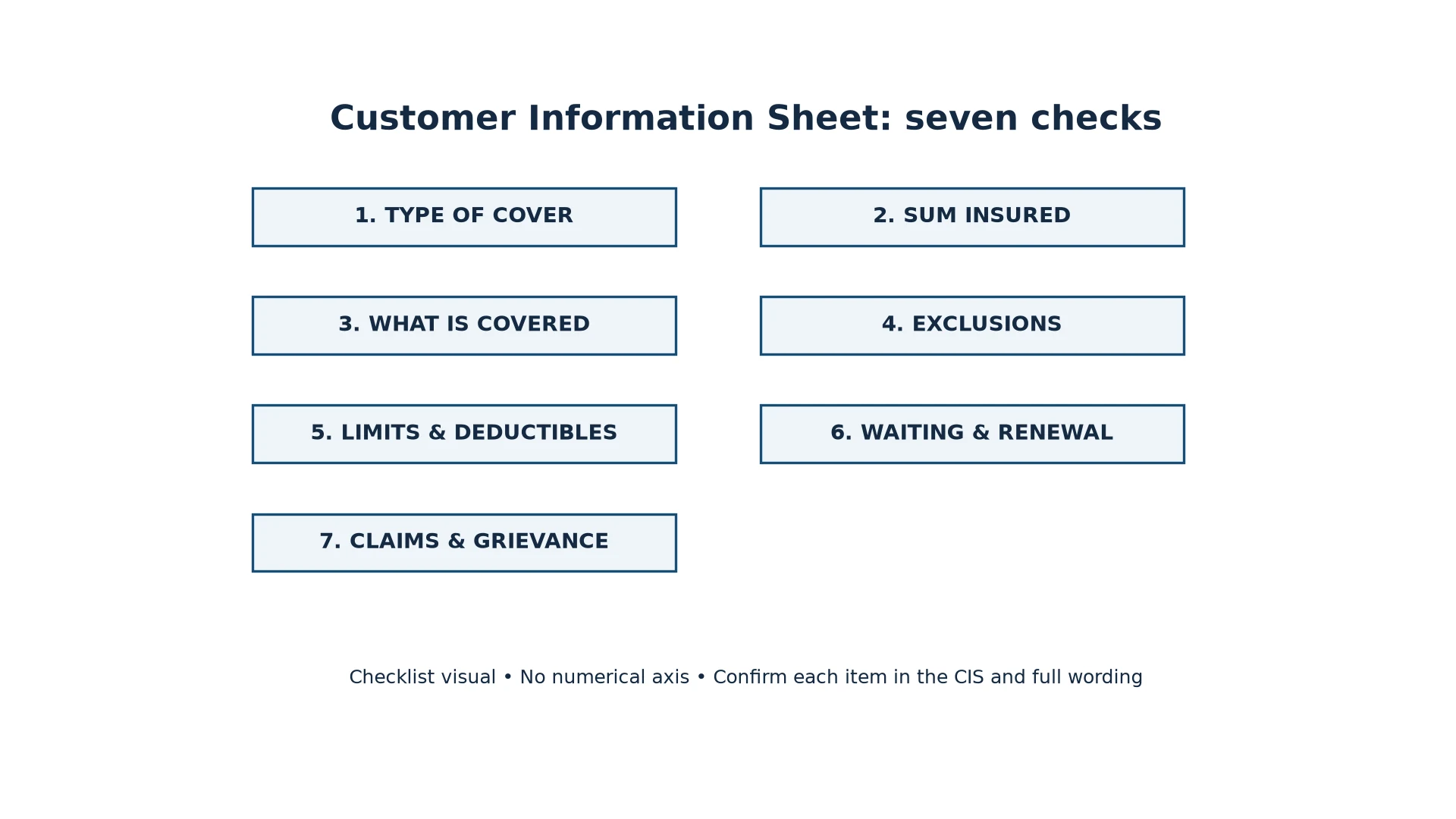
The visual has no numerical data axis: it is a seven-item document checklist. Read each box as a question to answer from the CIS and full wording. The inference is practical: if an item is blank or unclear, pause and obtain written clarification before deciding.
3. Confusing exclusions, limits and waiting periods
An exclusion removes a risk or circumstance from cover. A sub-limit caps a particular expense or benefit. A deductible is the amount borne before the insurer pays according to the contract. A waiting period delays cover for specified conditions or benefits. These mechanisms have different effects on a claim; placing all of them under “terms and conditions” hides the real trade-off.
Do not infer a claim outcome from a brochure sentence. Match the product name and version to the policy schedule, CIS and complete wording. Keep the proposal form and your answers because the contract should reflect what was disclosed.
4. Leaving nominee and contact information stale
Nomination, address, phone number, bank details and authorised representative information affect servicing and claim communication. Review them after marriage, a move, a change of bank account or a change in family responsibility. IRDAI’s insurance-repository guidance says policy-level details such as nomination, assignment, address, endorsement and terms can be maintained in an e-insurance account. IRDAI insurance repository FAQ
5. Treating an illustration as a promise
An illustration, estimate or example is not the same as a contractual benefit. For market-linked or participating products, read the fixed and variable portions separately. For health or general insurance, read what is payable, when it is payable and what evidence is required. Never convert an example into a return or claim promise.

The two corporate scenes show a single review story: define the need, then cross-check the contract. They contain fictional people, blank documents and no customer data.
6. Ignoring grievance routes and records
First write to the insurer’s grievance officer and keep the complaint, policy, proposal, correspondence and supporting documents. IRDAI’s grievance guidance says policyholders can use Bima Bharosa if the insurer does not resolve the matter or the response is unsatisfactory. The Insurance Ombudsman route has its own eligibility conditions, including first approaching the insurer and a claim-value ceiling; check the current official rules before relying on it. IRDAI grievance guidance and IRDAI Ombudsman information
A five-step purchase workflow
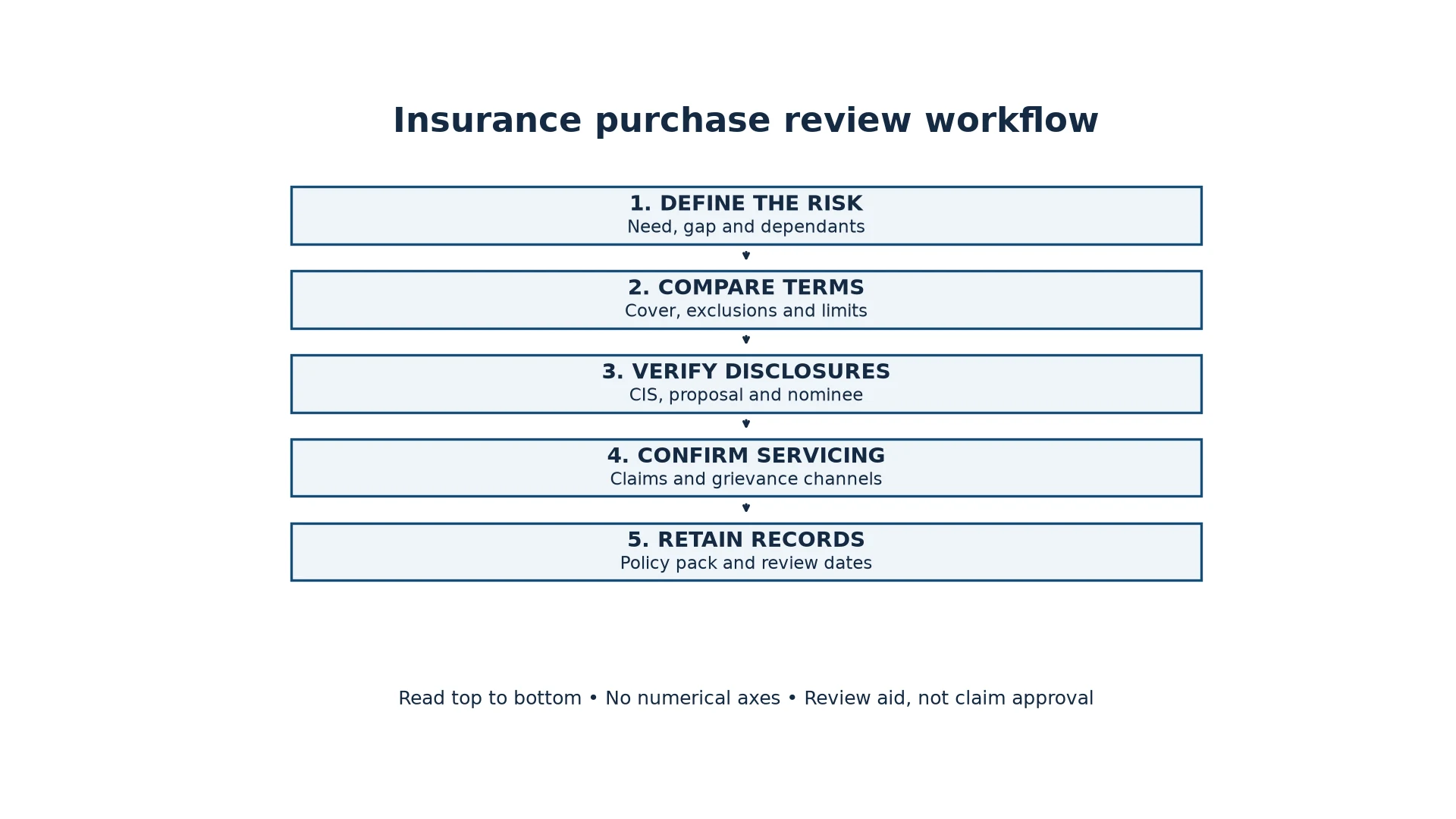
This workflow has no numerical axes. Read it from top to bottom:
- Define the financial risk and the gap.
- Compare the exact contract terms, exclusions, limits and costs.
- Verify the CIS, proposal answers, nominee and payment record.
- Confirm claim and grievance channels before purchase.
- Save the policy pack and review it after material life changes.
Final checklist
Before deciding, explain the policy in your own words: what event triggers payment, what is excluded, what is capped, what you must disclose, how a claim is notified and who receives the benefit. If any answer depends on an informal promise, ask for written confirmation or pause the decision.
For a suitability discussion, Contact Abhipra. Review the exact policy documents before making a decision.
Source Links
- IRDAI health-department consumer information
- IRDAI insurance repository FAQ
- IRDAI grievance guidance
- IRDAI Ombudsman information
Disclaimer
This article is for educational and informational purposes only. It should not be considered investment advice, trading advice, tax advice or insurance advice. Investments in securities market are subject to market risks. Please read all related documents carefully before investing. Past performance is not indicative of future returns. Please consult a qualified financial advisor, tax advisor or insurance advisor before making any financial decision.