Critical Illness Cover Explained: Read the Payout Conditions Before the Premium
A hospital bill is only one part of a serious illness’s financial impact. Time away from work, household expenses and care arrangements may also need funding. Critical illness cover can provide a defined cash benefit—but the diagnosis must satisfy the policy’s conditions.
By Abhipra Insurance Advisory Desk. Sources checked: 19 September 2026.

What does critical illness insurance pay?
A benefit-based policy pays a specified amount when a covered event meets its terms. An indemnity health policy pays eligible medical expenses, within its limits. The benefit is therefore not calculated simply by adding hospital invoices. These are different protection functions; one should not automatically replace the other. IRDAI’s health insurance FAQs explain this distinction.
A critical illness benefit can help with the wider financial disruption of a qualifying illness. However, it does not promise payment for every serious diagnosis. The covered illness, severity, timing and exclusions matter. Some contracts end after the benefit is paid; check what remains in force. IRDAI’s consumer guide to health insurance describes the purpose and usual structure of this cover.
A disease name is not the complete claim definition
Read the policy wording and schedule together. For example, the available HDFC ERGO Critical Illness Insurance wording, UIN HDFHLIP21464V022021 specifies cancer of a defined severity. Its benefit and exclusion sections also describe a 90-day initial waiting period, with a stated continuous-renewal exception, and a survival requirement of 30 or 15 days as selected in the schedule.
This is an illustration of contract detail, not a market-wide rule or a product recommendation. Waiting periods restrict eligibility after cover begins; a survival period applies after the insured event. Neither is a promise that payment arrives immediately when that period ends. Diagnosis evidence and claim assessment still matter. Check the product UIN and applicable version using the insurer’s policy-wording directory.
What the government’s cancer figures show—and their limits
The Ministry of Health’s Lok Sabha response dated 5 December 2025 reports the following ICMR–NCRP estimates. These historical figures provide context for protection planning; they are not current-year counts, insurance claims or a measure of your personal risk. Lok Sabha Question 1135, annexure.
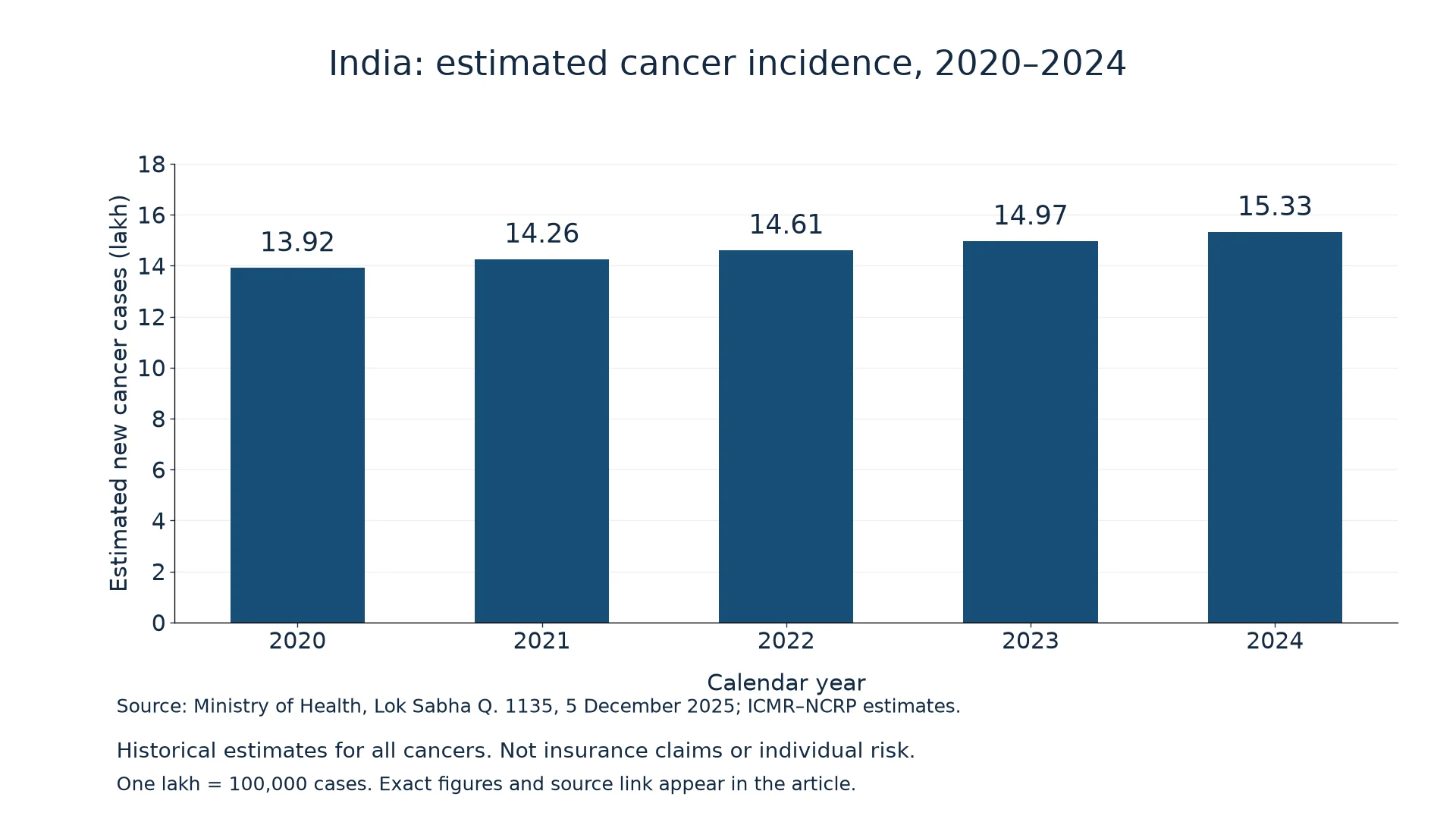
The horizontal axis shows calendar years 2020–2024. The vertical axis, starting at zero, shows estimated new cancer cases in lakh; one lakh equals 100,000 cases. Exact source figures are:
- 2020: 13,92,179 cases.
- 2021: 14,26,447 cases.
- 2022: 14,61,427 cases.
- 2023: 14,96,972 cases.
- 2024: 15,33,055 cases.
Inference: the estimates increase across this series. They do not establish how many cases satisfy an insurance policy’s severity definition, how much cover a household needs, or whether a claim will be accepted. Cancer is also only one category of illness relevant to some critical illness policies.
Start with your household’s cash gap
Consider a fictional planning exercise: essential outgoings of ₹50,000 per month for six months equal ₹3 lakh. Add an assumed ₹1 lakh for extra care and travel: the total is ₹4 lakh. If ₹1.5 lakh of liquid savings is genuinely available for this purpose, the remaining illustrative gap is ₹2.5 lakh.
These are chosen assumptions, not treatment-cost data, an insurance quote or a recommended sum insured. The calculation excludes hospital bills assumed to be assessed separately under health cover. Do not subtract the same savings twice, count retirement assets as readily available cash, or assume employer benefits continue indefinitely. Maintain cash access while any claim is assessed; a conditional future payout is not cash in hand. Review affordability and any applicable tax treatment separately with a qualified adviser.

The two office scenes illustrate consecutive planning steps: identifying ongoing household commitments, then checking whether a policy’s defined benefit addresses that gap. They depict fictional people and contain no customer records.
A practical review workflow
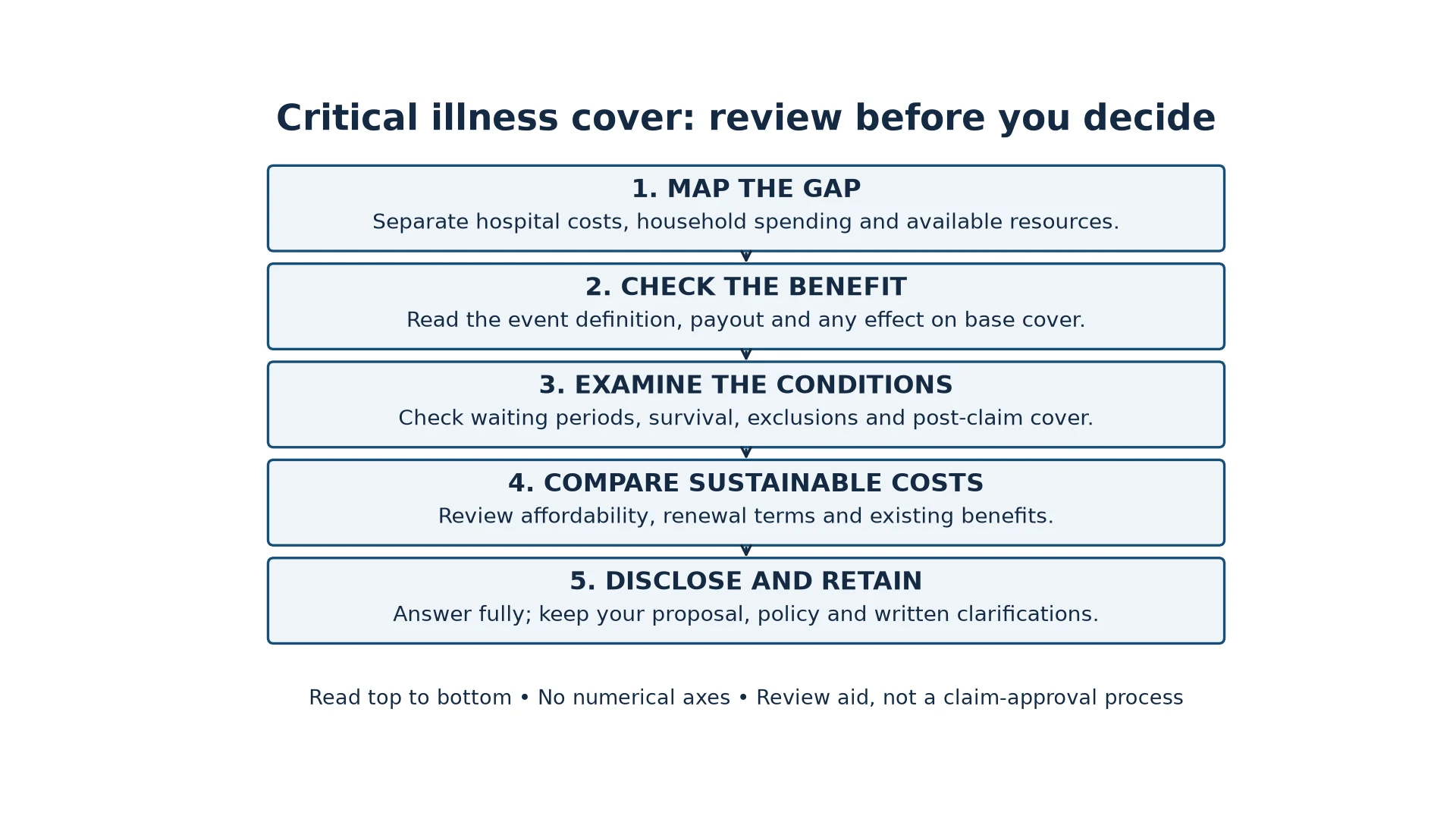
This is a process diagram, so it has no numerical axes. Follow the arrows from top to bottom:
- Map the gap. Separate hospital expenses, household outgoings and additional care needs; identify dependable resources.
- Check the benefit. Read the insured-event definition and payout amount. If comparing a rider, ask in writing whether a claim reduces the base life cover or other benefits.
- Examine the conditions. Check initial and pre-existing-condition waiting periods, any survival requirement, severity thresholds, exclusions and what happens after a claim.
- Compare sustainable costs. Review the applicable renewal terms, premium affordability and existing benefits. A longer illness list alone does not settle suitability.
- Disclose and retain. Answer proposal questions fully and accurately. Keep the submitted proposal, schedule, wording, customer information sheet and claim instructions; record written clarifications.
Inference: choose only after the gap and the contractual trigger are both clear. This workflow is an editorial review aid, not an insurer’s claim-approval process. IRDAI’s health insurance FAQs support reviewing policy documents, disclosures and benefit terms.
Before you decide
Avoid buying solely on premium, treating all cancers or heart conditions as automatically covered, assuming employer protection is permanent, or relying on verbal assurances. Obtain the exact wording for the proposed contract and clarify ambiguities before accepting it. If there is a dispute, start with the insurer’s grievance process; IRDAI’s Bima Bharosa portal provides a grievance channel.
For a discussion of your protection needs, Contact Abhipra. Suitability depends on your circumstances and the policy offered.
Source Links
- IRDAI’s health insurance FAQs: indemnity and benefit policies, disclosures and policy information.
- IRDAI’s consumer guide to health insurance: critical illness benefits and their purpose.
- Lok Sabha Question 1135, annexure: estimated cancer incidence, 2020–2024; response dated 5 December 2025.
- HDFC ERGO Critical Illness Insurance wording, UIN HDFHLIP21464V022021: a policy-specific example, especially printed pages 3 and 10.
- insurer’s policy-wording directory: matching the product and version.
- IRDAI’s Bima Bharosa portal: grievance information.
Editorial status: submitted for Abhipra Research / Compliance Team review.
Disclaimer
This article is for educational and informational purposes only. It should not be considered investment advice, trading advice, tax advice or insurance advice. Investments in securities market are subject to market risks. Please read all related documents carefully before investing. Past performance is not indicative of future returns. Please consult a qualified financial advisor, tax advisor or insurance advisor before making any financial decision.