Health Insurance: Why Employer Cover May Not Be Enough
Your employer’s health insurance can be valuable. The question is whether its limits, covered family members and continuity match your household’s needs—especially when you change jobs, take a career break or retire.
By Abhipra Insurance Advisory Desk. Research checked on 15 September 2026.

Start with what your employer policy actually covers
Ask HR or the insurer for the policy schedule, certificate of insurance, applicable benefits and Customer Information Sheet (CIS). IRDAI describes the CIS as a plain-language summary of key policy features. Compare it with the full wording rather than relying only on an employee benefits presentation. See IRDAI’s Health Department FAQs.
Check four areas:
- People: Are your spouse, children and parents enrolled? Confirm their names and any eligibility conditions.
- Payment limits: Read the sum insured, room-rent limits, treatment sub-limits, co-payment and deductibles.
- Access: Check the insurer’s current hospital network near home and where dependent parents live.
- Continuity: Obtain written confirmation of the date your membership ends and what happens during notice periods, unpaid leave or retirement.
These are questions for your actual scheme, not assumptions that every employer policy has the same restrictions. Group cover may have valuable benefits that a new personal policy does not immediately replicate.
What IRDAI’s data shows
IRDAI’s Annual Report 2024–25 reports approximately 58 crore lives covered by general and health insurers, excluding personal accident and travel business. The reported mix was 47.4% group business, 42.3% government-sponsored schemes and about 10.3% individual business. Source: IRDAI Annual Report 2024–25, printed page 40, paragraphs I.6.5.2–I.6.5.3.
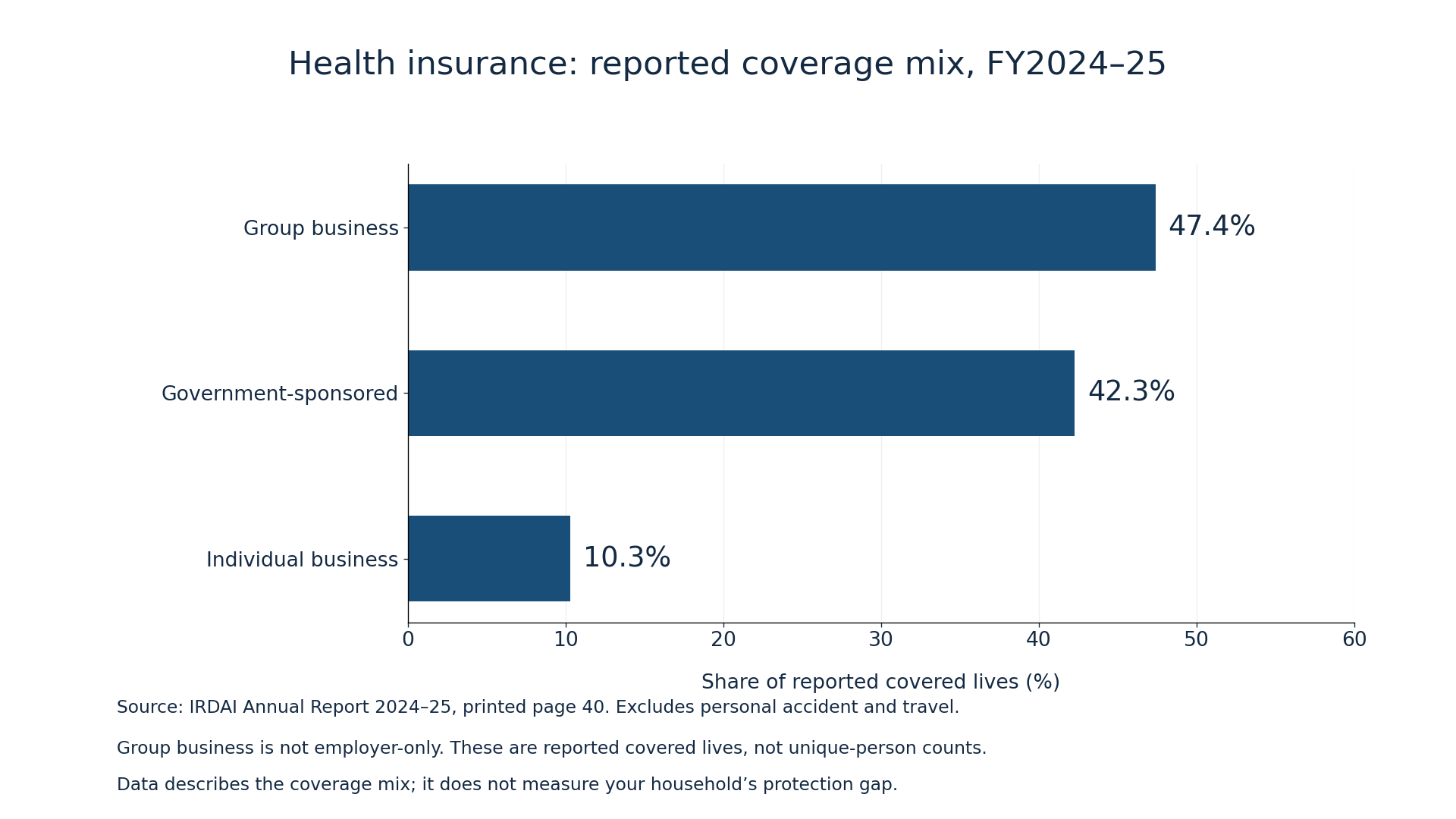
The horizontal axis shows the share of reported covered lives, in percent, starting at zero. The vertical axis lists the three business categories. Group business has the largest share in this classification.
The inference is limited: group arrangements are a major part of reported health coverage. Group business is not synonymous with employer insurance, and these figures should not be treated as a count of unique insured Indians. A person may have overlapping coverage. The chart says nothing about your family’s adequacy of cover.
A large sum insured does not mean every bill is paid in full
A Government of India response on cashless health insurance claims lists sum-insured limits, co-payment, sub-limits, deductibles, room-rent caps and non-medical expenses among reasons claims can be partly disallowed or repudiated. Cashless treatment is a payment arrangement; policy terms still determine the amount payable.
Consider a fictional arithmetic example, not a hospital-cost estimate or insurance quote. A policy has ₹5 lakh of available cover, a ₹4 lakh claim is fully admissible before co-payment, and a 20% co-payment applies. Assume no deductible, sub-limit or other reduction. The patient’s share is ₹80,000 and the insurer’s share is ₹3.20 lakh. The nominal ₹5 lakh cover has not removed out-of-pocket spending.
IRDAI defines co-payment as the insured’s specified percentage of an admissible claim in its health insurance regulations FAQs. Actual settlement follows your policy and claim assessment; the example is not a standard industry co-payment rate.
Plan continuity before a job change
Ask the existing insurer about migration options before group membership ends. IRDAI’s Health Department FAQs distinguish migration, which transfers eligible policy credits within the same insurer, from portability, which transfers eligible credits between insurers. The applicable process, timing and underwriting conditions matter.
Do not assume a group policy automatically converts into an identical personal policy, or that an application alone provides cover. Ask the insurer to confirm eligibility, credited waiting periods, any remaining waiting period, the offered terms and the effective date in writing. The IRDAI Insurance Products Regulations, 2024, Schedule III, clause 10, provide the regulatory framework for migration and portability.
If considering a separate personal policy, assess its affordability, exclusions, waiting periods and fit with your family’s needs. Starting a policy and having every condition covered immediately are different things. Keep existing cover active where possible until replacement cover is confirmed; do not cancel solely on a verbal assurance.

The two consultation scenes show fictional people organising policy documents and dates. They are AI-generated illustrations, not photographs of actual customers or endorsements.
A workflow for checking the gap
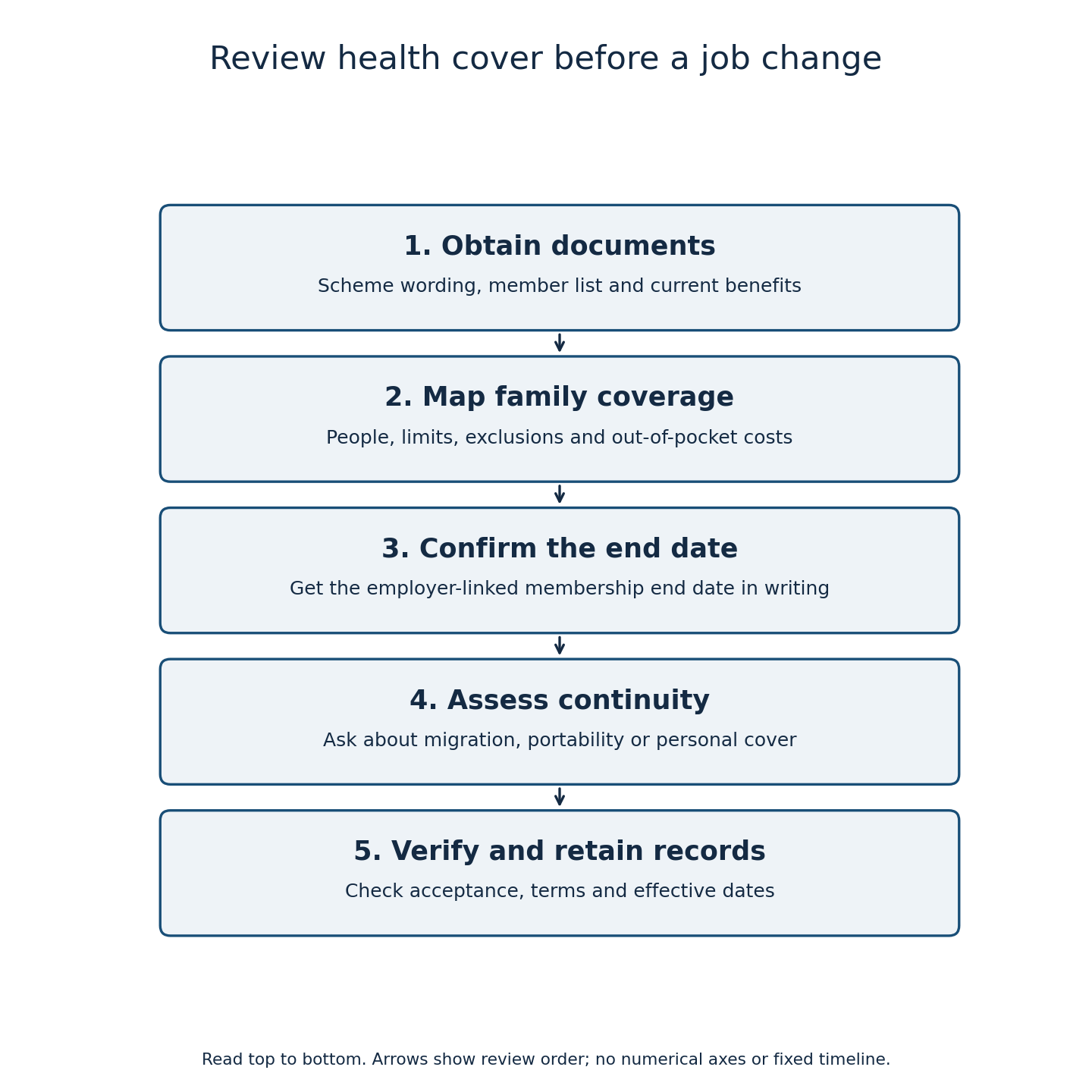
Read the image from top to bottom. It has no numerical axes; arrows indicate the order of review, not a fixed timeline.
- Obtain the scheme documents, member list and current benefits.
- Map each family member against coverage, exclusions and likely out-of-pocket exposure.
- Confirm the exact end date of employer-linked membership.
- Evaluate migration, portability where applicable, or a suitable personal policy with the insurer or a qualified adviser.
- Verify acceptance, terms and effective dates; retain policy and claim records and arrange accessible funds for uncovered costs.
Do not add two indemnity policy limits and assume both will reimburse the same expense in full. IRDAI’s health insurance regulations FAQs explain that indemnity cover reimburses eligible costs subject to policy terms. Disclose other cover and ask insurers how to coordinate a claim.
A deductible-based top-up also needs careful review: check how the deductible applies and how you would fund it if employer cover ceased. A tax benefit, if applicable to your circumstances, should not determine the amount or suitability of protection.
For help organising a review, use Abhipra’s Contact page. Bring your current scheme documents and a family coverage checklist.
Source links
- IRDAI Annual Report 2024–25, hosted by the Life Insurance Council: reported covered lives and category shares, printed page 40.
- IRDAI’s Health Department FAQs: CIS, migration and portability concepts.
- IRDAI Insurance Products Regulations, 2024, government-hosted PDF: Schedule III, clause 10.
- Government response on cashless claims: policy conditions affecting claim payment.
- IRDAI health insurance regulations FAQs: co-payment and indemnity concepts; historical procedural deadlines are not used here.
Editorial review status: pending Abhipra Research / Compliance Team review.
Disclaimer
This article is for educational and informational purposes only. It should not be considered investment advice, trading advice, tax advice or insurance advice. Investments in securities market are subject to market risks. Please read all related documents carefully before investing. Past performance is not indicative of future returns. Please consult a qualified financial advisor, tax advisor or insurance advisor before making any financial decision.