How Much Life Insurance Cover Is Enough? Calculate Your Household’s Protection Gap
A large round number can feel reassuring. But enough life insurance means enough money to meet the responsibilities your family would inherit if your income stopped permanently. Start with those responsibilities, then compare the gap with cover you already hold.
By Abhipra Insurance Advisory Desk. Research checked on 14 September 2026.

Start with the people who depend on you
List the family members who need financial support, how long that support may last, outstanding loans and essential future commitments. Include the cost of replacing unpaid care as well as lost earnings. Assess each earning or caregiving family member separately.
IRDAI explains that life cover can address the financial loss associated with future income, and that term insurance pays a specified benefit on death during the contract period, subject to its terms. This supports a needs-based review; it does not prescribe one universal cover amount. See IRDAI’s introduction to insurance.
What the official data tells us—and its limits
IRDAI’s Annual Report 2024–25 records India’s life insurance penetration at 2.8% in FY2023–24 and 2.7% in FY2024–25. Penetration measures premiums as a percentage of GDP. It does not measure the percentage of people insured or whether a particular household has adequate death cover. The report is available through the Life Insurance Council, page 12, paragraph I.2.1.8. The PIB insurance-sector overview also reports the FY2024–25 figure.
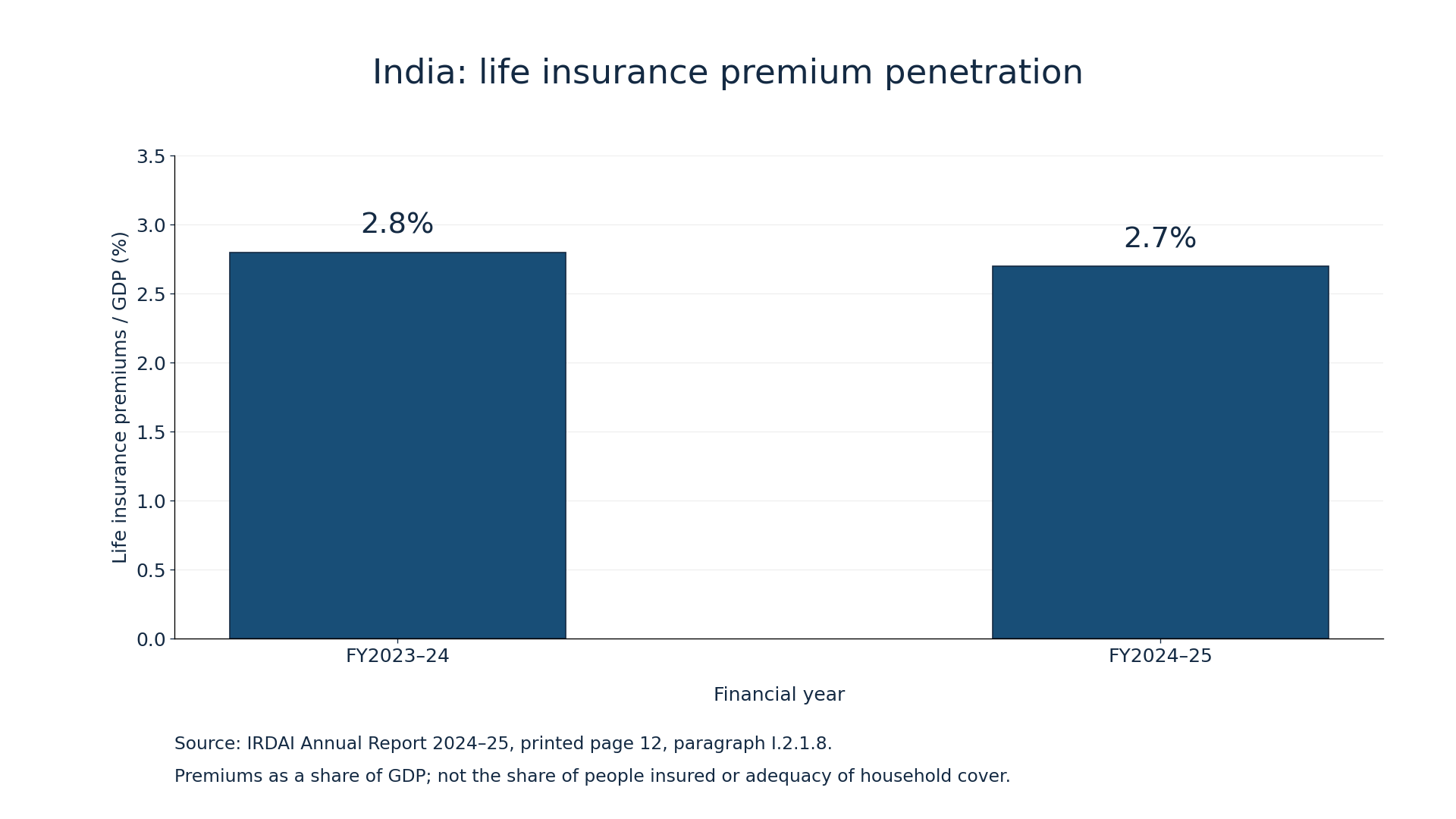
The horizontal axis shows the financial year; the vertical axis shows life insurance premiums as a percentage of GDP, starting at zero. The decrease is 0.1 percentage point. The useful inference is limited: aggregate premium penetration fell slightly. This chart cannot calculate your family’s protection gap or rank insurers.
Build the cover estimate from household needs
Use this planning equation, with all amounts valued as of today:
Additional cover needed = household support fund + debt repayment + essential goals + transition costs − usable assets − existing suitable life cover.
Treat a negative result as zero additional cover under those assumptions, then review what the calculation may have missed. This is an educational framework, not an IRDAI formula or an underwriting entitlement.
For household support, estimate the annual shortfall after dependable surviving income. Exclude a loan EMI if you separately include full repayment of that same loan. Allow for changing expenses, dependency duration, inflation and conservative investment returns after tax and costs. A salary multiple alone cannot reflect all these differences.
Subtract only assets the family can realistically use. A home they need to live in, inaccessible business interests and money already reserved for another essential purpose should not automatically reduce the gap. Check the net proceeds available after taxes, liabilities and sale costs. Count each asset and policy benefit once.
Worked example: an additional ₹1.05 crore, under stated assumptions
Consider a fictional household with a ₹6 lakh annual support shortfall for 15 years, excluding loan EMIs, after surviving income. For a simple present-value example, assume 0% real return after taxes and costs: investment growth exactly matches inflation. The support fund is therefore ₹6 lakh × 15 = ₹90 lakh in today’s purchasing power. This is an assumption, not a forecast or a promised return.
All the amounts below are invented for education. Goals are expressed at today’s value using the same simplifying real-return assumption; actual education costs may grow differently from household expenses.
| Input | Amount |
|---|---|
| Household support fund | 90 |
| Outstanding debt to repay | 30 |
| Essential education goal | 20 |
| Immediate transition costs | 5 |
| Total need | 145 |
| Less usable assets | 15 |
| Less existing suitable life cover | 25 |
| Additional cover gap | 105 |
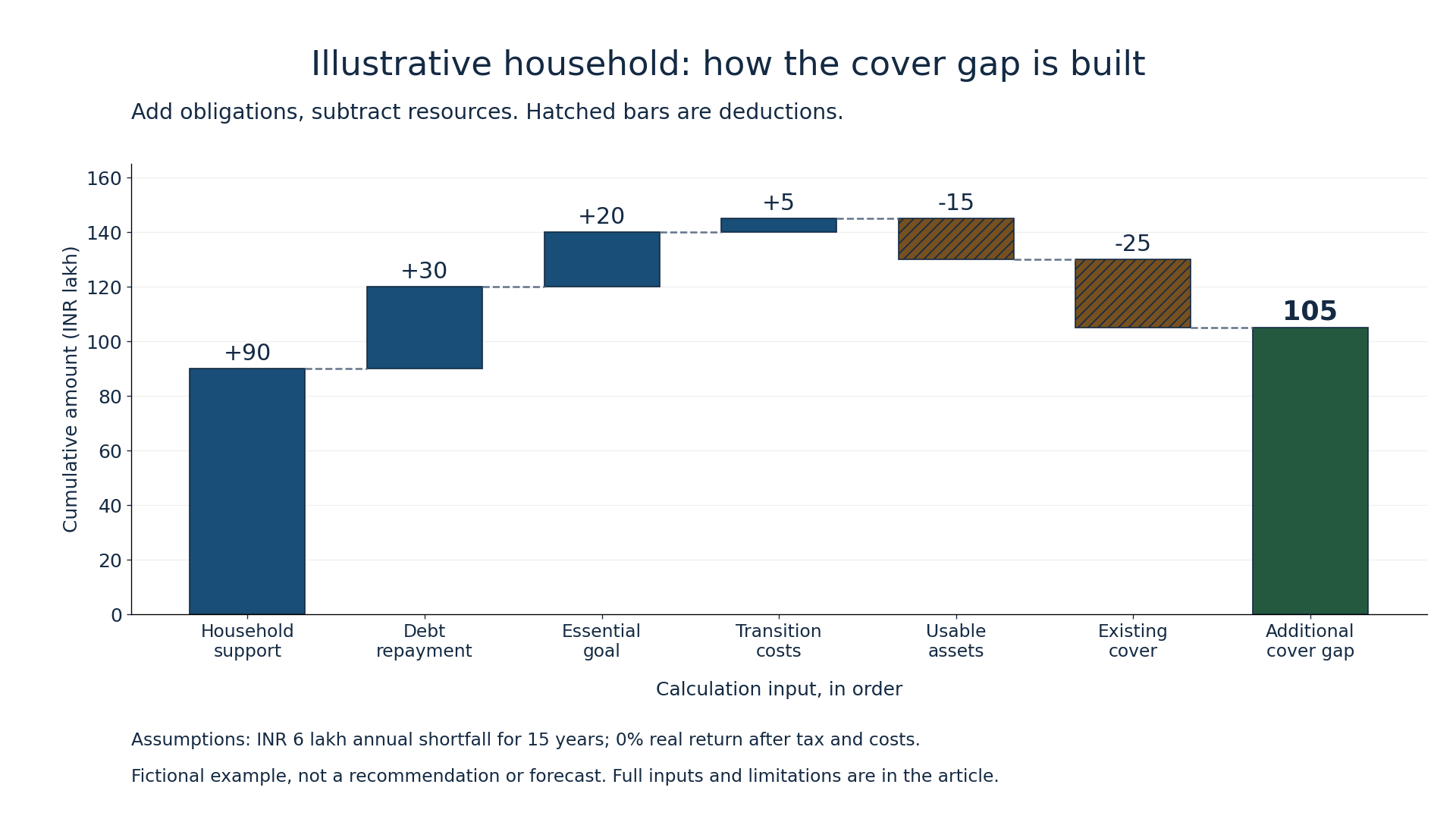
The horizontal axis follows the calculation inputs; the vertical axis is the cumulative amount in ₹ lakh. Additions raise the running total to ₹145 lakh; deductions reduce it to ₹105 lakh, or ₹1.05 crore of additional cover. Including the existing ₹25 lakh policy gives ₹130 lakh of total life cover in this example. The inference is that both obligations and genuinely usable resources determine the gap.
If support lasts 20 years instead of 15, keeping all other assumptions unchanged, the support fund becomes ₹120 lakh and the additional gap becomes ₹135 lakh. This sensitivity shows why the dependency period deserves careful discussion. Lower real returns or unexpectedly higher costs can also increase the required fund.
Turn the estimate into a policy review

The consultation scene brings the calculation back to real documents: expense records, loan balances, goal estimates, accessible investments and existing policy schedules. The people shown are fictional AI-generated illustrations, not customers or advisers endorsing a product.
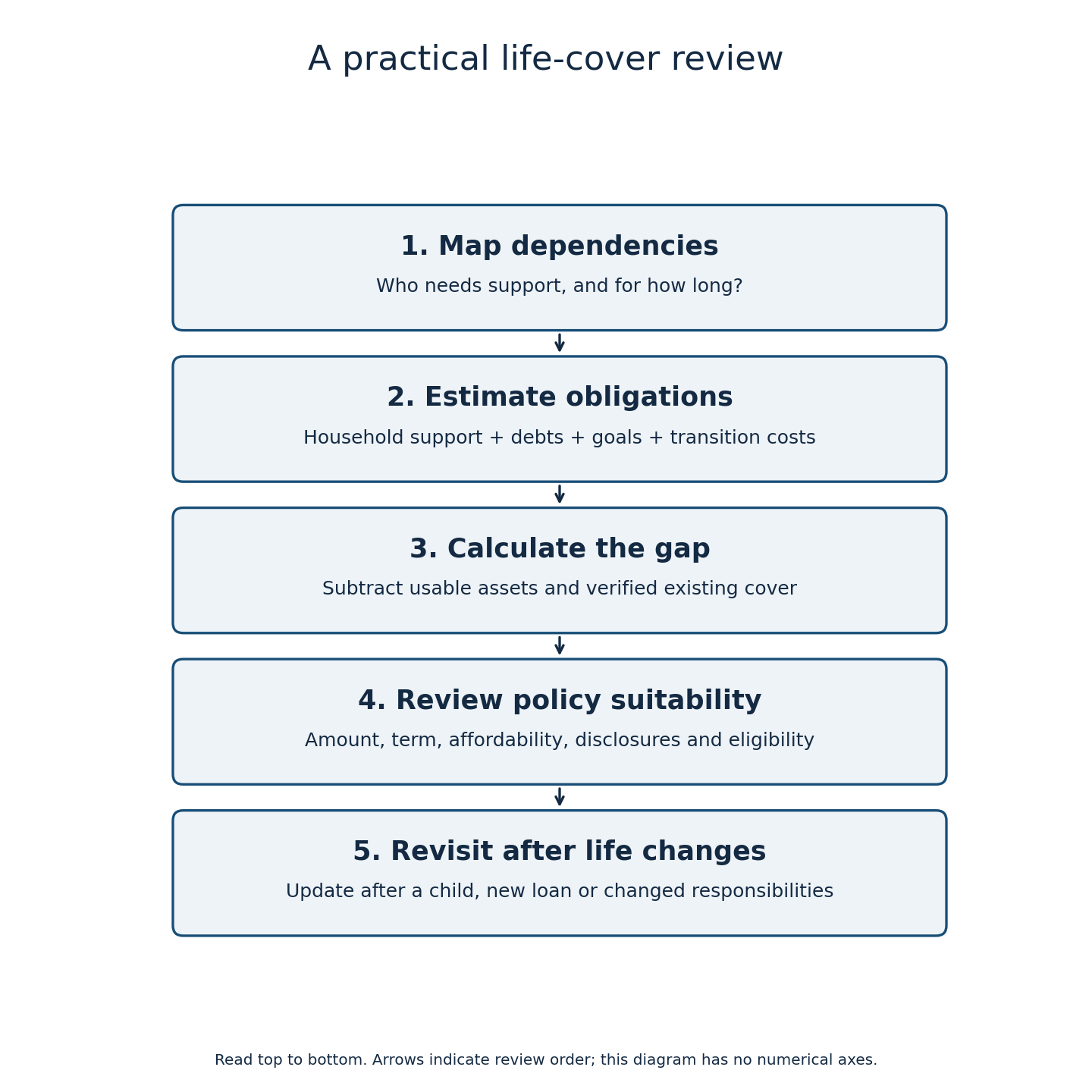
Read the workflow from top to bottom. It has no numerical axes: arrows indicate review order, not elapsed time or a promised outcome.
- List dependants and the period for which support is needed.
- Estimate household support, debts, goals and immediate costs without duplication.
- Deduct usable assets and verified existing benefits to identify the gap.
- Discuss the amount, cover duration, premium affordability, exclusions and insurer eligibility with a qualified insurance adviser; read the proposal and policy documents carefully.
- Revisit after a new child, loan, major income change or a change in responsibilities.
Before counting employer cover, check the scheme’s continuation and exit terms. Verify existing policy benefits and expiry dates; do not treat premiums paid or a projected maturity value as the death benefit. Complete health, occupation and other requested disclosures accurately. Keep nomination details and policy records accessible to the family.
Keep immediately accessible funds for near-term needs while a claim is processed. A life-cover calculation also does not substitute for a separate health and disability protection review. Review tax treatment for the actual policy and circumstances with a qualified adviser; this example assumes no specific tax concession.
For help organising a protection review, use Abhipra’s Contact page. A completed needs worksheet is a useful starting point for that conversation.
Source links
- IRDAI Annual Report 2024–25, hosted by the Life Insurance Council: printed page 12, penetration definition and FY comparison.
- PIB insurance-sector overview: official sector context and penetration definition.
- IRDAI’s introduction to insurance: life-cover purpose and product definitions. Used for general principles, not historical regulatory deadlines.
Editorial review status: pending Abhipra Research / Compliance Team review.
Disclaimer
This article is for educational and informational purposes only. It should not be considered investment advice, trading advice, tax advice or insurance advice. Investments in securities market are subject to market risks. Please read all related documents carefully before investing. Past performance is not indicative of future returns. Please consult a qualified financial advisor, tax advisor or insurance advisor before making any financial decision.