Family Floater vs Individual Health Insurance: Compare the Limits Before the Premium
A family floater lets insured family members draw from one shared limit. Individual cover assigns a separate limit to each insured person. The useful comparison is how those limits would work for your family if one person had a large claim—or several people needed treatment in the same policy year.
By Abhipra Insurance Advisory Desk. Research checked on 16 September 2026.

Shared cover and separate cover do different jobs
IRDAI’s Health Department FAQs explain that a family floater has one sum insured available to any or all covered family members. Its consumer guide to health insurance distinguishes individual sum-insured cover from family floater cover.
With a floater, a claim by one member reduces the common available pool, subject to the policy’s bonus and restoration provisions. With separate individual limits, one member’s claim ordinarily uses that person’s cover; another member’s unused limit is not automatically transferable.
Check the schedule rather than counting policy documents: what matters is whether the sum insured is shared or assigned per person.
What the official numbers can—and cannot—tell you
IRDAI reports 558.57 lakh covered lives in individual health business in FY2023–24 and 601.46 lakh in FY2024–25. This is the report’s business classification, not a breakdown of separate-limit policies versus family floaters. It must not be used to claim that individual limits are more popular or better. Source: IRDAI Annual Report 2024–25, printed page 40, Table I.26.
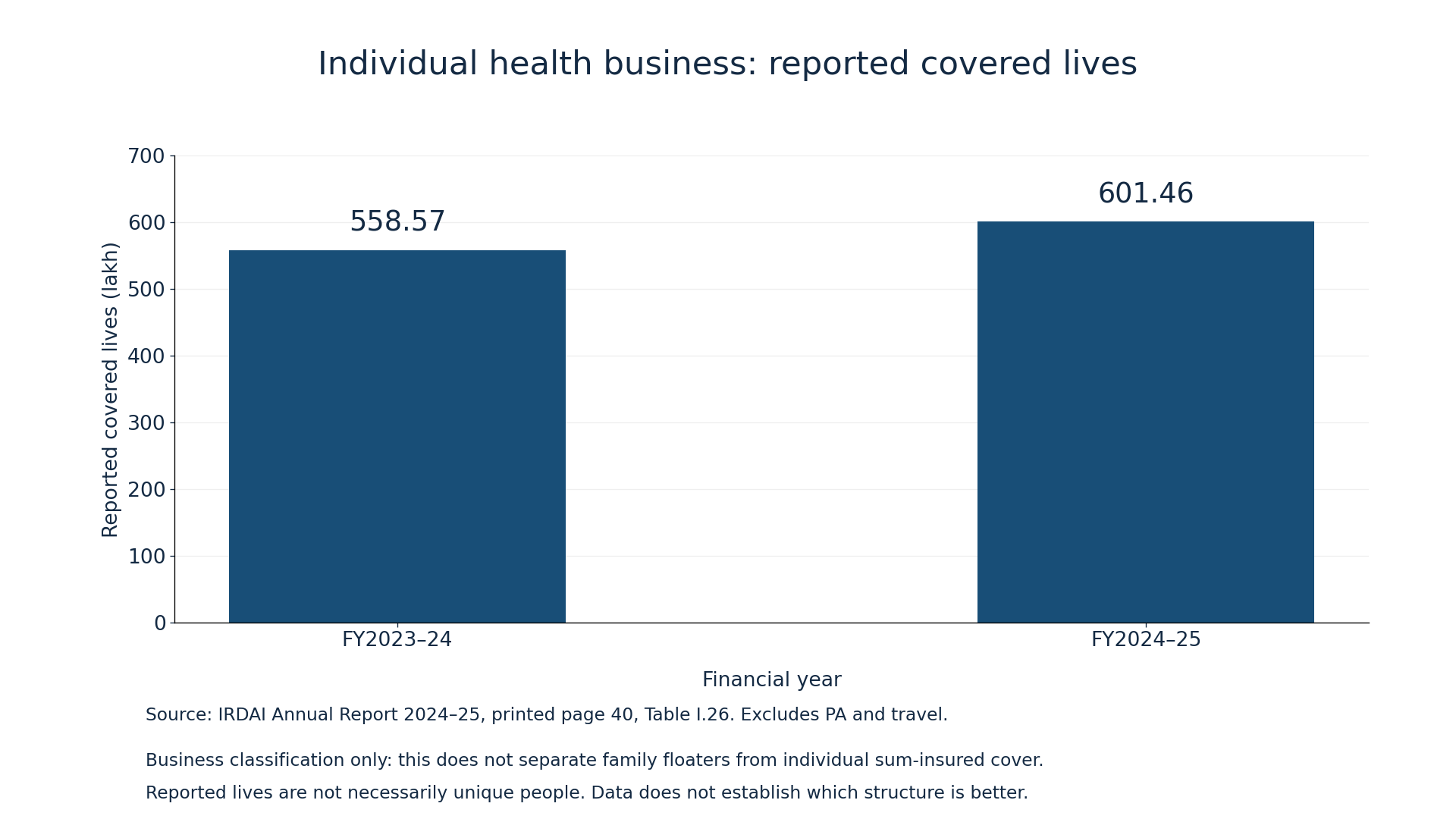
The horizontal axis shows financial years; the vertical axis shows reported covered lives in lakh, starting at zero. The increase is 42.89 lakh, calculated from the reported values. The inference is growth in the reported individual-business segment. These are not necessarily unique people, and personal accident and travel business are excluded.
Two claim examples make the trade-off clearer
Compare a ₹10 lakh family floater for two adults with ₹5 lakh individual cover for each adult. The nominal combined limits are both ₹10 lakh, but their availability to one person differs.
The following amounts are fictional teaching examples, not treatment-cost estimates or policy quotes. Assume all claims are otherwise admissible, both adults are covered, the full limits are initially available, and there are no co-payments, deductibles, sub-limits, bonuses or restoration. Each scenario starts a fresh policy year.
- Scenario A: one adult claims ₹8 lakh; the other makes no claim. The floater pays ₹8 lakh, leaving ₹2 lakh in the shared pool. Separate limits pay ₹5 lakh, leaving ₹3 lakh uncovered for the claimant, while the other adult’s ₹5 lakh remains unused.
- Scenario B: the first adult claims ₹6 lakh, followed by the second adult claiming ₹6 lakh. The floater pays ₹6 lakh and then ₹4 lakh; total payment is ₹10 lakh and total uncovered cost is ₹2 lakh. Separate limits pay ₹5 lakh for each adult, also totaling ₹10 lakh, with ₹1 lakh uncovered for each person.
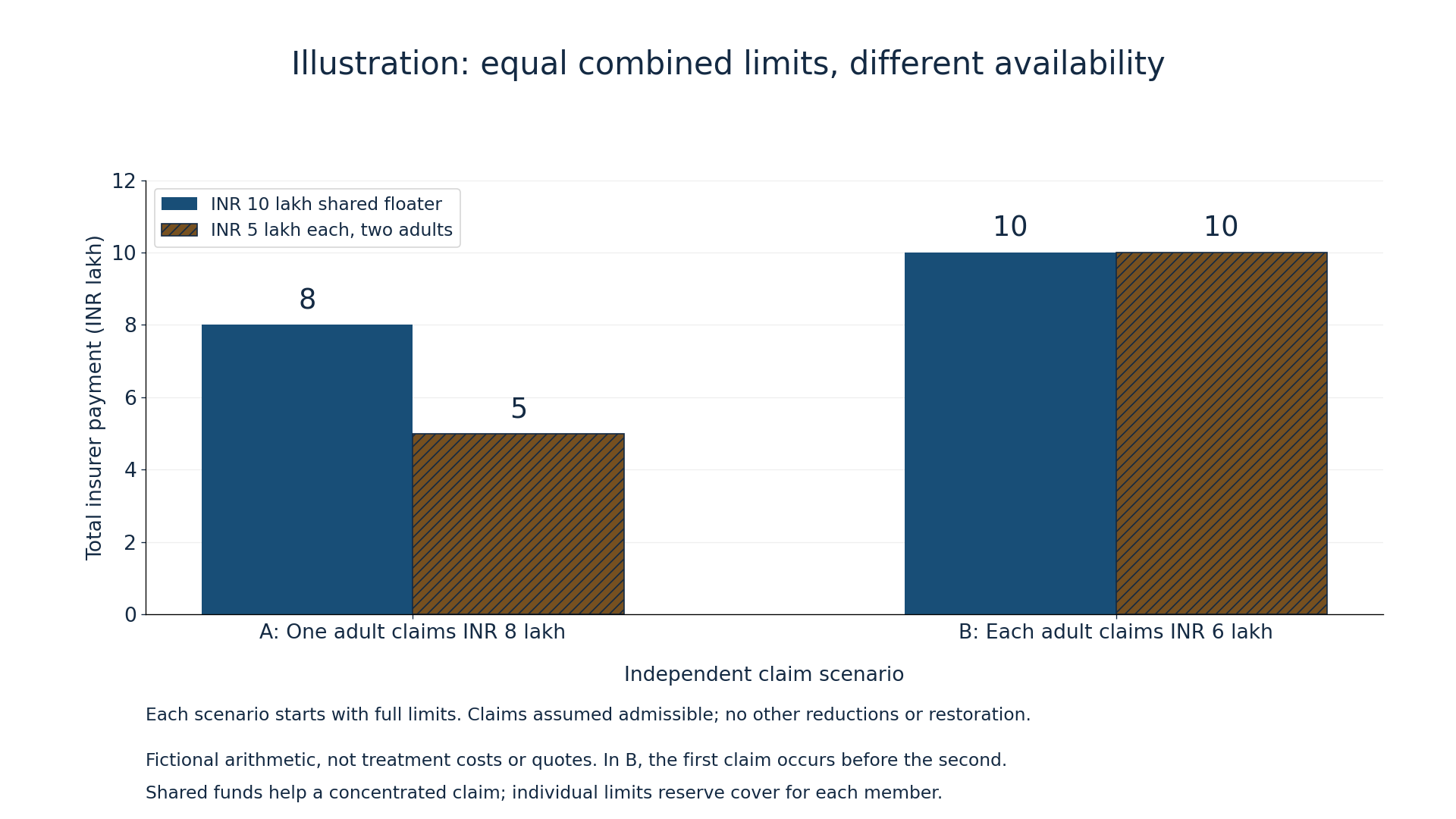
The horizontal axis identifies each independent claim scenario; the vertical axis shows total insurer payment in ₹ lakh. Labels and hatching distinguish the two structures without relying on colour alone. The inference is that sharing can help with a concentrated claim, while separate limits reserve capacity for each member. Neither design removes the need to choose sufficient cover.
₹10 lakh per person would be a different comparison: it provides ₹20 lakh of combined nominal capacity for two adults. Do not compare it with a ₹10 lakh shared floater as if the protection or premium were equivalent.
Compare the actual offer, including parents’ needs
Ask for written quotations for the same family members and comparable benefits. Compare the total premium, the amount available to one member, the amount left after a claim and renewal affordability. A floater is not automatically cheaper or more suitable in every case.
For an older parent or someone with distinct healthcare needs, compare inclusion in the floater with separately allocated cover. Consider medical history, the risk of several claims, premium affordability, exclusions and waiting periods. Age alone does not settle the choice, and separate cover is not guaranteed to be available on identical terms.
Read room-rent limits, co-payment, deductibles, treatment caps and hospital access. A Government of India response on health claims identifies these types of policy conditions among reasons payment may fall short of a bill. Cashless access does not mean every expense is payable.
For restoration, ask whether it requires exhaustion, covers the same person or illness, applies to the current claim or only later claims, and how often it can be used. Do not substitute an advertised restoration multiple for the base limit without reading the wording.
Follow a family review workflow

The corporate scenes represent a shared family discussion followed by a member-by-member review. The people are fictional AI-generated illustrations, not actual customers or endorsements.
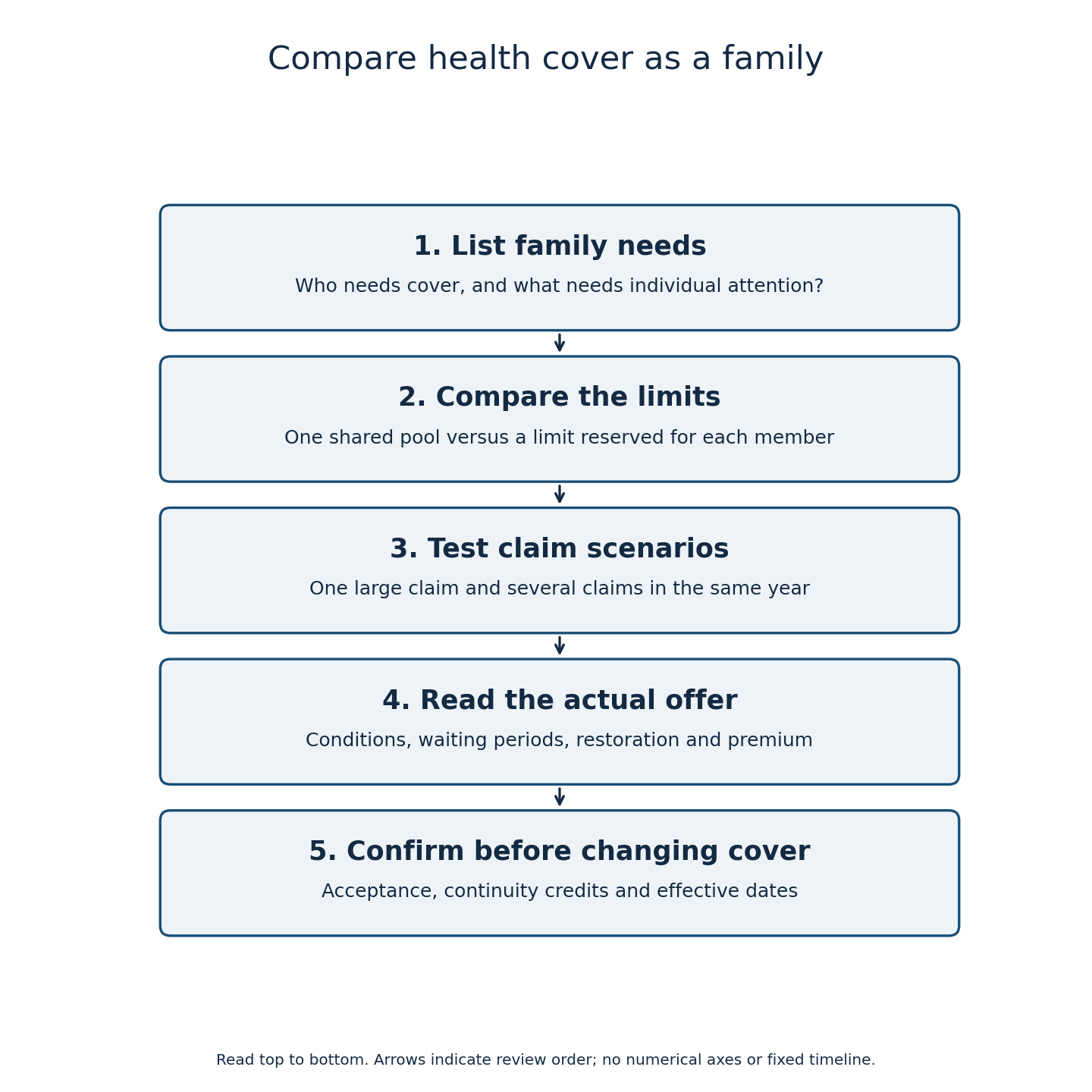
Read the workflow from top to bottom. Arrows show review order; the diagram has no numerical axes or fixed timeline.
- List who needs cover and each person’s relevant healthcare needs.
- Compare the common pool with the amount reserved for each member.
- Test a large single claim and multiple claims in the same year.
- Check exclusions, waiting periods, restoration, claim access and premium affordability.
- Confirm the insurer’s acceptance, terms and effective dates before changing existing cover.
Keep accurate medical disclosures and policy records. If changing the structure of existing cover, ask the insurer how migration or portability and continuity credits apply; do not cancel on a verbal assurance. Maintain accessible funds for deductibles and other uncovered costs. Evaluate any tax treatment for your circumstances rather than assuming a concession.
For help organising the comparison, use Abhipra’s Contact page.
Source links
- IRDAI’s Health Department FAQs: floater definition, indemnity, migration and portability concepts.
- IRDAI consumer guide to health insurance: individual and shared sum-insured structures; historical procedural deadlines are not used.
- IRDAI Annual Report 2024–25, hosted by the Life Insurance Council: Table I.26, reported individual-business covered lives.
- Government response on health insurance claims: policy conditions affecting claim payment.
Editorial review status: pending Abhipra Research / Compliance Team review.
Disclaimer
This article is for educational and informational purposes only. It should not be considered investment advice, trading advice, tax advice or insurance advice. Investments in securities market are subject to market risks. Please read all related documents carefully before investing. Past performance is not indicative of future returns. Please consult a qualified financial advisor, tax advisor or insurance advisor before making any financial decision.