Top-Up and Super Top-Up Health Insurance: Understand the Deductible Before You Buy
A top-up policy can add a higher hospitalisation limit above a deductible, but the trigger is the detail that decides whether it helps. A single large claim and several claims adding up during a policy year can cross a deductible differently.

Top-up and super top-up are not interchangeable
A top-up generally applies the deductible to each eligible claim or hospitalisation event. A super top-up generally applies the deductible to the aggregate of eligible expenses during the policy year. The exact contract controls, including whether the deductible is per person or family, whether expenses can aggregate across members, and how a base policy is coordinated.
An IRDAI-hosted policy wording explains this distinction: the deductible is applied on a per-event basis for a top-up and on a per-year basis for a super top-up. This is a policy-document example, so use the proposed product’s current wording and schedule for the decision. IRDAI-hosted health policy wording
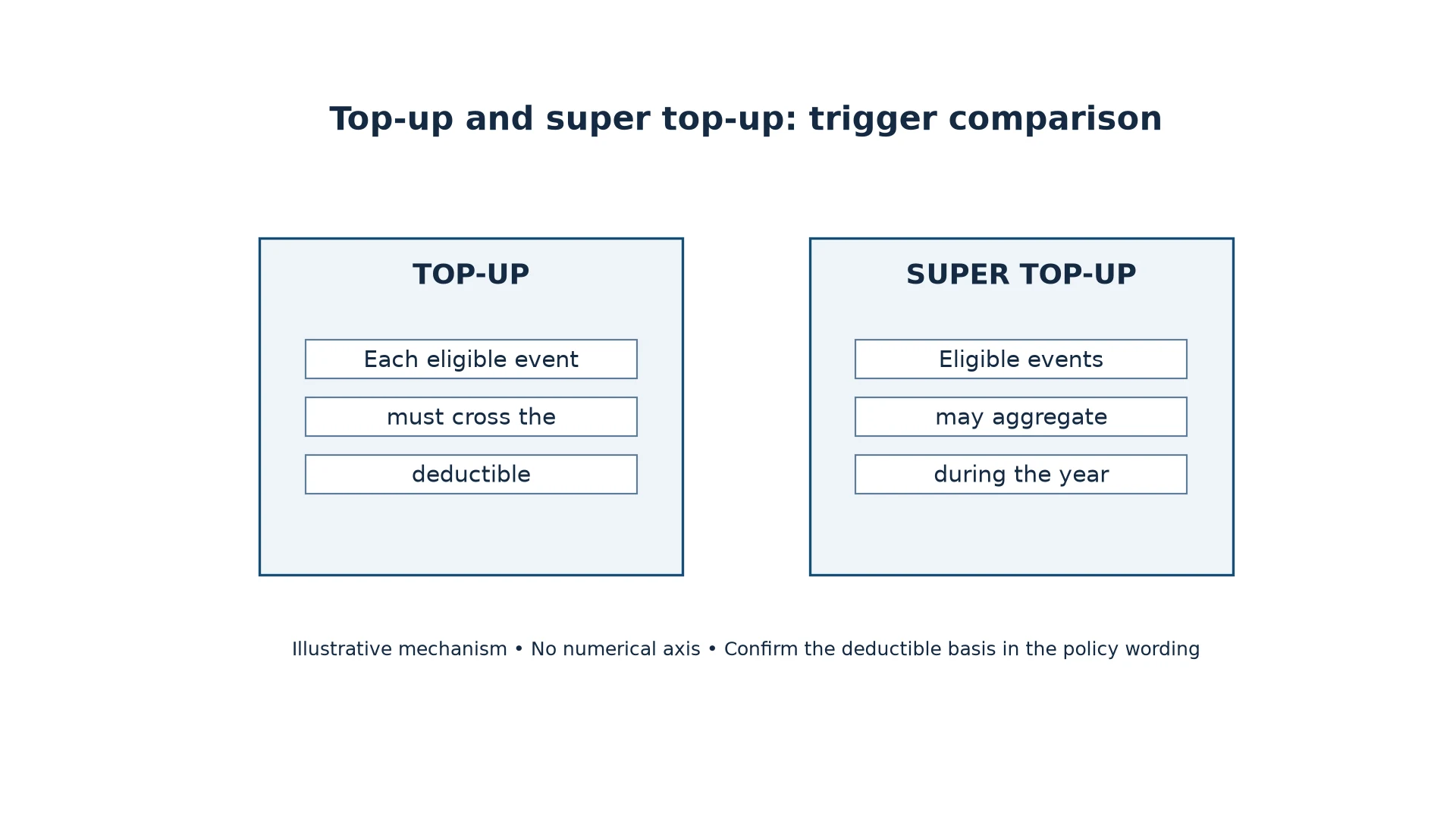
The comparison visual has no numerical axis. Read the left panel as “each eligible event must cross the deductible” and the right panel as “eligible events may accumulate during the policy year.” The inference is that the same household expenses can produce different claim outcomes under the two structures; never infer the trigger from the product name alone.
What is a deductible?
IRDAI defines a deductible as a specified amount up to which the insurer does not pay, or which is deducted from a claim according to the policy. A deductible does not automatically reduce the sum insured. It is different from a co-payment, where the policyholder bears a specified percentage of an admissible claim, and from a sub-limit, which caps a specified treatment or service. IRDAI health-department FAQ
A simple illustrative example
Assume a fictional family has a base health policy and a separate top-up or super top-up with a ₹5 lakh deductible. Two eligible hospitalisation events of ₹3 lakh and ₹4 lakh may behave differently depending on whether the deductible is tested per event or on the ₹7 lakh annual aggregate. These amounts are chosen only to explain the mechanism; they are not a quote, claim estimate or recommendation.
Do not assume the base policy automatically pays the deductible. Check coordination, claim documents, room-rent limits, exclusions, waiting periods, co-pay, network rules, family-floater treatment and whether the deductible is shared or individual.

The two office scenes show a single planning story: understand the trigger, then coordinate it with existing health cover. They contain fictional people and blank documents.
Five checks before buying
- Trigger: Is the deductible per claim, per event, per person or per policy year?
- Eligible expense: Which hospitalisation, day-care, domiciliary or modern-treatment costs count?
- Coordination: Can the base policy or another insurer pay first, and what documents prove that payment?
- Cost sharing: What exclusions, sub-limits, deductibles and co-payments remain after the deductible?
- Continuity: How are waiting periods, portability, renewal, nominee details and claims handled?
IRDAI says the Customer Information Sheet should summarise the type of insurance, sum insured, coverage, exclusions, sub-limits, deductibles, waiting periods and claims or grievance information. Read it with the full policy wording. IRDAI consumer information
Review workflow
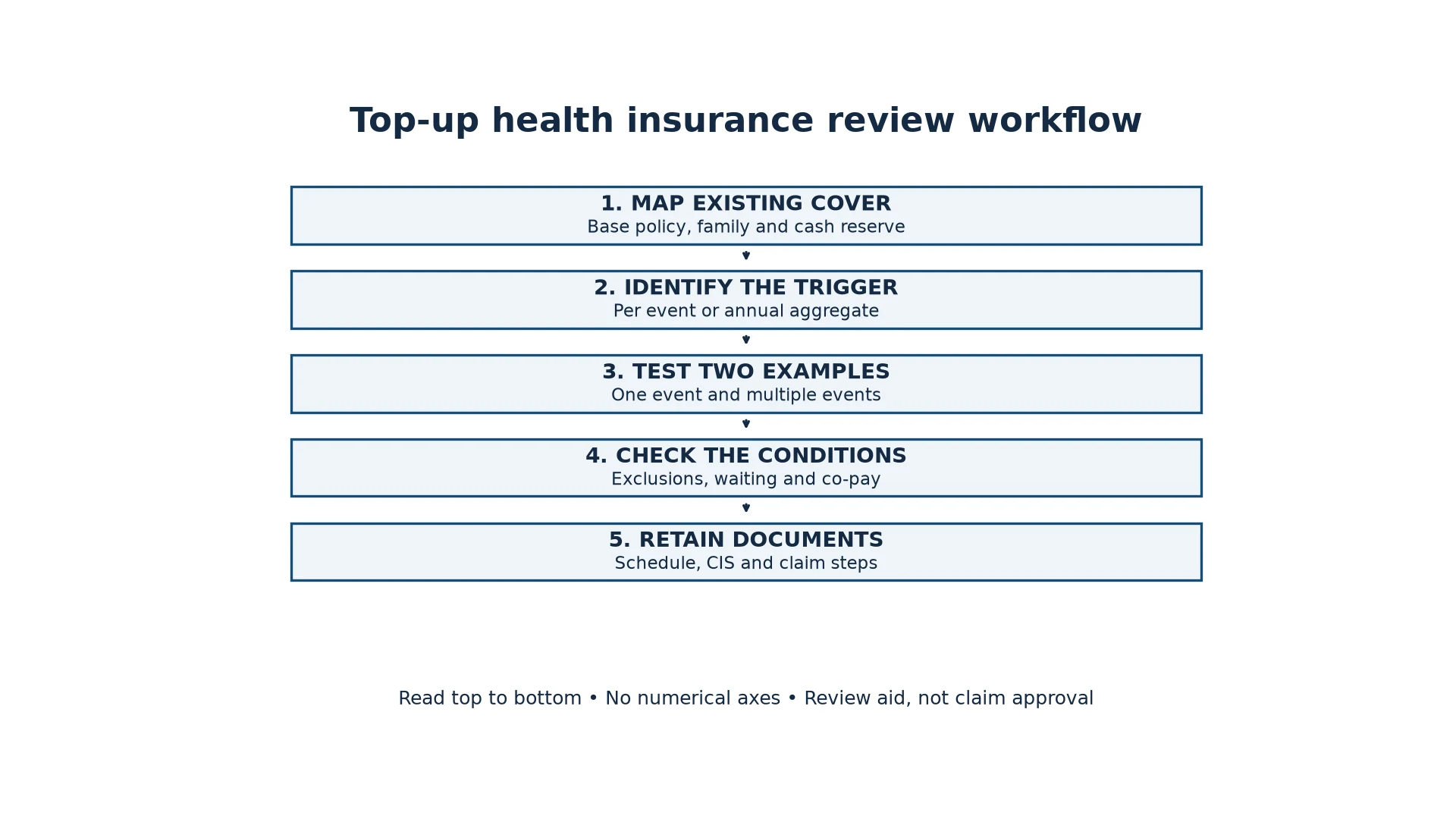
This workflow has no numerical axes. Read it from top to bottom:
- Map the existing base cover, family members and likely cash reserve.
- Identify the deductible trigger and whether claims aggregate.
- Test one single-event example and one multi-event example using the wording.
- Check exclusions, waiting periods, co-pay, sub-limits and coordination rules.
- Retain the schedule, CIS, proposal, payment record and claim instructions.
Common mistakes
Do not choose a deductible only because the premium is lower. Do not confuse a top-up with a super top-up. Do not count the same base-policy limit twice. Do not assume every medical bill is an eligible expense. Do not overlook family-floater wording or renewal conditions. Ask for written clarification when a sales explanation differs from the policy document.
For a suitability discussion, Contact Abhipra. Review the exact policy documents before making a decision.
Source Links
- IRDAI health-department FAQ
- IRDAI-hosted health policy wording
- IRDAI health-insurance-products listing
Disclaimer
This article is for educational and informational purposes only. It should not be considered investment advice, trading advice, tax advice or insurance advice. Investments in securities market are subject to market risks. Please read all related documents carefully before investing. Past performance is not indicative of future returns. Please consult a qualified financial advisor, tax advisor or insurance advisor before making any financial decision.