Insurance Planning for Self-Employed Professionals: A Practical Risk Map
A self-employed person may have no employer-provided health cover, paid leave or group life benefit. That does not automatically mean every policy is needed. It does make it useful to review household responsibilities, work-related exposure and existing cover together—and to keep personal protection separate from business insurance.

What the employment data says—and what it does not
The Ministry of Statistics and Programme Implementation’s Periodic Labour Force Survey (PLFS) 2025 reports that, among employed people in India under the usual-status measure, 56.2% were classified as self-employed, 23.6% as regular wage or salary workers, and 20.2% as casual labour. In this classification, “self-employed” combines own-account workers, employers and helpers in household enterprises. It is not a count of freelancers or professional service providers.
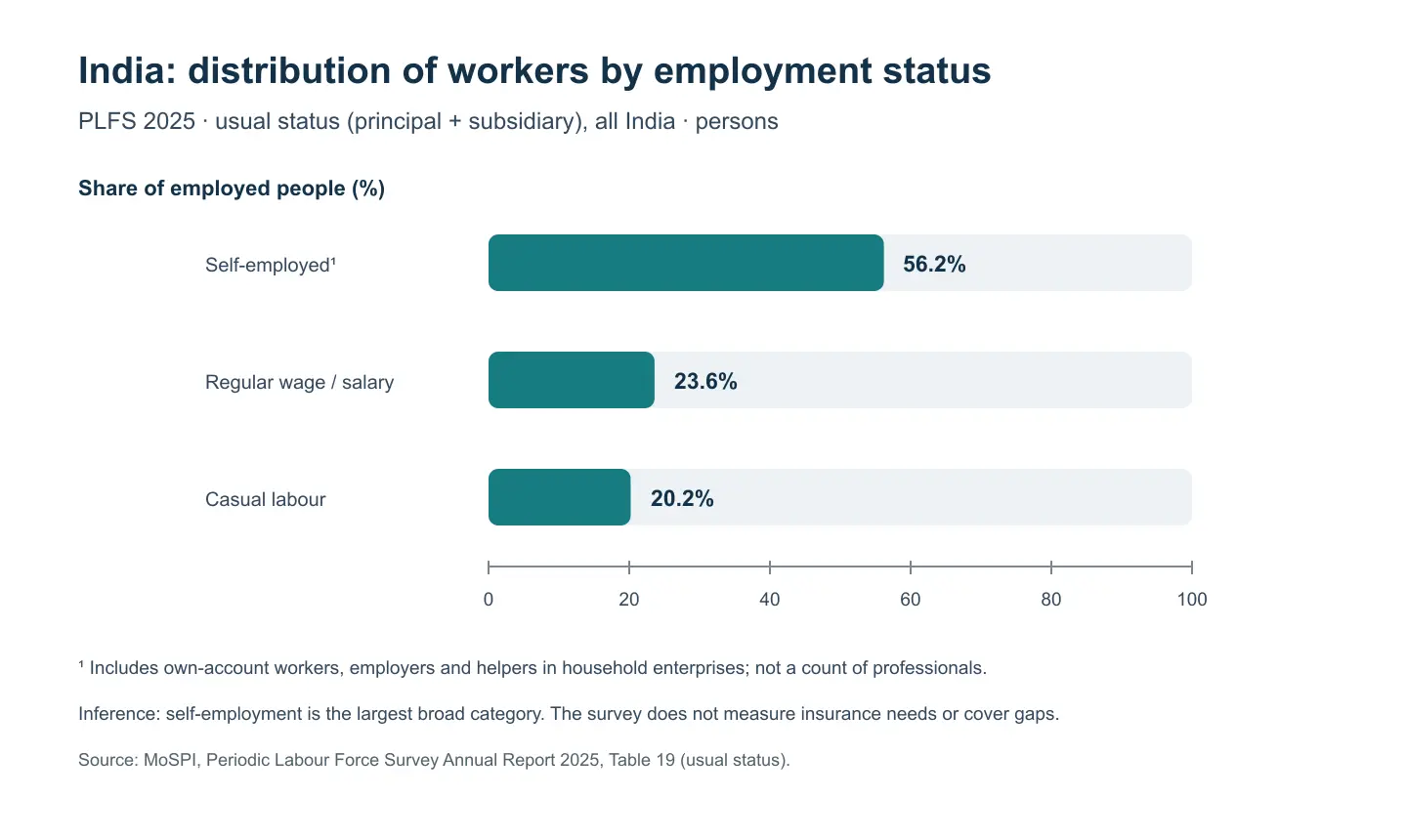
The chart’s horizontal axis is the share of employed people, from 0% to 100%; the bars show each category’s percentage. The inference is limited: self-employment is the largest broad category in this survey. The figures do not establish that a worker lacks insurance, needs a particular product, or faces a specific risk.
Start with the risks around your income
Write down who depends on your income, regular household commitments, outstanding borrowing and the work you do. Consider what could happen if illness or an accident interrupted your ability to earn, and whether clients, contracts, equipment or premises create separate business exposures. A freelance designer, for example, might need to think through household expenses during a period when both work and invoicing stop; this is an illustrative scenario, not a forecast.
Review personal protection
- Check what health cover you already have, including any family policy, portability or continuation terms, and whether your preferred hospitals appear in the insurer’s current network.
- If others depend financially on you, assess whether life cover is relevant to your household’s needs and affordability. Do not rely on a generic income multiple as a personal recommendation.
- If an accident could stop you from working, read the policy definition of disability, benefit triggers, exclusions and claim requirements before deciding whether accident cover fits your situation.
- Keep an emergency reserve and insurance review as distinct parts of household planning: a policy pays only when its terms and claim conditions are met.
Review work and business exposure separately
Professional liability, property, equipment, cyber or business-interruption cover may be relevant in some occupations and contracts, but availability and terms vary. Check contract obligations, the insured activity, limits, deductibles, exclusions and whether a business policy covers the actual legal entity and work performed. Do not assume a personal policy protects business assets or liabilities.
Read the policy before choosing
IRDAI’s consumer guidance asks health-insurance buyers to disclose pre-existing conditions and review items such as waiting periods, exclusions, room-rent and other limits, co-payment, network hospitals and cashless arrangements. Request and read the Customer Information Sheet (CIS); it summarises key benefits, exclusions and claim information. Verify the insurer and intermediary through official channels, note renewal dates, and keep policy and claim contact details accessible.
For any policy, compare the wording that applies to your occupation and duties, the events covered, key exclusions, waiting periods, claim documentation and grievance process. Ask the insurer or licensed intermediary to clarify terms in writing when wording is unclear. Premium is one factor; it does not by itself show whether a policy fits the risk.
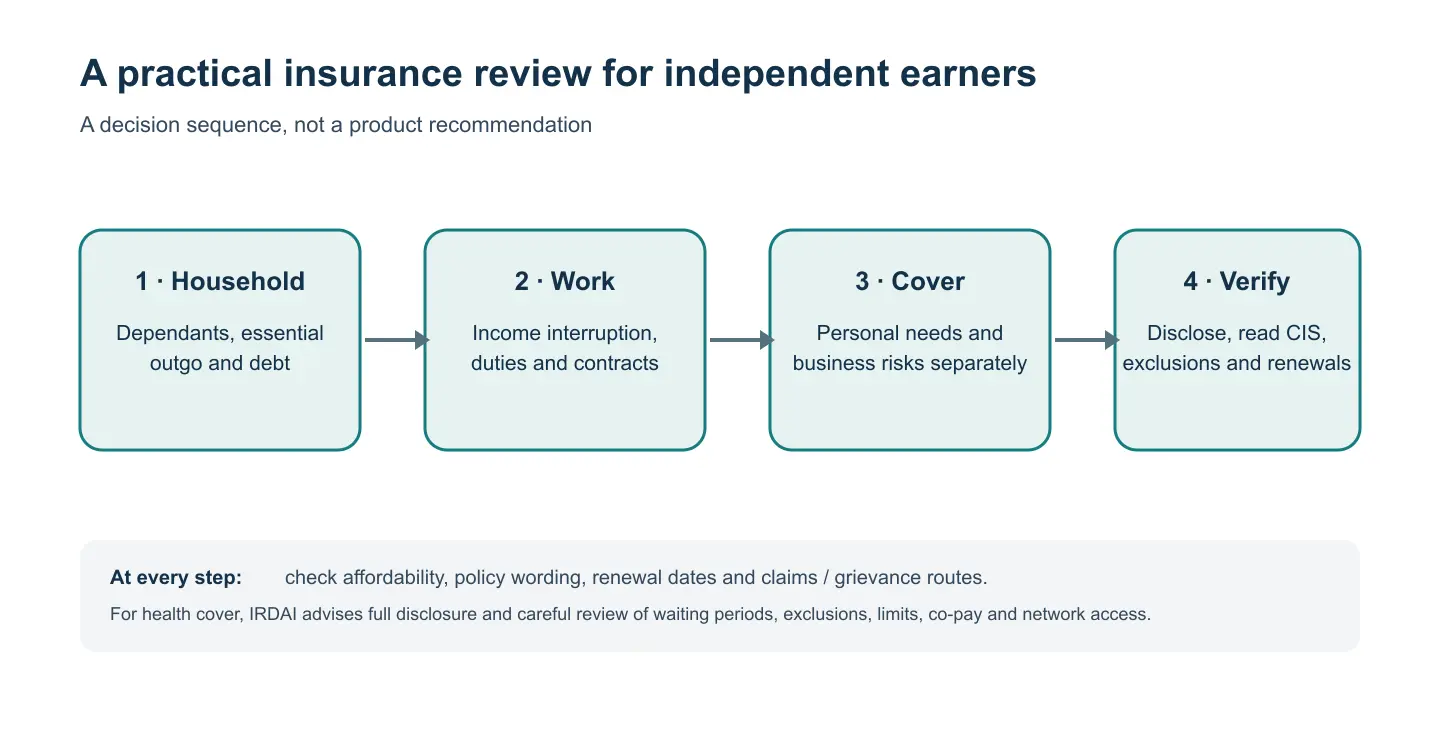
The workflow starts with household commitments, then maps work exposure, separates personal and business needs, and ends with policy-term checks. At every step, consider affordability and confirm details against the actual policy wording. It is a review sequence, not a product recommendation.
A simple annual review checklist
- List current policies, insured people, renewal dates and benefit limits.
- Update household dependants, borrowing and essential commitments.
- Update your occupation, duties, contracts, business assets and work location.
- Check new or changed exclusions, waiting periods, co-payments, sublimits and claim steps.
- Confirm contact details, nominee information where applicable, premium affordability and grievance routes.
- Save the policy schedule, CIS, receipts and claim instructions somewhere your trusted family contact can find them.
Sources and image credits
- MoSPI, Periodic Labour Force Survey Annual Report 2025 (PDF), Table 19 — employment-status context.
- IRDAI, Health Department consumer guidance — disclosures and policy features to review.
- IRDAI, Master Circular on Life Insurance Products 2024 — life-product and Customer Information Sheet framework.
- Illustrative photographs by William Fortunato on Pexels; used under the Pexels License. The people shown do not endorse Abhipra or any insurance product.
This article is for general investor and consumer education. It is not personalised insurance, legal or financial advice. Product availability, underwriting, exclusions and claims are governed by the insurer’s policy terms and applicable rules. Consider your needs and consult an appropriately licensed insurance professional before making a decision.
Reviewed by Abhipra Insurance Advisory Desk