Group Health Insurance for Employees: What to Check Beyond the Headline Cover
An employer group health plan can be an important part of compensation. The useful question is not only the headline sum insured: it is who is enrolled, what the scheme pays under its own terms, how claims work and what changes when employment changes.
By Abhipra Insurance Advisory Desk. Research checked on 7 October 2026.

Read the employee scheme as a policy, not a presentation
Ask HR, the insurer or the scheme administrator for the member certificate, policy schedule, complete wording and Customer Information Sheet (CIS). IRDAI says a CIS must be provided to a member of a group insurance policy and describes it as a single-place summary of the policy's key features. The full policy wording remains important when there is a difference. See IRDAI's Health Department FAQs on the CIS and health-policy features.
Use the actual documents to check these four items:
- People enrolled: confirm whether a spouse, children and parents are included, named correctly and subject to an eligibility rule.
- Money that may remain with you: note the sum insured, room-rent or treatment sub-limits, co-payment, deductibles and exclusions.
- Care access: confirm the current network hospital list near home and where dependent family members live; cashless approval and policy terms still matter.
- Employment link: get the membership start and end conditions in writing, including what the scheme says about notice, leave, retirement or a job change.
IRDAI defines co-payment as the insured person's specified share of an admissible claim. A deductible is a stated amount or time threshold before benefits become payable under the relevant policy type. Neither phrase tells you how much your own scheme will pay without reading its terms. See IRDAI's explanations of co-payment, deductibles, cashless care and claims.
What the reported coverage mix shows
IRDAI's Annual Report 2024-25 records 58 crore lives covered under 2.65 crore health-insurance policies issued by general and health insurers, excluding personal-accident and travel policies. Its reported mix of covered lives was 47.4% group business, 42.3% government-sponsored schemes and 10.3% individual business. Read the Annual Report 2024-25, section I.6.5.2 and Table I.26.
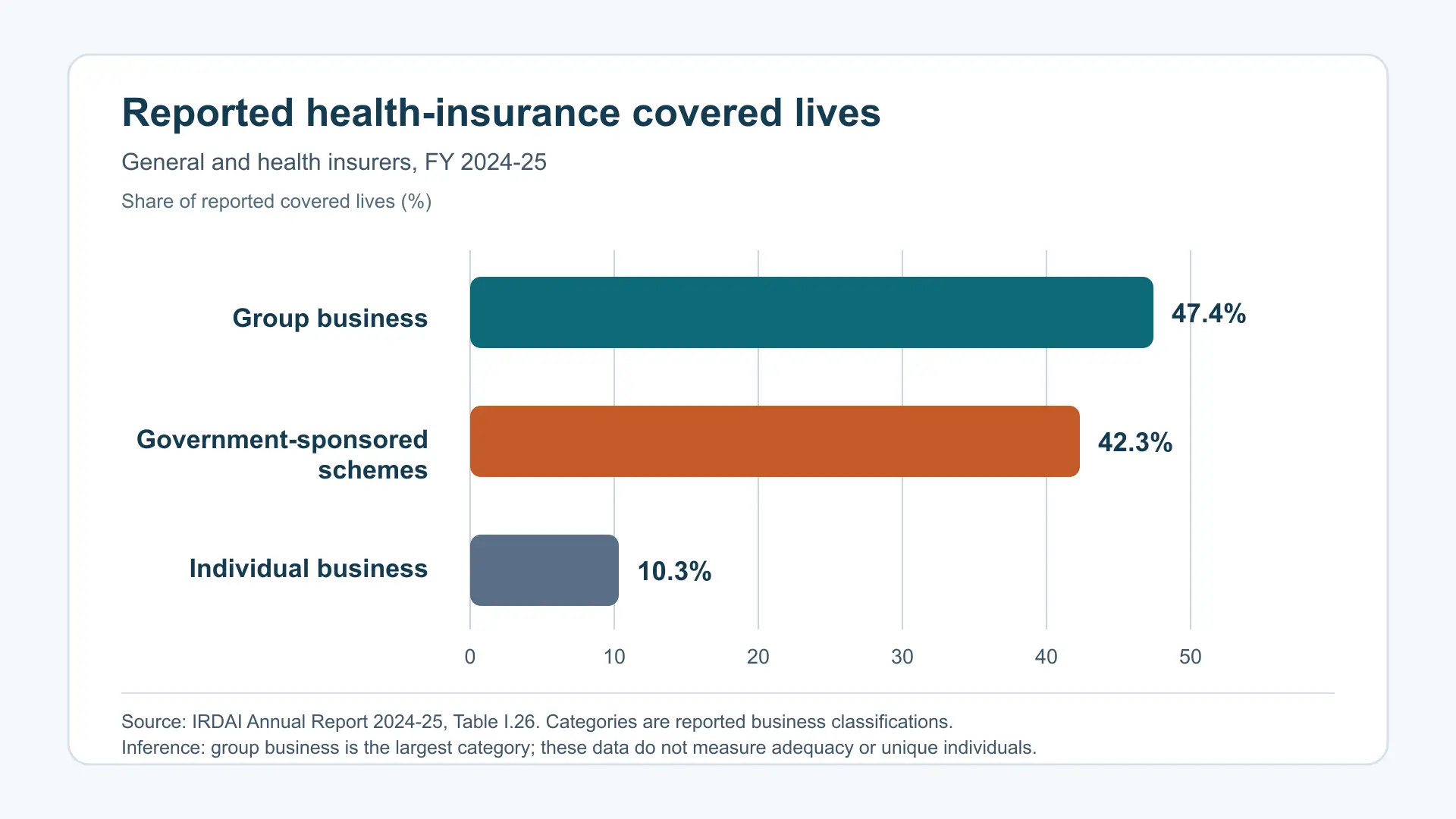
The horizontal axis is the share of reported covered lives in percent, from 0 to 50. The vertical axis lists the reported business categories. Group business is the largest category in this classification.
The inference is deliberately narrow: group arrangements are a major channel in the reported figures. Group business is broader than employee cover, and reported covered lives are not a count of unique people. The chart cannot say whether a particular employee or family has sufficient cover.
Turn a headline benefit into a usable claim plan
Cashless treatment is a payment route under which the insurer or TPA pays a network provider to the extent pre-authorisation is approved and subject to the policy. It is not a statement that every medical expense will be paid. IRDAI's health FAQ says reimbursement and cashless claims remain subject to the contract terms. Use the scheme's claims contacts and hospital network list for your particular policy.
Before planned care, ask the insurer or TPA for the current pre-authorisation process and retain correspondence. In an emergency, follow the scheme's notification and claim instructions as soon as reasonably possible. For a rejected or partially admitted claim, read the insurer's reasons against the cited policy condition and use the insurer's grievance channel if clarification is needed. IRDAI's Health Department page explains that the CIS includes claims, servicing and grievance information.

These illustrations show a document-review conversation. They depict fictional people, not customers, insurers or endorsements.
Review continuity before employment changes
Do not assume that group membership automatically becomes identical personal cover. Ask the insurer what options, if any, apply to you and each covered family member before membership ends. IRDAI's Health Department FAQs distinguish migration within the same insurer from portability between insurers; eligibility, credited waiting periods, underwriting and effective dates depend on the applicable rules and policy.
Keep the existing scheme active where possible until any replacement arrangement is confirmed. An application or an informal assurance is not proof of cover. Compare the offered wording, exclusions, waiting periods, premium, renewal conditions and effective date with your household needs. The IRDAI Insurance Products Regulations, 2024 contain the regulatory framework for health-policy migration and portability.
A five-step employee review workflow
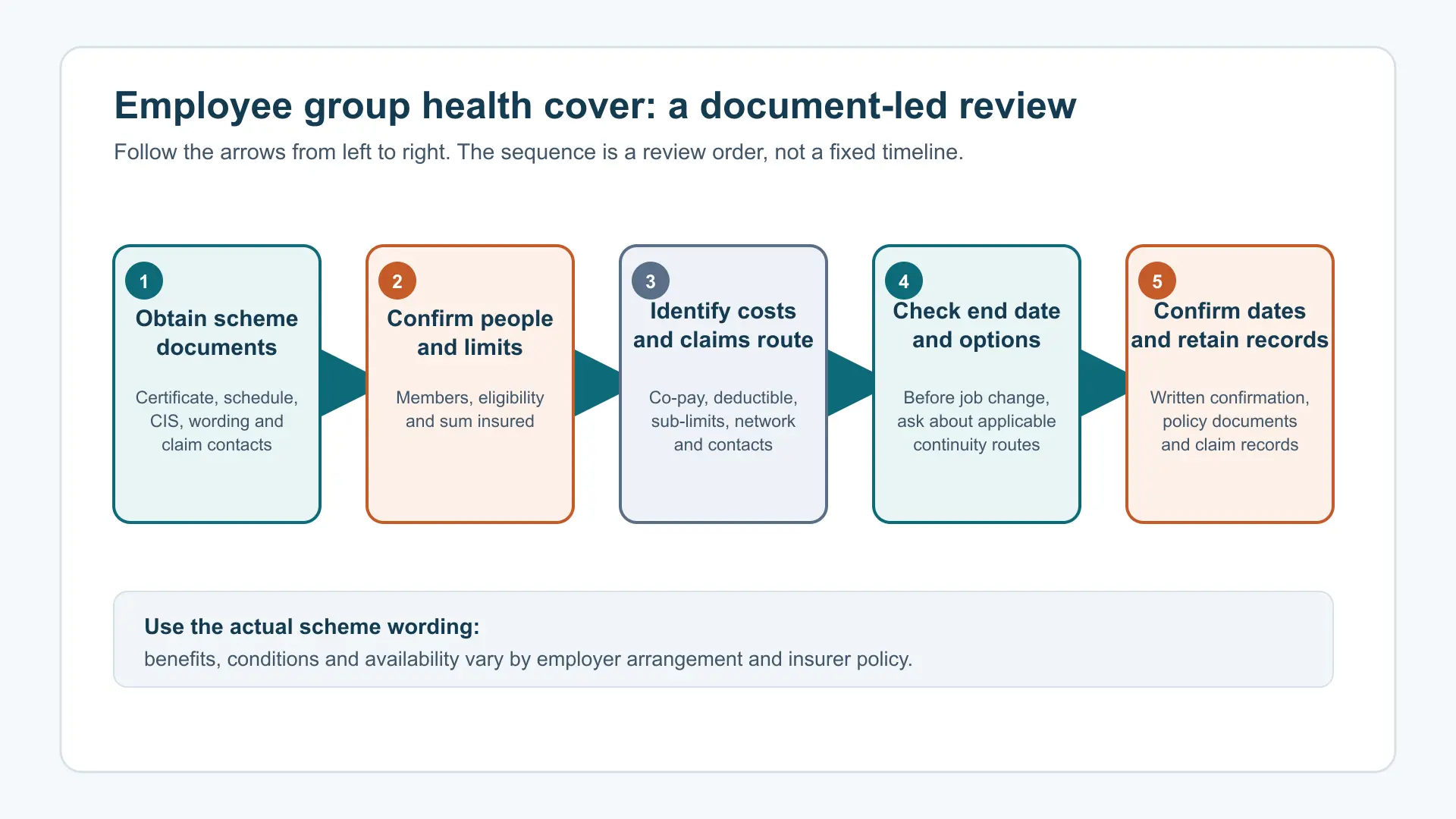
Read the workflow from left to right. It has no numerical axes: arrows show the review order, not a fixed timeline.
- Obtain the current member certificate, schedule, CIS, wording and claims contacts.
- Confirm the enrolled people, sum insured and family eligibility conditions.
- Record co-payment, deductible, sub-limit, exclusion, network and claims-process details that apply to your scheme.
- Before a job change, confirm the membership end date and ask the insurer about any applicable continuity, migration or portability route.
- Keep written confirmation of effective dates, policy documents and claim records; plan for costs that the policy does not cover.
For help organising a document-led protection review, use Abhipra's Contact page. For related reading, see Health Insurance: Why Employer Cover May Not Be Enough.
Source links
- IRDAI Annual Report 2024-25: reported health-insurance policies, covered lives and business-category mix.
- IRDAI Health Department FAQs: CIS for group members, policy features, claim information, migration and portability concepts.
- IRDAI Health Insurance Regulations FAQs: cashless care, reimbursement, co-payment, deductible and multiple-policy explanations.
- IRDAI Insurance Products Regulations, 2024: regulatory framework cited for migration and portability.
Editorial review status: pending Abhipra Research / Compliance Team review.
Disclaimer
This article is for educational and informational purposes only. It should not be considered investment advice, trading advice, tax advice or insurance advice. Investments in securities market are subject to market risks. Please read all related documents carefully before investing. Past performance is not indicative of future returns. Please consult a qualified financial advisor, tax advisor or insurance advisor before making any financial decision.