
Group Term Life Insurance for Employees: Check the Certificate Before Relying on the Cover
Employer-provided group term life cover can be a valuable employee benefit. It is still important to confirm the member-level benefit, nomination, eligibility and the point at which cover changes or ends instead of relying on a benefits presentation alone.
By Abhipra Business Protection Desk. Research checked on 8 October 2026.

Start with the member certificate and the scheme rules
IRDAI's Master Circular on Life Insurance Products lists group term insurance and one-year renewable group term insurance among the products permitted for employer–employee groups. That framework does not make every employer scheme identical. The master policy, certificate and the insurer's wording govern the member benefit.
Ask HR, the master policyholder or the insurer for the current member certificate or certificate of insurance, schedule, claims contact and relevant wording. Then confirm:
- Who is covered: eligibility, membership start date and any age or employment conditions.
- What is payable: the stated death benefit, any benefit definitions and exclusions in the member documents.
- Who should receive it: nomination or beneficiary information, and how a change is recorded.
- When cover applies: the effective date, renewal status and the scheme's employment-linked end conditions.
Do not infer a benefit amount from salary, designation or a colleague's arrangement. Record the amount and conditions shown for your own membership.
What IRDAI's group-product framework shows
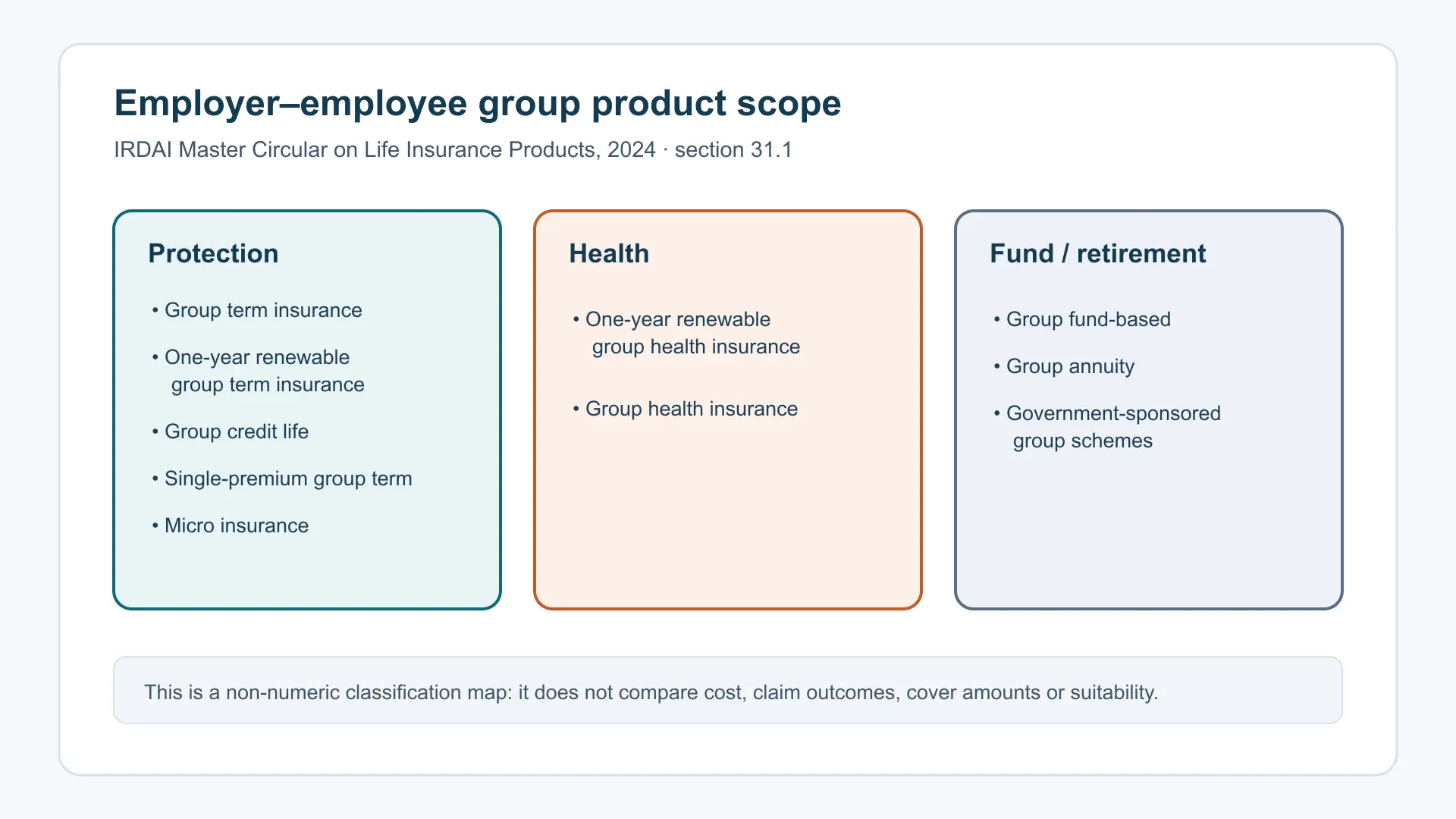
This is a non-numeric scope map, so it has no x-axis or y-axis. It groups the ten employer–employee product types listed in section 31.1 of IRDAI's 2024 Master Circular into three practical reading buckets: protection, health and fund or annuity arrangements. The map does not compare cost, claim outcomes or suitability.
The useful inference is limited: group term cover is a recognised employer-group product category, while the actual certificate and scheme terms determine the employee's benefit. Use the map to ask for the right document, not to rank products.
Keep beneficiary details and records current
For life cover, outdated contact or nomination details can create avoidable follow-up at a difficult time. Check the member record after a marriage, divorce, birth, death in the family or a change in contact details. Ask the insurer or scheme administrator which form and acknowledgement applies to the scheme.
IRDAI's Master Circular on Protection of Policyholders' Interests, 2024 is the current regulator resource for policyholder servicing. The individual policy or certificate should identify the claims and grievance route that applies to your cover. Keep copies outside only a work inbox, so a family member can locate them if needed.

The two office scenes show fictional people organising employee-benefit records. They are AI-generated editorial illustrations, not customers, insurers or endorsements.
Review cover before a job change
Group term cover is often linked to an employer relationship. Before resignation, retirement, long leave or a change in employment status, ask in writing whether membership will end, whether any continuation or conversion option exists, the associated conditions and the effective dates. Do not assume that an employer scheme automatically becomes an identical personal policy.
If you consider separate personal life cover, compare the policy wording, underwriting, affordability, exclusions and effective date against the household's needs. An application and a confirmed policy are different stages. The decision should not be made only because an employer benefit may end.
A five-step group term review workflow
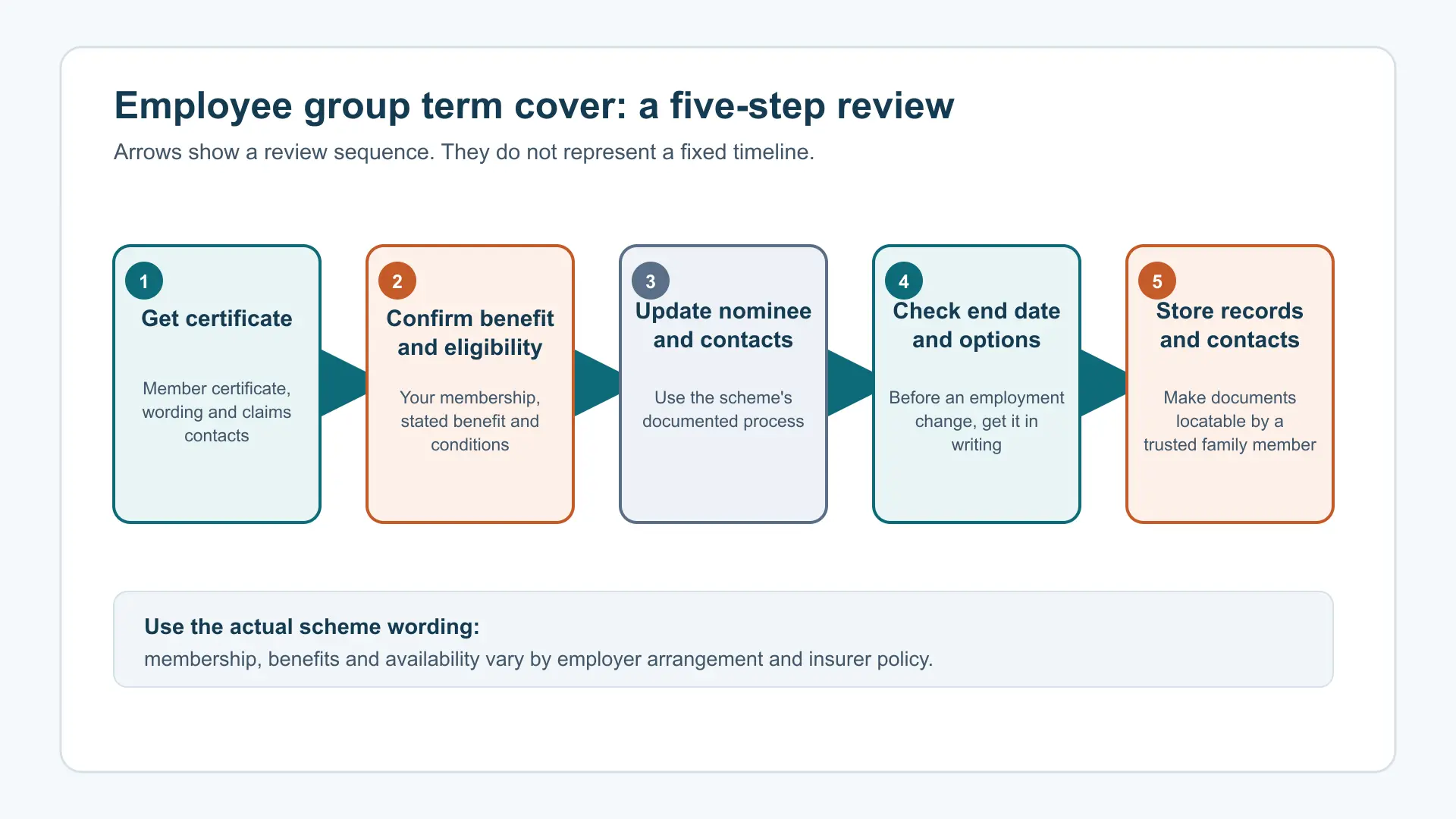
Read the workflow from left to right. It has no numerical axes; its arrows show a review sequence rather than a fixed timeline.
- Obtain the member certificate, scheme schedule, wording and claims contact details.
- Confirm your own membership, stated benefit and the conditions that apply.
- Check that nominee or beneficiary and family contact details are current, using the scheme's documented process.
- Before an employment change, obtain written confirmation of the cover end date and any applicable options.
- Store the certificate, acknowledgement and claims contacts where a trusted family member can locate them.
For a document-led protection review, use Abhipra's Contact page. For related reading, see What Happens If a Business Loses Its Founder?.
Source links
- IRDAI Master Circular on Life Insurance Products, 12 June 2024: section 31.1 permitted employer–employee group product types.
- IRDAI Circulars: current Master Circular on Protection of Policyholders' Interests, 2024.
Editorial review status: pending Abhipra Research / Compliance Team review.
Disclaimer
This article is for educational and informational purposes only. It should not be considered investment advice, trading advice, tax advice or insurance advice. Investments in securities market are subject to market risks. Please read all related documents carefully before investing. Past performance is not indicative of future returns. Please consult a qualified financial advisor, tax advisor or insurance advisor before making any financial decision.