Insurance Planning for Directors and Senior Management: Separate the Roles Before Choosing Cover
A director or senior manager can be an employee, shareholder, board member and household income earner at the same time. Those roles create different questions. A company benefit may help during employment; a personal policy is held for the individual or household; and a management-liability policy may respond to certain covered claims against insured people or the company. Treating them as one pool can leave important assumptions untested.

Start with the role, not a product label
Make a short role map before considering any insurance arrangement. Record whether the person is acting as a director, a whole-time director, a senior employee, an officer, a shareholder, a partner or a founder. Then list what depends on that role: household income, employer-provided health or life cover, company decisions, contractual duties, team continuity and any personal guarantees or borrowing.
The person, the employer and the company may be different policyholders or insured parties. A benefit supplied by an employer can be valuable, but its eligibility, benefit design and continuity when employment changes should be read from the scheme documents. Likewise, a management-liability policy is not a substitute for an individual’s household protection review, and personal protection is not a substitute for the company’s governance and risk controls.
Three protection questions to keep separate
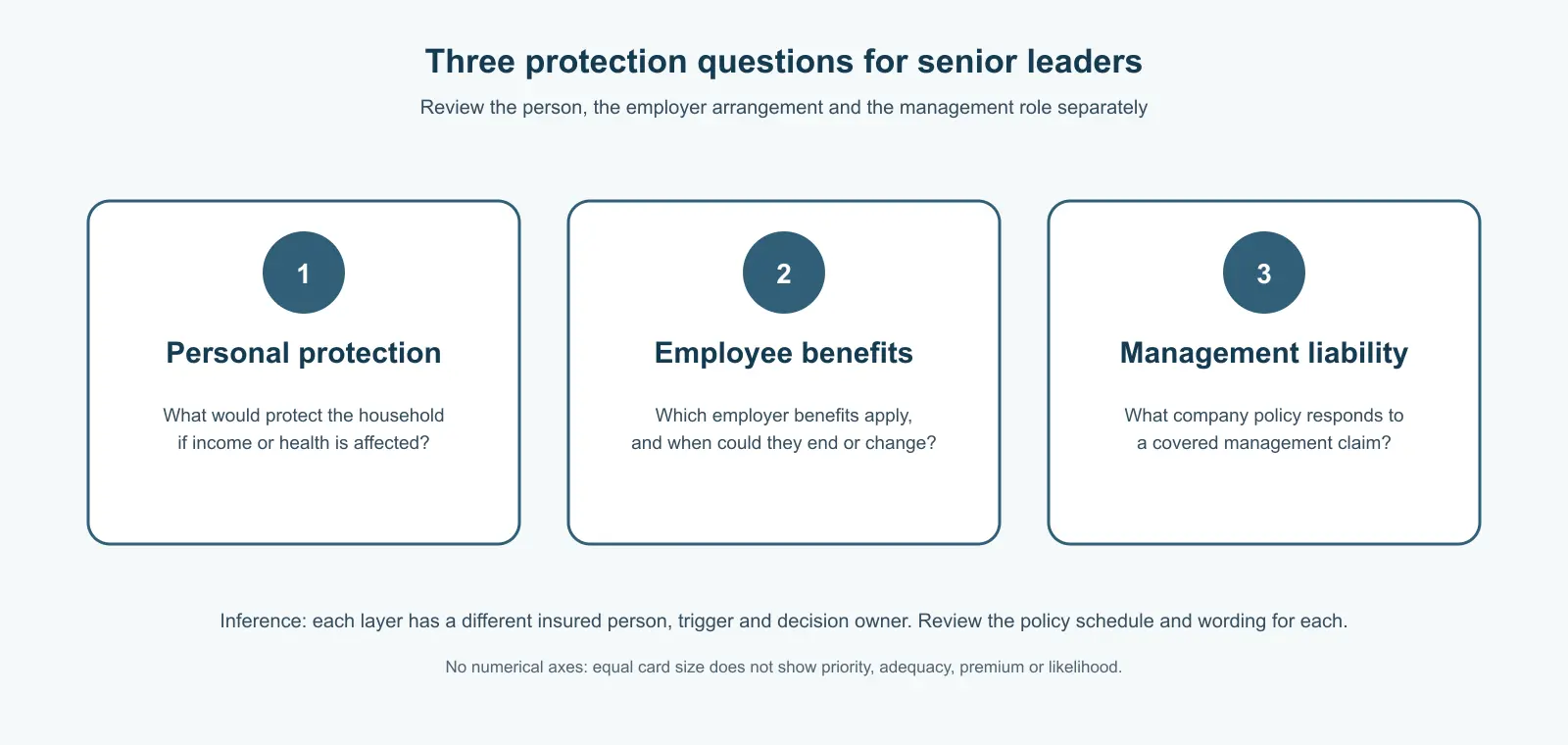
The graphic presents three categories, not a ranking. There are no numerical axes. Personal protection asks how the household would cope if income or health is affected. Employee benefits asks what the employer arrangement actually covers and when it could change. Management liability asks what company policy, if any, may respond to a covered claim arising from a management role. Each needs its own policy schedule, wording and advice where appropriate.
For listed entities, SEBI’s current Listing Obligations and Disclosure Requirements Regulations state that the top 1,000 listed entities by market capitalisation must undertake Directors and Officers insurance for all independent directors, with the quantum and risks determined by the board. That is a listed-entity governance requirement with a defined scope; it should not be read as a universal requirement for every private company or as proof that every director, claim or loss is covered.
Read management-liability cover as a contract
A Directors and Officers policy can be designed to address personal liability arising from alleged wrongful acts in a managerial capacity, subject to the wording, definitions, exclusions, limits, retention and claims process. One insurer’s current overview describes its D&O product in those terms and refers to legal expenses for specified investigations or proceedings with the insurer’s written consent. It is an example of product framing, not a statement of what every policy covers.
Ask practical questions of the actual policy:
- Who is insured: the company, directors, officers, employees in named capacities, or past and future office holders?
- What is the claim trigger, notification requirement and applicable period?
- What costs, limits, sub-limits, retentions and exclusions apply?
- Does the company indemnify the individual first, and if so, when could that not happen?
- Are subsidiary, overseas, employment-practice, regulatory investigation or shareholder-related issues addressed, excluded, limited or subject to an endorsement?
Keep the answer in the policy records rather than in an informal understanding. A later post will examine D&O insurance in more detail; this review is about avoiding confusion between a person’s financial protection, an employment benefit and a company’s management-liability arrangement.
A review workflow for senior leaders

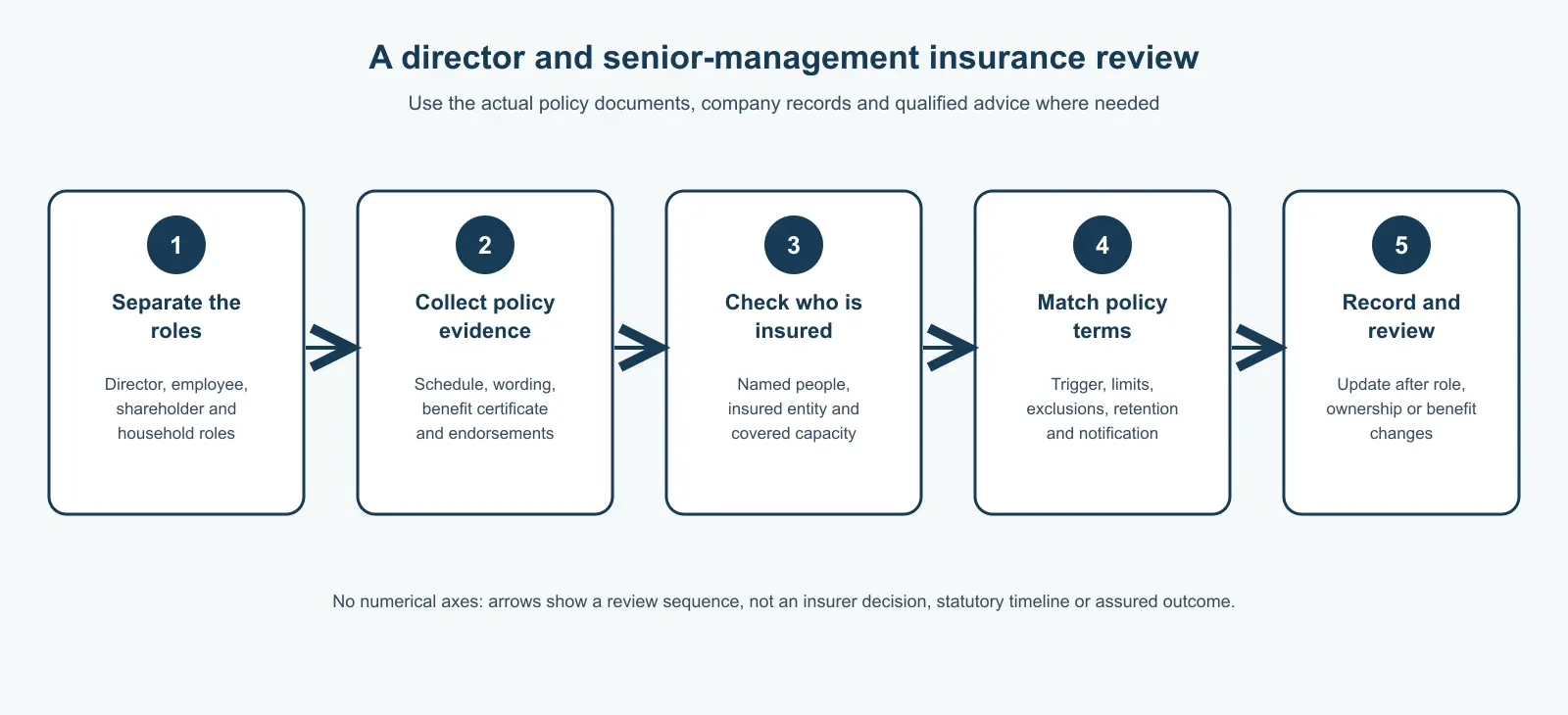
Read the workflow from left to right. First separate the roles; then collect the policy schedule, wording, benefit certificate and endorsements. Confirm who is insured and in what capacity. Compare a realistic scenario with the actual trigger, limits, exclusions, retention and notification clauses. Finally, record the gaps and revisit the review after a role, ownership, benefit or company change. The arrows show order for review, not a statutory timeline, claim decision or assured outcome.
Keep governance and continuity records current
Insurance works alongside, rather than in place of, sound governance. Maintain current board and delegation records, meeting minutes, authorised signatories, benefit enrolment records and claims contacts. Limit access to sensitive documents and store recovery instructions securely. Revisit the review after a director joins or leaves, a company acquires a subsidiary, remuneration changes, a benefit plan changes, or the company changes its borrowing or operating model.
The business should also plan for operational dependence on senior people. Abhipra’s founder-continuity guide explains why delegated authority, shared knowledge and documented processes matter alongside insurance.
Prepared by Abhipra Business Protection Desk for Abhipra Research / Compliance Team review.
Source Links
- SEBI, Listing Obligations and Disclosure Requirements Regulations, 2015, amended through 22 January 2026 — regulation 25(10) on D&O insurance for independent directors of the top 1,000 listed entities by market capitalisation.
- ICICI Lombard, Directors and Officers Liability overview — example product overview; always consult the actual policy wording and schedule.
- IRDAI product listing for Directors & Officers Liability Insurance — regulatory product-listing context.
Disclaimer
This article is general educational information, not insurance, legal, tax or investment advice. Cover, indemnity, liability and claim eligibility depend on the policyholder, insured persons, policy schedule, wording, exclusions, limits, evidence and applicable law. Review the actual documents with the insurer or an appropriately licensed and qualified adviser before acting.