
What Happens If a Business Loses Its Founder? A Practical Continuity Plan
A founder’s sudden illness, death, resignation or departure can leave a business unsure who may make decisions, access records, reassure customers or keep payments moving. The company does not have to stop by definition; the outcome depends on its legal structure, governing documents, ownership, contracts and the work already shared with others.

What is most exposed when one person is absent?
The first disruption is often practical. Important customer and supplier contacts may sit in one phone. Only the founder may know how to approve a payment, release an order, negotiate a renewal, access a system or resolve a quality issue. If staff cannot confirm who has authority, ordinary decisions can wait while uncertainty spreads to customers, lenders and employees.
Make an “absence map” before naming a successor. List the decisions and relationships that depend on the founder, where the relevant information is held, and who can take over temporarily. Include banking and payment permissions, insurance and loan records, statutory filing calendars, contracts, payroll, data backups and emergency contacts. Limit access to sensitive records to authorised people and store recovery instructions securely; do not circulate passwords in a general continuity document.
Ownership, management and director roles are different
A founder may be a shareholder, director, managing director, employee and day-to-day decision maker at the same time. These roles do not automatically pass together to one person. A family member, co-founder or senior employee should not assume they can exercise every power simply because they are next in line informally.
For companies, the Companies Act sets out director appointment requirements, and a board or shareholder process may be needed depending on the circumstances and the company’s articles. Listed entities also have SEBI governance requirements: the board’s responsibilities include selecting and, where necessary, replacing key managerial personnel and overseeing succession planning. Those listed-company provisions should not be treated as a one-size-fits-all rule for every proprietorship, partnership or private company. Check the entity’s current documents and obtain company-secretarial or legal advice for an actual event.
The practical step is to distinguish interim operating authority from a permanent leadership or ownership decision. Write down who can keep routine operations moving, which actions need board or partner approval, who can call a meeting, and how a longer-term appointment or ownership transfer would be handled. Review the articles, partnership deed, shareholder or buy-sell agreements, loan covenants and key customer contracts with appropriate advisers.
Build continuity across people, records and cash

Choose a primary interim decision owner and a backup for each critical function. Give them supervised practice while the founder is available. Document recurring decisions in short procedures, keep current customer and supplier records in a controlled shared system, and test that authorised staff can reach essential files and systems without relying on one person’s device.
Next, estimate the temporary cash requirement if delivery, collections or approvals slow down. Consider payroll, rent, debt service, supplier commitments, recruitment or transition costs, and the time needed to restore normal operations. Compare that need with available reserves and existing protections. Key-person insurance may provide funds after a covered event, subject to the policy wording and claim requirements; it does not itself appoint a leader, transfer shares, restore customer confidence or replace specialist knowledge. See our guide to assessing keyman insurance and business exposure.
A useful continuity review is to check five connected areas: dependencies, interim authority, records and access, cash and protection, and communications. The workflow below shows that sequence. It has no numerical axes; arrows indicate a planning order, not a mandatory legal timeline or a guaranteed result.
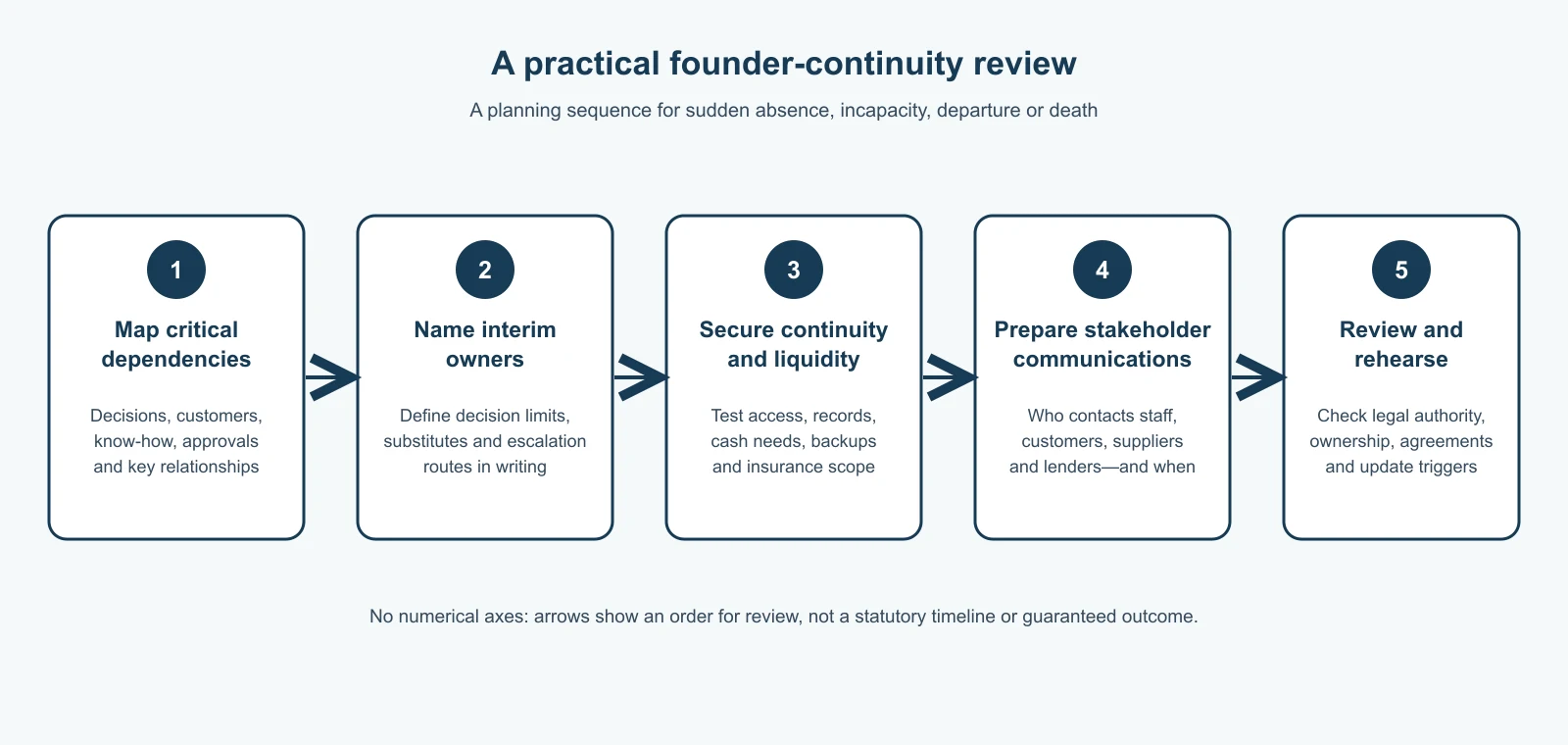
For example, if a founder approves every manufacturing release, the team can identify a trained alternate, record the approval limits, keep quality procedures current and test the handover on a routine order. This is an illustration, not a legal or insurance recommendation. Repeat the exercise for banking, customer escalation, payroll and cybersecurity recovery.
Communicate clearly if an absence occurs
Use a prepared contact tree. Confirm who is authorised to speak for the business, what can be shared, how staff should route urgent requests and how customers will receive service updates. Tell lenders, insurers, regulators or counterparties when required by the relevant agreement or law; confirm deadlines from the actual documents rather than relying on a generic checklist. Keep a record of decisions and communications during the transition.
Avoid announcing a permanent successor before the required governance steps are complete. A calm, factual interim message can explain who is managing day-to-day matters, how customers can get help and when the next update will come, without disclosing private health or family information.
A founder-continuity checklist
- Identify decisions, expertise and relationships concentrated in one person.
- Name temporary owners and backups, with clear limits and escalation routes.
- Securely document operating procedures, contacts, records and recovery access.
- Review legal authority, ownership documents, contracts, borrowing and insurance wording.
- Estimate short-term liquidity needs and test how the business would respond.
- Rehearse the plan, update it after material changes, and explain roles to relevant people.
Our article on separating business assets from personal retirement planning explores another planning issue for business owners. Business continuity, ownership succession, personal financial planning and insurance are related, but they require separate reviews.
Prepared by Abhipra Business Protection Desk for Abhipra Research / Compliance Team review.
Source Links
- SEBI, Listing Obligations and Disclosure Requirements Regulations, 2015 (amended through 22 January 2026) — board responsibilities include overseeing succession planning for listed entities.
- Ministry of Corporate Affairs, Companies Act, 2013 — see section 152 on appointment of directors.
- Abhipra, Keyman Insurance in India: Assess Business Exposure Before Choosing Cover.
Disclaimer
This article is general educational information, not legal, tax, insurance or investment advice. Company rules, authority, ownership transfers, notification duties and policy benefits depend on the entity’s documents, applicable law and contract wording. Seek advice from appropriately qualified professionals before acting.