Business Continuity Planning and Insurance: Build the Plan Before a Disruption
A power interruption, fire, cyber incident, supplier failure or loss of access to a worksite can interrupt even a well-run Indian business. Insurance may help with a defined financial loss, but it cannot tell staff what to do on the day or keep an order moving by itself. The useful question is: which activities must continue, what could stop them, and which costs would the actual policy respond to?

Start with the work that must keep moving
List the products or services customers rely on, then trace the people, premises, machines, information, utilities and suppliers each activity needs. Mark what would create a safety issue, contractual problem, cash-flow pressure or lasting customer impact if unavailable. Identify who makes each time-sensitive decision and where authorised staff can find the records they need.
For each important activity, write a practical fallback: an alternate supplier, manual process, temporary workspace, backup equipment, secure data restore or customer update. Name the owner, how to activate the workaround and what would stop it working. Keep access instructions controlled and current; do not put passwords in an open continuity plan.
The UN Office for Disaster Risk Reduction’s 2026 small-business continuity guide provides three template levels—Basic, Intermediate and Advanced—to suit differing organizational maturity, needs and resources. The levels are categories, not a performance score. The short descriptions in the visual below are illustrative planning ideas; use the source guide for its actual templates and instructions.
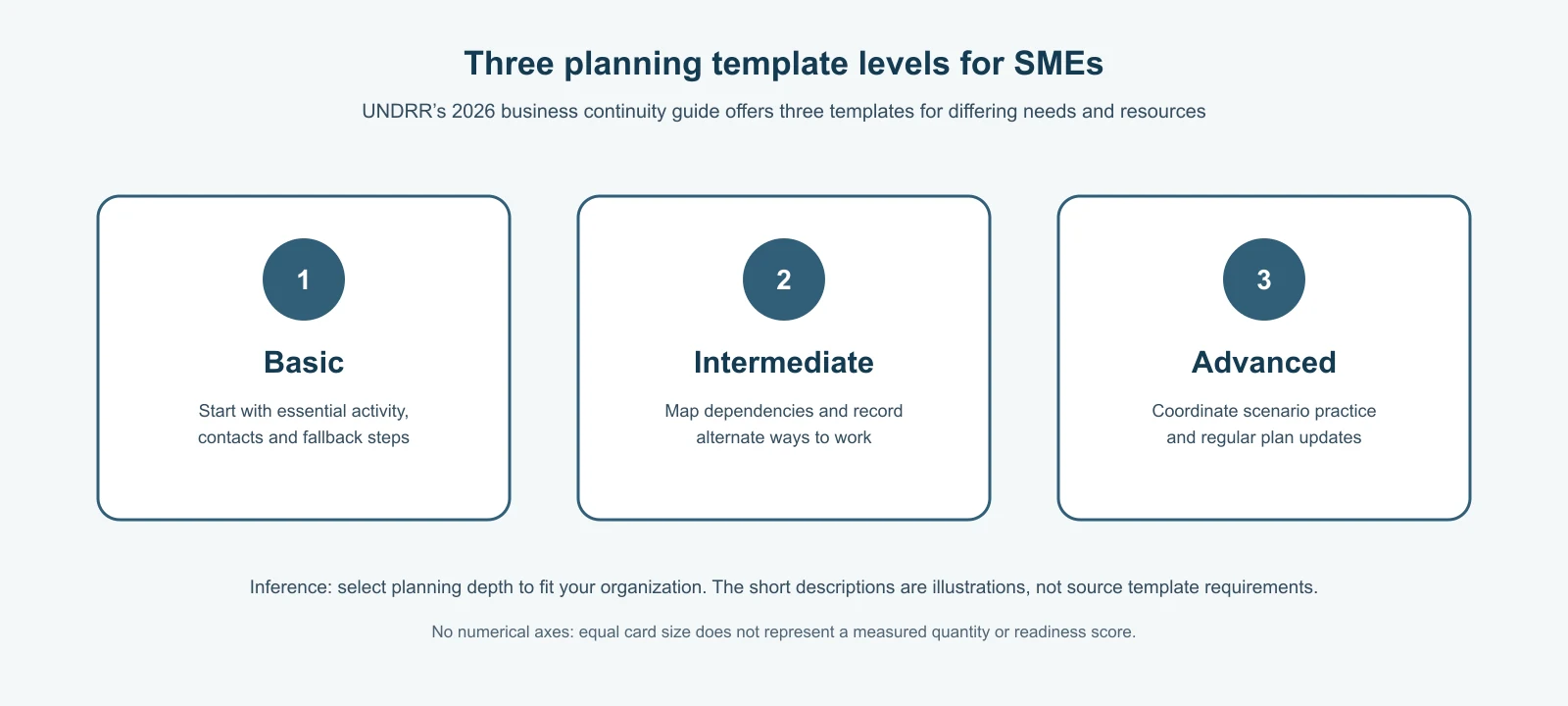
There are no numerical axes: each card represents one of the three template categories named by UNDRR. The practical inference is to start with a plan the team can use and maintain, then add detail where operational exposure and resources call for it; the labels do not certify resilience.
Match the insurance review to a disruption scenario
Separate the operational response from the possible insurance response. For each scenario, ask: what property, stock or equipment might be physically damaged? Could the business lose income or incur extra costs while it recovers? Which business premises and interests are insured? Is business interruption or consequential loss cover actually selected in the schedule, and what event triggers it? Check sums insured, sub-limits, deductibles, waiting periods, indemnity period, exclusions and claim duties against the full wording.
One published SME policy wording illustrates why this detail matters: its consequential-loss section describes interruption cover following specified physical damage to property by perils covered under a separate property policy, subject to linked policy terms, schedule limits and other conditions. That example is specific to that contract and does not establish a universal trigger. A power or supplier outage, cyber event, nearby damage, or loss of access may be treated differently by different wordings. Ask the insurer or licensed adviser to explain the actual policy and scenario in writing.
Insurance and continuity planning do different jobs. A tested workaround may help keep a critical process operating; a policy may indemnify certain covered losses after a defined event. Neither replaces the other. For a related discussion of people-dependent financial exposure, see Abhipra’s keyman insurance guide.

Use one review workflow for the plan and policy
The following sequence links a practical continuity review to the insurance documents. Its arrows show review order, not a legal deadline, claim decision or promise of recovery.
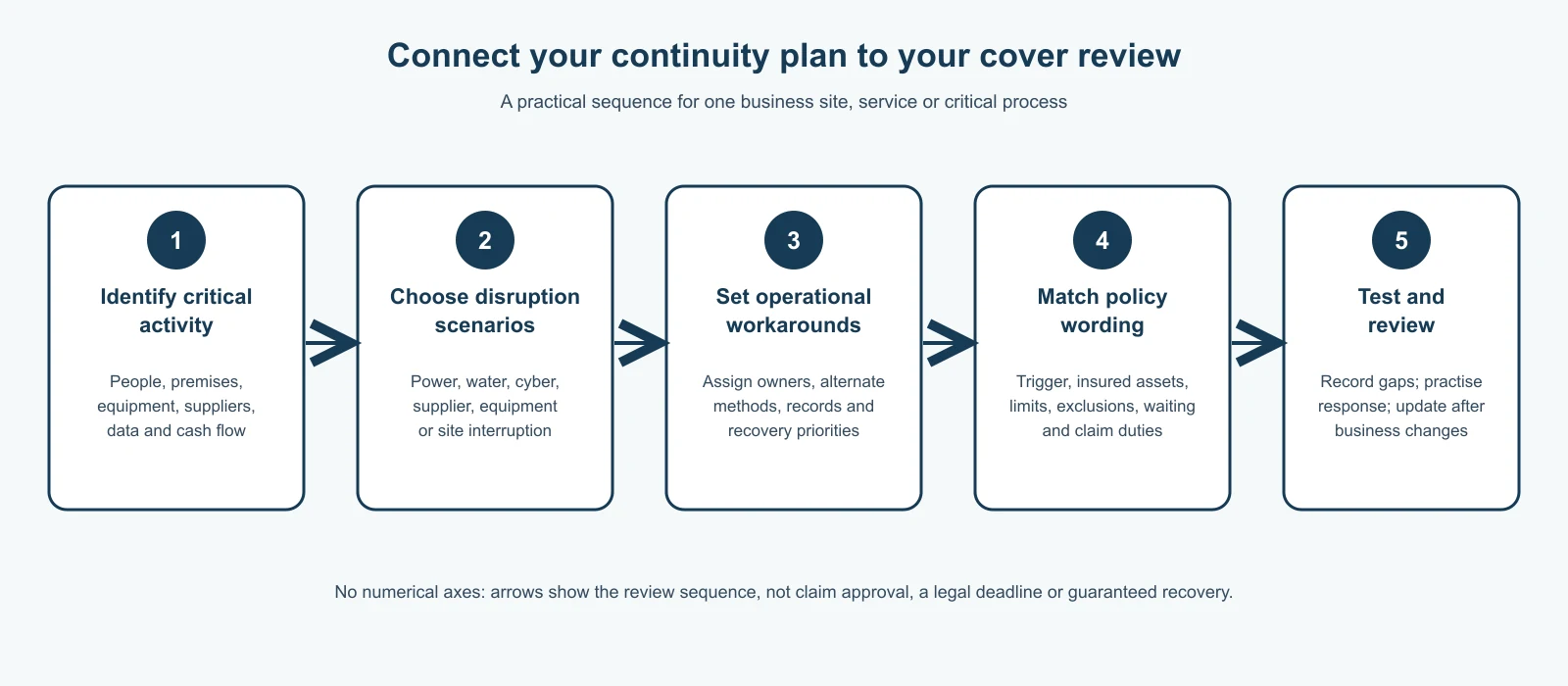
Read it from left to right: identify the work and dependencies; choose plausible disruption scenarios; assign people and fallback methods; check the exact policy trigger, limits and exclusions; then test the plan, document gaps and update it when the business changes. There are no data axes because this is a process diagram, not a quantitative chart.
Keep evidence and claim contacts ready
Store the current policy schedule and wording with an authorised contact list. Keep asset, stock, maintenance, purchase, payroll and accounting records in a secure location that can be reached if the main site is unavailable. Note the insurer’s notification channel and the records it may request. In the example SME wording linked below, notice is required when damage may give rise to a claim, and supporting business records may be requested; read the conditions and time limits in the policy actually held by the business.
During an incident, protect people first and follow emergency directions. Notify relevant authorities and the insurer when required under the applicable rules and contract. Preserve evidence where safe, record expenses and decisions, and coordinate non-urgent repairs with the insurer or surveyor where the policy requires it. Do not assume an insurance payment will be immediate or that every interruption cost is covered.
A practical continuity and insurance checklist
- Identify essential activities and the dependencies that could stop them.
- Assign an owner and backup for each activity; document safe, usable workarounds.
- Test access to records, data backups, alternate suppliers and emergency contacts.
- Compare each scenario with the property and interruption triggers in the actual policy wording and schedule.
- Record limits, exclusions, deductibles, waiting periods, indemnity period and claim notification steps.
- Rehearse the response and update the plan after changes to premises, processes, suppliers, equipment or cover.
Business continuity planning also connects to the wider owner’s financial picture. Abhipra’s MSME promoter guide discusses why the business should not automatically be treated as the owner’s only personal financial plan.
Prepared by Abhipra Business Protection Desk for Abhipra Research / Compliance Team review.
Source Links
- UNDRR, Strengthening disaster resilience of SMEs through business continuity planning: Guidance and templates (2026) — three template levels designed for differing organizational maturity, needs and resources.
- IRDAI, Standard Fire and Allied Perils Insurance Policy — regulator’s policyholder information page.
- ICICI Lombard, Business Shield SME policy wording — one contract example of consequential loss cover linked to specified property damage and policy conditions; terms may change and do not describe every policy.
Disclaimer
This article is general educational information, not insurance, legal, tax or investment advice. Cover, claim eligibility and recovery depend on the insured business, policy schedule, current wording, exclusions, limits, evidence and applicable law. Review the documents with the insurer or an appropriately licensed and qualified adviser before acting.