Fire and Property Insurance for Businesses: Build the Record Before You Need It
For a business, a fire or other covered property event can affect more than a building. It may interrupt access to stock, machinery, records, suppliers and customer commitments. Property insurance can be one part of the response, but it works best when the business has accurate records, knows what is actually declared and maintains practical risk controls.

Start with what the business could lose
Make a location-wise asset list before comparing any policy. Separate the building, plant and machinery, furniture and fixtures, stock, work in progress and property that belongs to a customer or supplier. Identify what would have to be repaired, replaced or documented before operations could resume.
IRDAI notes that a Standard Fire and Allied Perils policy generally addresses a range of property perils, including fire, riot, flood and storm. Exact cover depends on the specific product, schedule, endorsements, definitions, exclusions and conditions. A business should not assume that every asset, cause of loss, interruption cost or location is automatically included. IRDAI’s non-life insurance guidance explains the general property-insurance context.
| Record to verify | Why it matters | Practical evidence |
|---|---|---|
| Location and occupancy | A policy schedule must describe the right premises and use. | Lease/title record, address, site photos and process description. |
| Asset and stock list | The declared property should reflect what the business actually has. | Fixed-asset register, stock records, invoices and dated photographs. |
| Value basis | Replacement and market-value approaches can produce different outcomes. | Valuation basis, purchase records and current replacement evidence. |
| Scope and limits | Perils, sub-limits, deductibles and exclusions affect the claim response. | Policy schedule, wording, endorsements and written insurer clarification. |
| Safety and maintenance records | Controls can reduce loss and support a factual incident record. | Inspection logs, service reports, training and incident records. |
IRDAI describes market value and reinstatement value as two approaches for valuing certain property. It also says reinstatement value is generally for fixed assets, not stock or stock in process, and is subject to the policy terms and sum insured. That is a reason to ask which value basis applies to each insured item—not a reason to assume an amount will be paid. Read IRDAI’s explanation of asset valuation and premium factors.
Read the wording before treating a risk as covered
The policy schedule is not a substitute for the wording. Review the named insured, premises, property descriptions, policy period, insured values, perils, exclusions, deductibles, conditions and each endorsement. If a business depends on one site, specialised equipment, seasonal stock or customer-held goods, ask for an explanation of how those facts are reflected in the documents.
Premium is not a proxy for protection. IRDAI says fire-policy cost can depend on the perils selected, the value of property, premises use, location, construction and occupancy, among other factors; insurer pricing may differ. Compare the scope and evidence requirements as well as the commercial terms. IRDAI’s consumer guidance is a useful starting point.
Turn records into a claims-readiness routine

The two photographic scenes show a fictional business carrying out preventive documentation. They are illustrative editorial images, not an insurer, customer or endorsement.
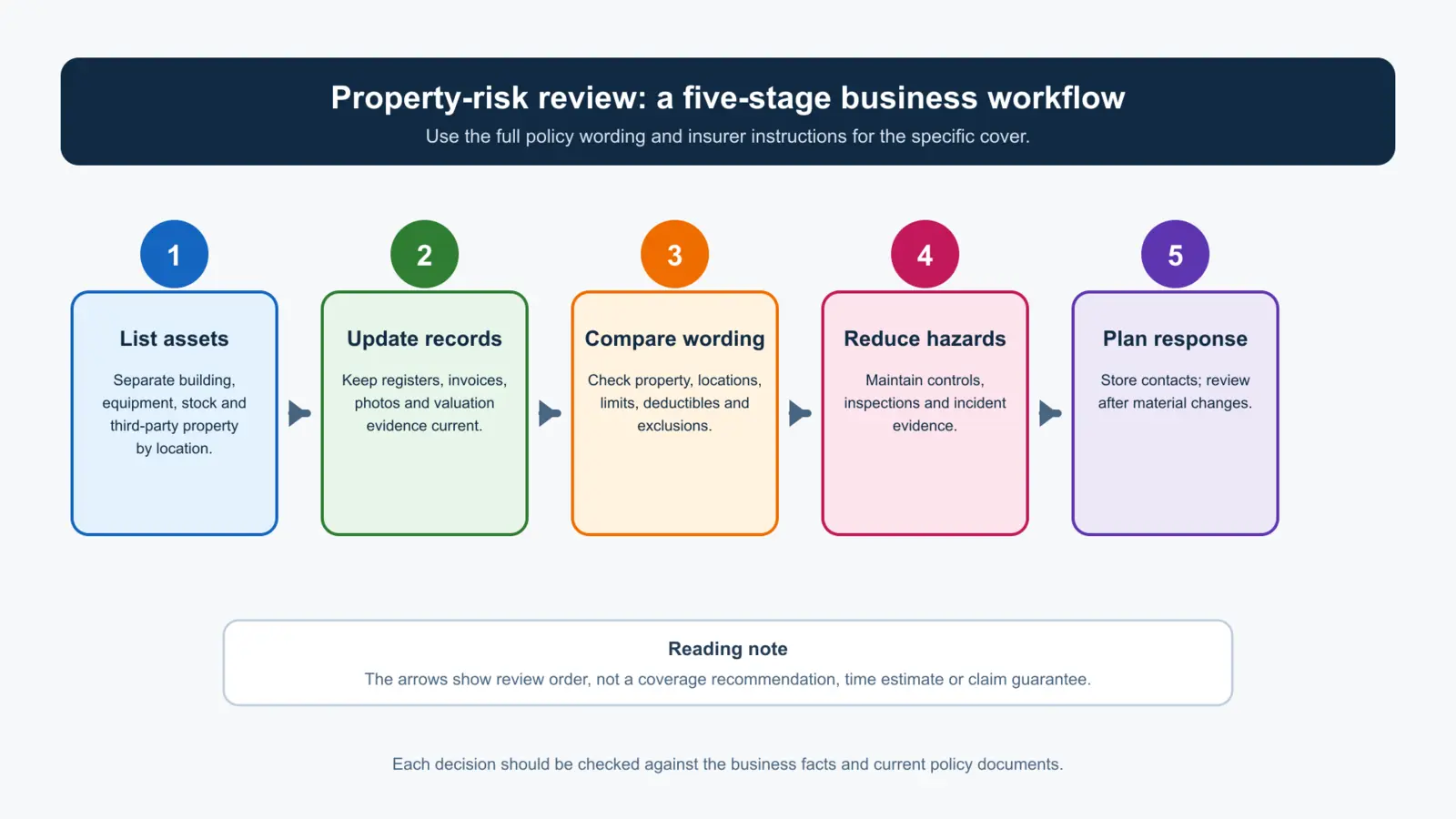
The workflow is a sequence, not a data chart: first list property by location; then update values and supporting records; match the schedule and wording to the facts; maintain site controls and evidence; and finally keep claims contacts and review triggers available. Its inference is simple: a policy document and a business record system need to stay aligned.
- List buildings, equipment, stock and third-party property separately for every location.
- Keep invoices, registers, photos, maintenance records and a contact list in a secure, accessible place.
- Compare the facts against the policy schedule and wording at renewal and after a material change.
- Follow site-safety procedures and, after an incident, prioritise life safety and follow the insurer’s documented notification instructions.
- Preserve factual records; do not repair, dispose of or make admissions beyond what is necessary for safety without checking the policy process and insurer directions.
Common mistakes to avoid
- Using an old asset list after equipment, stock, premises or business use has changed.
- Treating a broad policy name as proof that every event or consequential loss is covered.
- Combining fixed assets and stock without checking the value basis and policy descriptions.
- Relying only on cloud folders that a site team cannot access during disruption.
- Assuming a safety certificate, insurer inspection or premium quote guarantees claim acceptance.
- Waiting for a loss before locating the schedule, wording, endorsements and claims contact route.
A practical review checklist
- Confirm the legal entity, locations and business activity shown in the proposal and schedule.
- Reconcile insured property with the fixed-asset register, current stock data and responsibility for third-party property.
- Ask for the relevant wording and endorsements; flag any ambiguity in writing before renewal or a change in risk.
- Record the valuation basis, sum insured, deductible and any sub-limit for each material class of property.
- Keep authorised contact details, safety records and evidence backups under appropriate access controls.
- Revisit the file after relocation, expansion, a major asset purchase, a change in occupancy, material stock increase or a significant process change.
For a document-led business-protection discussion, use Abhipra’s Contact page. A business should obtain advice tailored to its own policy wording, assets, safety duties and legal obligations.
Source links
- IRDAI: Non-life insurance and property-insurance guidance — property-interest, product context, valuation approaches and premium factors.
- IRDAI: Standard Fire and Allied Perils policyholder resource — policyholder reference for the standard fire-policy context.
- IRDAI: Filing of fire insurance products for dwellings, micro and small businesses — current regulator circular index reference.
- Insurance Act, 1938, section 64UM — statutory context for surveyors and loss assessors in general insurance.
Disclaimer
This article is for general business and insurance education. It is not a recommendation to buy insurance, legal or tax advice, or a guarantee that any claim will be paid. Product availability, pricing, underwriting, benefits, exclusions, deductibles, valuation, safety obligations and claim outcomes depend on the applicable law, proposal disclosures and policy wording. Read the full policy and obtain suitably qualified advice before making a decision. The photographs are original illustrative images of fictional people and do not imply endorsement.
Reviewed by Abhipra Research / Compliance Team.