Why You Should Not Stop SIPs During Market Falls
When markets fall, many investors feel that stopping a SIP is the safest action. The logic sounds simple: pause now, restart when things look better. In practice, that decision can quietly damage the very discipline for which the SIP was started.
A Systematic Investment Plan is not a promise of returns and it does not remove market risk. Its real strength is behavioural: it keeps investment linked to cash flow and reduces the pressure to predict the perfect entry date.

A Falling Market Is Not Automatically A SIP Failure
Market-linked investments can move down for weeks, months or longer. That does not mean the SIP mechanism has failed. It means the underlying asset class is volatile.
If the goal is long term, the emergency fund is intact, and the selected fund remains suitable, a fall may be the period when the SIP buys more units for the same rupee amount. Stopping the SIP at that point can interrupt the averaging process.
How Rupee Cost Averaging Works
With a fixed SIP amount, the number of units purchased changes with NAV. When NAV is lower, the same monthly amount buys more units. When NAV is higher, it buys fewer units. This is the basic discipline behind rupee cost averaging.
The illustration below uses a fixed Rs 5,000 SIP and sample NAV levels. It is not a return forecast and does not represent any specific mutual fund scheme.
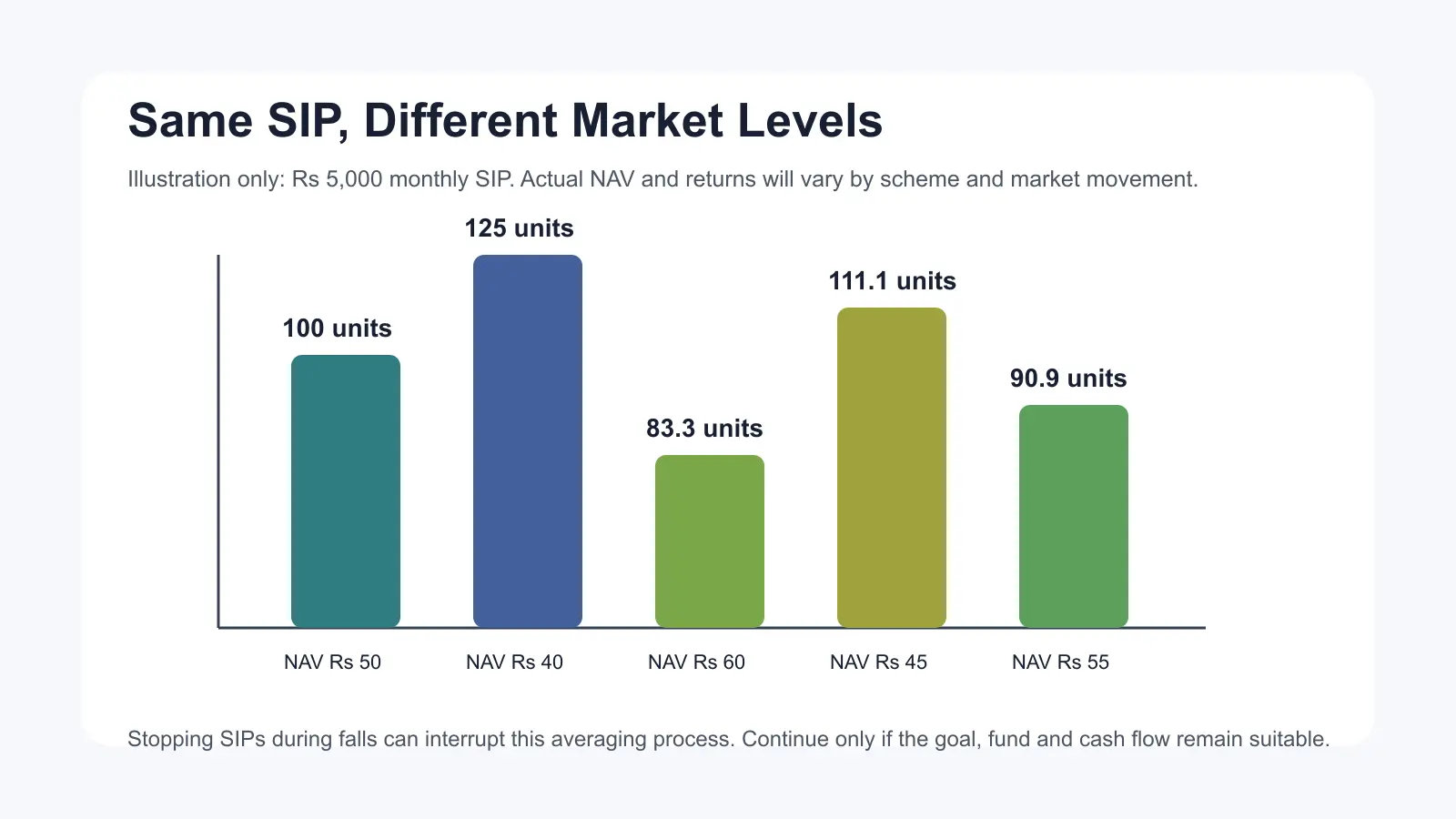
| Monthly SIP amount | Illustrative NAV | Units purchased | What it shows |
|---|---|---|---|
| Rs 5,000 | Rs 50 | 100.0 | Regular purchase at the starting sample NAV. |
| Rs 5,000 | Rs 40 | 125.0 | Lower NAV buys more units for the same amount. |
| Rs 5,000 | Rs 60 | 83.3 | Higher NAV buys fewer units. |
| Rs 5,000 | Rs 45 | 111.1 | Volatility can average the purchase cost over time. |
When Continuing A SIP Makes Sense
Continuing a SIP during a market fall may be sensible when the investment goal is still valid, the time horizon is long enough, the fund category suits the goal, and the investor has enough emergency liquidity.
It is also important to review whether the original fund selection was sound. SIP discipline cannot fix an unsuitable fund, wrong category, excessive risk, poor cash-flow planning or lack of emergency fund.

The desk review shows the sequence an investor should follow before reacting: check the goal, emergency fund, time horizon, scheme category, risk level and SIP affordability. If these remain aligned, the decision should be planned rather than emotional.
When Pausing May Be Reasonable
There are situations where pausing or reducing a SIP can be reasonable:
- Income has reduced or become uncertain.
- Emergency fund is inadequate.
- The goal has changed or is now near-term.
- The selected fund no longer fits the investor's risk profile.
- The investor is overexposed to one category or theme.
The issue is not whether a SIP must continue at all costs. The issue is whether the decision is based on cash flow and suitability, or only on fear after markets have already fallen.
Common Mistakes
The first mistake is stopping SIPs after a fall and restarting only after the market has recovered. This can mean missing the lower-NAV purchase phase.
The second mistake is increasing SIPs aggressively during falls without checking emergency liquidity. Market opportunity should not come at the cost of household stability.
The third mistake is treating every fund equally. A diversified equity fund, sector fund, thematic fund and debt-oriented fund can behave very differently.
Investor Checklist
- Confirm the goal and time horizon.
- Keep emergency money separate from investment money.
- Check whether the fund category still matches the goal.
- Review asset allocation before stopping or increasing SIPs.
- Avoid reacting only to recent market movement.
- Speak to an adviser if the fall has changed your risk comfort.
For SIP planning, mutual fund selection or portfolio review support, connect with Abhipra's Wealth Planning Desk through Abhipra's contact page.
Source Links
- AMFI: Mutual fund and NAV information
- SEBI: Master Circular for Mutual Funds
- SEBI: Investor website
Reviewed by Abhipra Research / Compliance Team.
Disclaimer
This article is for educational and informational purposes only. It is not investment advice, tax advice, a mutual fund recommendation or a promise of returns. SIP does not assure profit or protect against loss in falling markets. Mutual fund investments are subject to market risks. Investors should read all scheme-related documents carefully and evaluate suitability, risk appetite, investment horizon, liquidity needs and tax position before making investment decisions.