Why SME IPOs Have Become an Important Capital-Raising Route for Indian SMEs
Reviewed on: 23 September 2026. Prepared by Abhipra RTA Desk for editorial and compliance review.
An SME initial public offering (IPO) can give an eligible, growth-oriented business access to public equity capital and a regulated listing platform. It also brings disclosure, governance, investor servicing and continuing compliance responsibilities. Recent SEBI data shows more SME listings and a higher average issue size, but an IPO is suitable only when its cost, dilution, readiness and long-term obligations make sense for the company.

Why growing companies consider the SME platform
A growing business may need capital for capacity, technology, working capital, product development, acquisitions or expansion into new markets. An IPO that includes a fresh issue can raise money for stated corporate purposes. An offer for sale (OFS), by contrast, sells shares held by existing shareholders; those proceeds go to the selling holders, not to the company. An issue may combine the two, so the offer document matters.
An SME exchange platform creates a route for eligible smaller issuers to access public markets under a framework designed for that segment. It can broaden visibility and create a transparent market-based reference for shares. A listing can also support future financing conversations, acquisitions or employee ownership planning, depending on the business and the applicable rules.
These are possible strategic outcomes, not promises. A listing does not guarantee demand, a particular valuation, future fundraising, easy trading or a profitable exit. Market prices can move sharply, and trading depth in individual SME securities may be limited.
What recent SME IPO data tells issuers
SEBI’s Annual Report 2025–26 records 257 SME-platform listings during FY 2025–26, which mobilised ₹11,587 crore. The report says this amount was 18.1% higher than in FY 2024–25. Average issue size rose from ₹40.7 crore in FY 2024–25 to ₹45.1 crore in FY 2025–26.
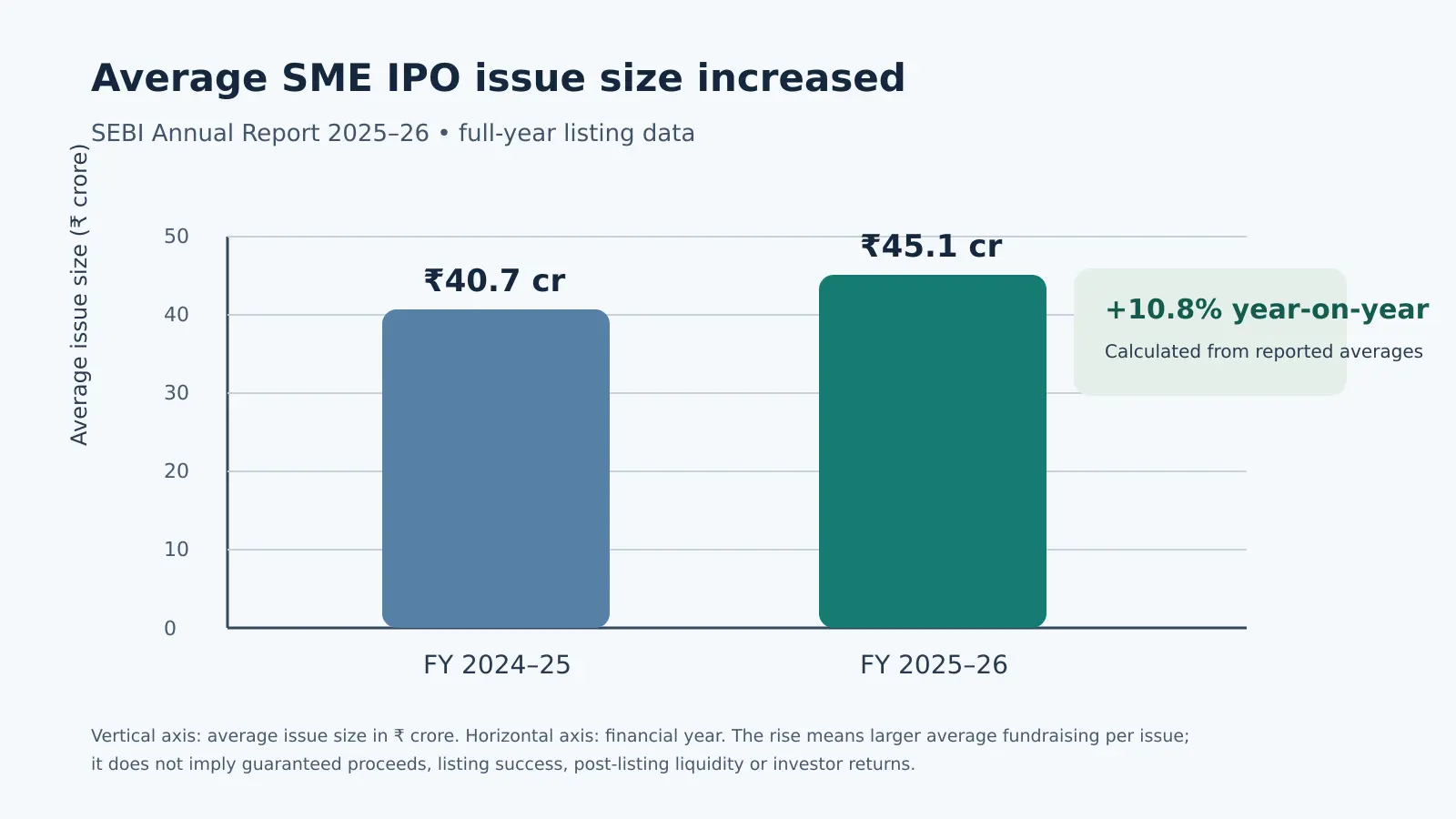
The chart’s horizontal axis is financial year; its vertical axis is average issue size in rupees crore. The reported averages imply an increase of about 10.8% year-on-year. This describes the average size of issues listed in those years. It does not show a typical company’s eligibility, the probability of a successful offer, post-listing performance or investor returns. The annual report’s 257 listings and ₹11,587 crore raised show that the SME platform is an active capital-raising route, while each issuer still needs to test whether public capital is the right fit.
| SEBI Annual Report 2025–26 measure | Reported figure |
|---|---|
| SME-platform companies listed in FY 2025–26 | 257 |
| Capital mobilised in FY 2025–26 | ₹11,587 crore |
| Change in amount raised from FY 2024–25 | +18.1% |
| Average issue size, FY 2024–25 | ₹40.7 crore |
| Average issue size, FY 2025–26 | ₹45.1 crore |
Readiness involves more than the offer document
Before committing to a public issue, the board and promoters should be clear about the business case, intended use of proceeds, dilution, ownership transition and continuing cost of being listed. The issuer also needs a reliable information base: reconciled financial and share-capital records, a clear capitalisation table, security-class and ISIN details where relevant, material contracts, litigation and related-party information, and well-supported disclosures.
Eligibility is governed by the SEBI ICDR Regulations and the current criteria of the chosen exchange. The criteria and issue rules can change. The applicable exchange reviews the issuer against its listing requirements; SEBI and exchange review processes do not turn an offer into an endorsement of the issuer or a guarantee of listing. A merchant banker and other appropriately qualified advisers should confirm the current route against the company’s facts.
The issuer should also plan for dematerialised holdings and clean depository records across relevant stakeholders, with timing and scope confirmed under current requirements. A Registrar to an Issue and Share Transfer Agent (RTA) may support the issue and related investor servicing within its appointment and agreed scope. The RTA does not replace the merchant banker, company secretary, statutory auditor, legal counsel, valuation professional or exchange review.

A practical preparation sequence
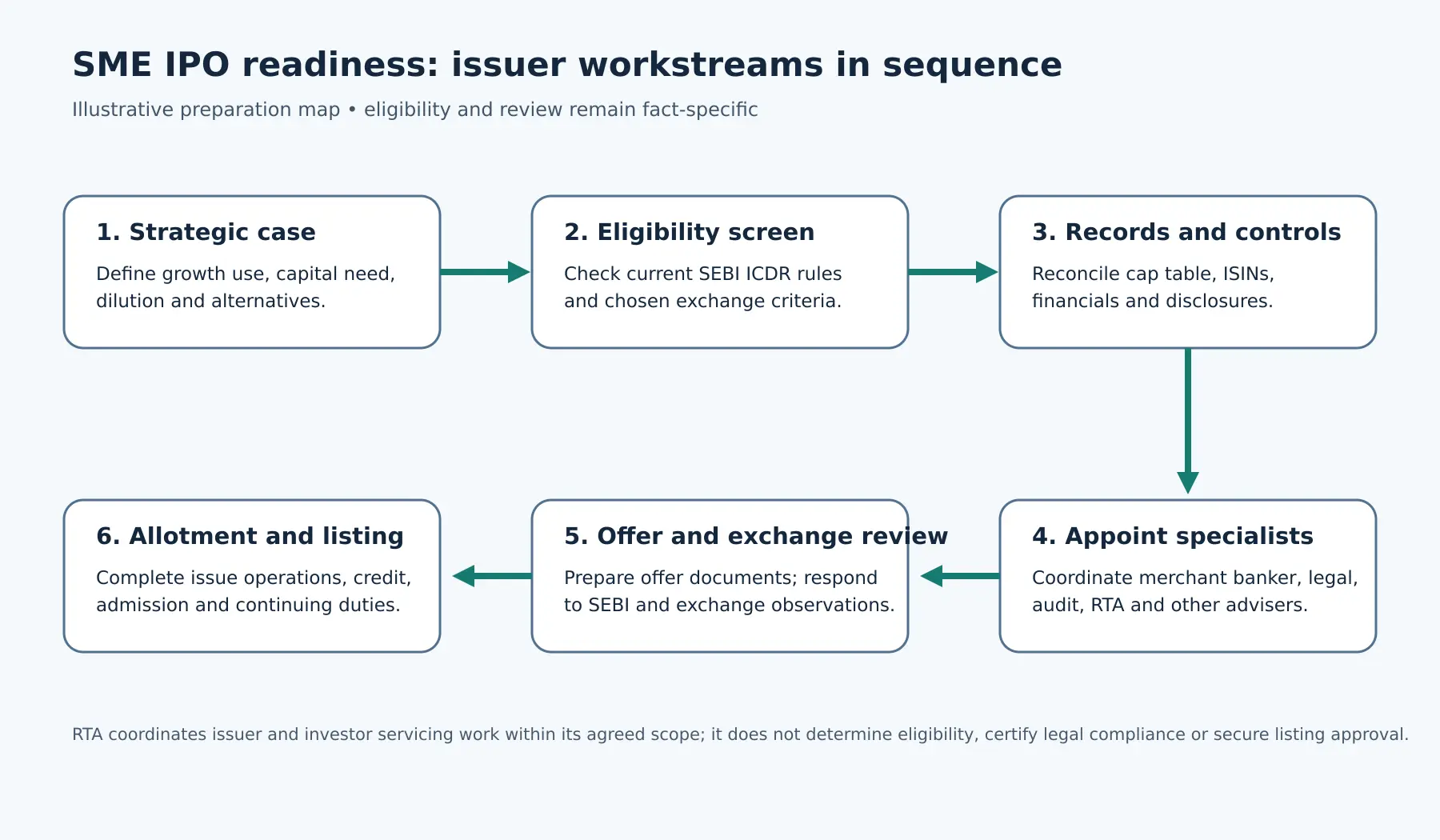
The workflow moves from the board’s strategic case to a current eligibility screen, then to record readiness and adviser appointments. Offer-document preparation and exchange or regulatory observations follow; issue operations, allotment, demat credit, admission and continuing duties complete the cycle. Some workstreams can run in parallel, but a material discrepancy or unresolved eligibility question can change the timetable. The RTA coordinates the servicing tasks assigned to it and does not decide eligibility or secure approval.
A board-level readiness discussion can start with these questions:
- What specific growth requirement needs equity capital, and why are other funding routes insufficient or less suitable?
- How much capital is required, what proportion is proposed as fresh issue, and how will proceeds be tracked against disclosed purposes?
- Are audited financials, tax and statutory records, promoter and shareholder details, and related-party disclosures complete and consistent?
- Are share capital, existing securities, demat holdings, ISINs and corporate actions reconciled across company and depository records?
- Can leadership sustain public reporting, investor communication, governance and compliance obligations after listing?
- Have the board and advisers verified current SEBI ICDR requirements and the selected exchange’s latest eligibility and process criteria?
Common planning errors
- Treating the SME route as a shortcut around eligibility, due diligence or disclosure requirements.
- Mixing up fresh-issue proceeds with money paid to shareholders in an OFS.
- Relying on old exchange criteria, stale templates or another issuer’s offer document instead of checking current requirements.
- Leaving capital, beneficial ownership, litigation, contracts or financial inconsistencies until the offer-document stage.
- Assuming market making ensures continuous liquidity or that a listing will produce a desired valuation.
- Treating the appointment of an RTA or dematerialisation work as a substitute for the company’s wider readiness and compliance responsibilities.
How Abhipra can assist
An issuer preparing for an SME IPO or main-board IPO may need an RTA workstream for issue operations and investor servicing. Abhipra can discuss the scope and coordination needs for that workstream. The proposed platform, eligibility, merchant-banker advice and regulatory approvals remain subject to the applicable framework and professional review.
Preparing for an SME IPO or main-board IPO and need a Registrar-to-an-Issue/RTA workstream? Contact Abhipra RTA Services at rtaservices@abhipra.com, call 011-42390783, or contact +91-9818080700. For an initial operational discussion, share the company name, proposed platform, latest audited financial year, capital structure, approximate shareholder count, existing ISINs and target issue timeline. Do not send passwords, OTPs, unmasked PAN, bank details or sensitive KYC files by ordinary email.
Source links
- SEBI Annual Report 2025–26, Chapter 3: Primary Markets — SME listing, capital mobilisation and average issue-size data.
- SEBI ICDR Regulations, 2018, last amended 21 March 2026 — current consolidated regulatory baseline checked for this article.
- NSE Emerge eligibility criteria — exchange criteria; verify the live requirements for the intended platform and filing date.
- NSE Emerge requirements and process — exchange process page, updated 29 April 2026 when checked.
- NSE Emerge trading system — trading features and market-making context.
Disclaimer
This article is for general educational information and does not constitute legal, tax, investment or transaction advice. Applicability depends on the company's and investor's facts and on the law, circulars and depository instructions in force on the relevant date.