Why Reconciliation and Investor Data Quality Matter Before Filing for an IPO
Reviewed on 22 September 2026 by Abhipra RTA Desk.
Before an IPO filing, the issuer should be able to explain how authorised, issued, subscribed and paid-up capital moved from incorporation to the proposed offer. Every allotment, transfer, conversion, buyback, split, bonus, employee award, pledge and dematerialisation record should connect to an approval, filing, register, depository record and financial statement where applicable.

Reconciliation is an evidence chain, not a spreadsheet exercise
The SEBI ICDR framework requires capital-structure and offer-document disclosures to be prepared for the applicable issue route. The consolidated regulations were last amended on 21 March 2026. The capital-structure work should therefore start with source records and end with a versioned explanation that the company, registrar, auditors, legal counsel and merchant banker can review.
Do not treat the latest cap-table export as the historical record. Build a dated security-class register and reconcile it to the statutory register of members, board and shareholder resolutions, allotment and transfer records, filed returns, share certificates where relevant, depository balances, PAS-6 or other applicable reconciliations, audited financial statements and the current offer-document draft. SEBI ICDR Regulations.
Establish the opening position by security class
For each class, record authorised, issued, subscribed and paid-up capital, face value, premium, voting rights, ISIN, whether listed or unlisted, and whether held in physical or dematerialised form. Keep equity, preference shares, convertibles, options and other rights in separate schedules. A single total can hide a class-level mismatch.
Record the opening balance at an agreed date, then roll forward every movement. Each movement should identify date, quantity, consideration, allottee or transferee, source approval, filing or return, certificate or depository reference, and the resulting balance. If the company changed its denomination, name, capital structure or security rights, preserve the before-and-after evidence.
Reconcile movements and exceptions
Common movements include incorporation allotments, private placements, rights, bonus issues, employee schemes, transfers, transmissions, buybacks, splits, consolidations, conversions and fresh issue allotments. Compare the movement ledger with bank evidence, contracts, board minutes, member resolutions, filings and depository or RTA records as appropriate.
Create an exception log rather than forcing a balance. Classify each exception as a quantity difference, name or folio mismatch, missing approval, missing filing, timing difference, duplicate entry, unconverted instrument, pledge or encumbrance issue, or unresolved legal question. Assign an owner, source request, materiality assessment and resolution date. Preserve superseded versions.
Keep fresh issue, offer for sale and transfers separate
An illustrative example makes the distinction clear. Suppose an issuer has 10 million issued equity shares before filing, proposes a 2 million-share fresh issue and includes a 1 million-share offer for sale. The fresh issue increases issued capital to 12 million shares; the OFS transfers existing shares and does not itself increase issued capital. The example is fictional and does not establish an offer structure or eligibility.
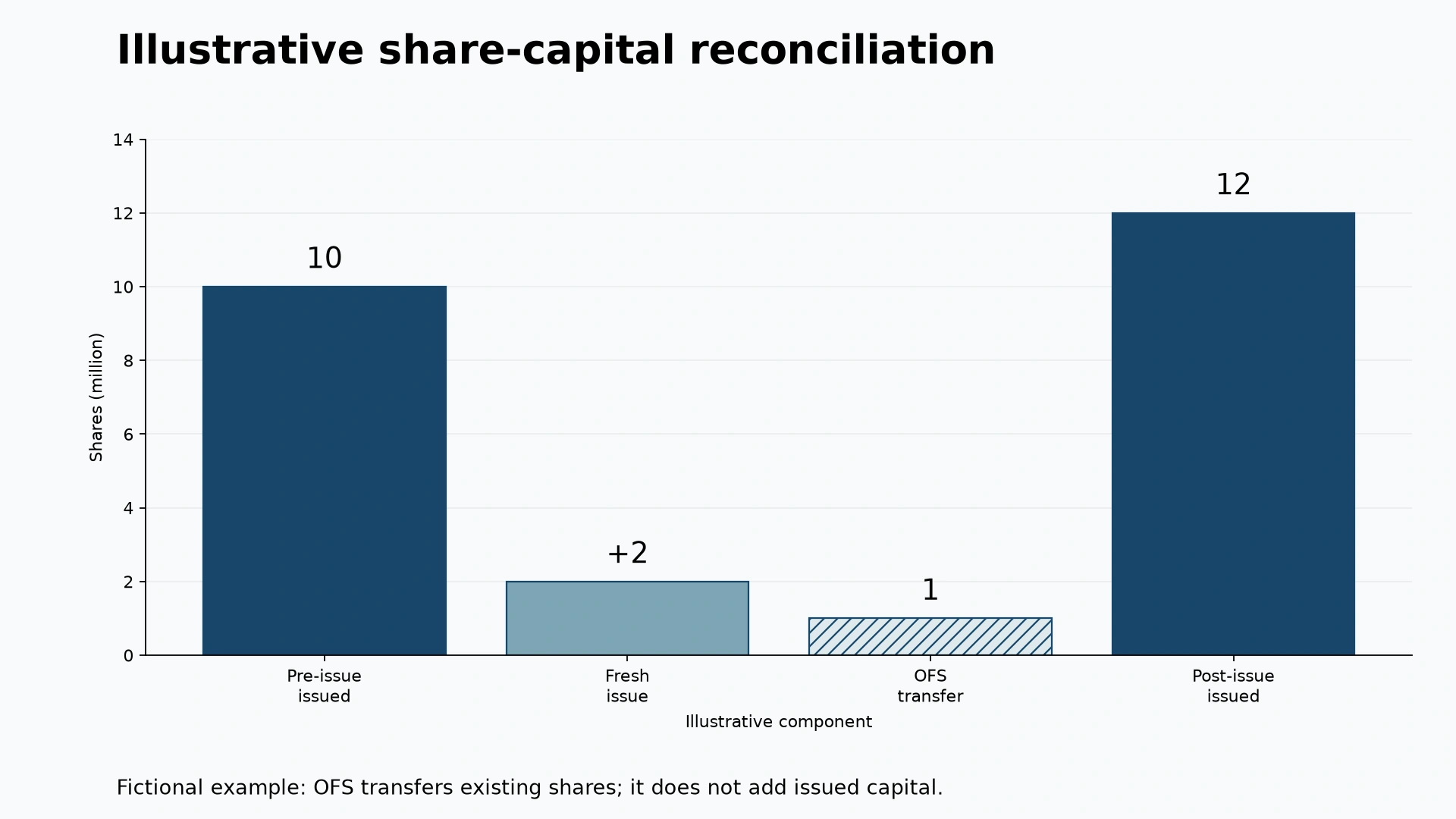
| Component | Shares (million) | Effect on issued capital |
|---|---|---|
| Pre-issue issued shares | 10 | Opening balance |
| Fresh issue | 2 | Increases by 2 |
| Offer for sale | 1 | Transfer; no increase |
| Post-issue issued shares | 12 | 10 + 2 |
Axes: the horizontal axis lists the illustrative components and the vertical axis measures shares in millions from zero. The bar for OFS is shown with a transfer pattern so it is not mistaken for new capital.
Inference: a reconciliation should show both the arithmetic and the legal nature of each movement. In this example, the post-issue issued balance is driven by the fresh issue; the OFS requires ownership and selling-shareholder checks but does not add shares to issued capital. Actual issue documents require issuer-specific calculations and review.
Align investor data before the offer document is locked
Match holder name, folio or demat account, quantity, class, joint-holder order, PAN or entity identifier as permitted, acquisition or allotment date, pledge or encumbrance flag and beneficial-owner information where relevant. Restrict sensitive identifiers to authorised reviewers and use secure transfer channels.
Compare the RTA register with depository files and issuer records using documented cut-off dates. Keep a separate controlled list for pending dematerialisation, rejected transfers, unclaimed or disputed holdings, transmission cases, frozen accounts and records requiring investor confirmation. A clean total does not prove that every underlying holder record is correct.
Use a controlled reconciliation workflow
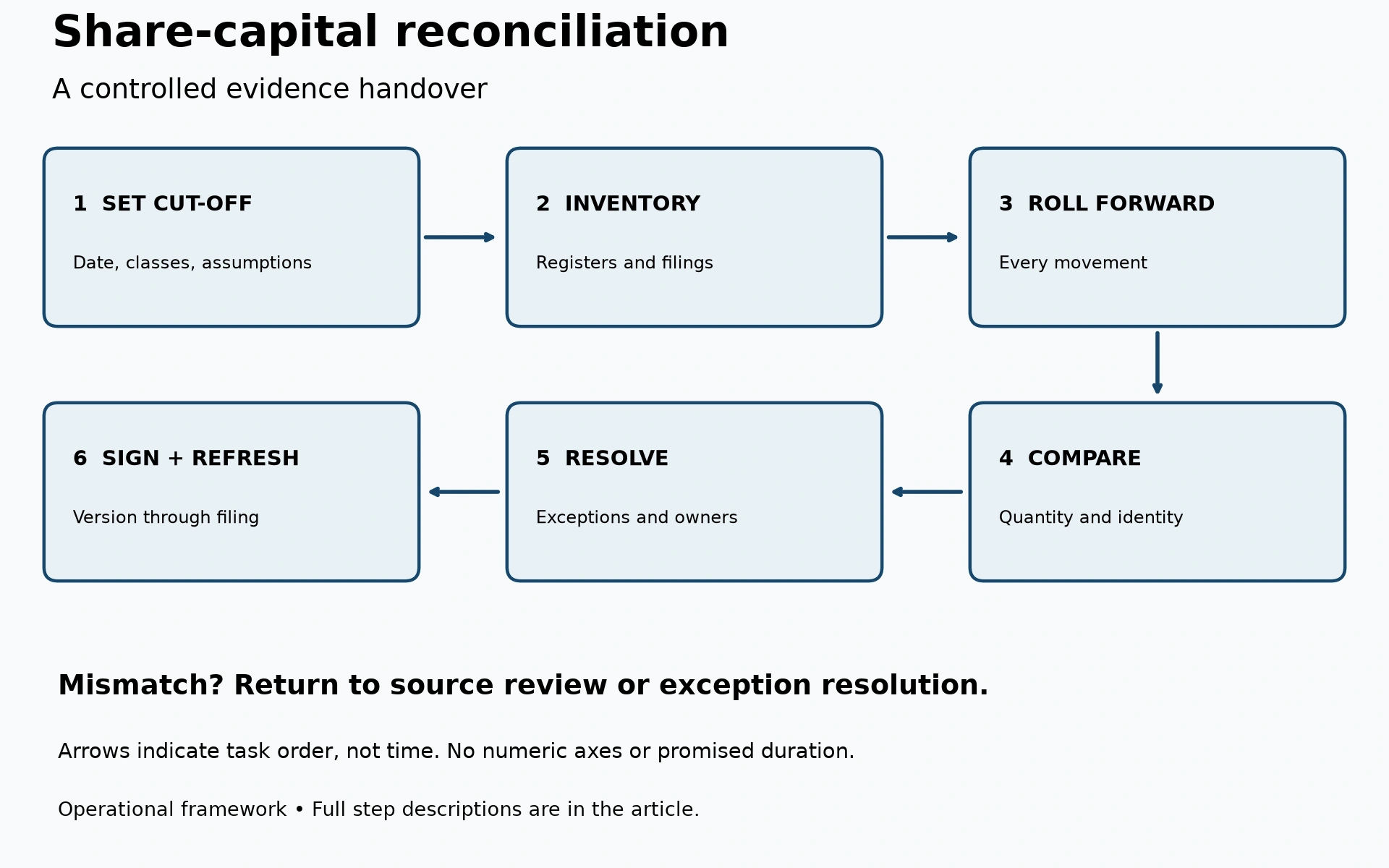
- Set the cut-off: approve the date, security classes and issue assumptions.
- Inventory sources: list registers, resolutions, filings, certificates, depository files, RTA extracts and financial records.
- Roll forward: enter every allotment, transfer, conversion, split, bonus, buyback and dematerialisation movement.
- Compare: run quantity, identity, date, class, premium and ownership checks across sources.
- Resolve: assign exceptions and obtain company-secretarial, legal, audit, RTA or DP conclusions as needed.
- Sign and refresh: preserve the versioned reconciliation and refresh it when capital or holder data changes.
The arrows show process order, not duration. The six numbered steps are the complete text alternative for the workflow image. A failed comparison returns to source review or exception resolution; it should not be hidden in an adjusted total.

Common reconciliation failures
- Treating authorised capital as issued or paid-up capital.
- Adding OFS shares to post-issue issued capital.
- Omitting employee awards, conversions, splits, bonus issues or recent private placements.
- Using a depository balance to replace the company’s historical allotment evidence.
- Combining a name mismatch, quantity mismatch and legal ownership dispute into one note.
- Circulating unmasked PAN, bank details, signatures or full KYC records by ordinary email.
How Abhipra can assist
Preparing for an SME IPO or main-board IPO and need an RTA workstream? Abhipra can discuss shareholder-record reconciliation, demat and ISIN coordination, and an operational evidence index for the appointed advisers. Capital history, investor identity, materiality, eligibility and offer disclosures remain subject to issuer-specific professional review.
Contact Abhipra RTA Services, call 011-42390783 or +91-9818080700. Share only the company name, entity type, proposed platform, broad capital structure, shareholder count, existing ISINs and target timeline initially. Wait for a secure submission method before sending sensitive records. Do not email passwords, OTPs, unmasked PAN, bank details or signatures.
Source links and review date
The SEBI ICDR consolidated regulations, Companies Act text and NSE public-issue guidance were checked on 22 September 2026. Companies Act, 2013 — India Code. NSE public-issue eligibility. Recheck current amendments, exchange instructions, depository requirements and the applicable issue route at the filing date.
Disclaimer
This article is general educational information and does not constitute legal, tax, accounting, investment or transaction advice. Applicability depends on the issuer’s facts and the law, regulations, circulars and exchange or depository instructions in force on the relevant date. Capital history, ownership, reconciliation, materiality, eligibility and offer disclosures require review by the company secretary, legal counsel, auditors, merchant banker, RTA, DP and other appointed advisers. The numerical example is fictional. Photographs are original AI-generated illustrations featuring fictional professionals.