Related Parties, Group Companies, Material Contracts and Litigation: Building the IPO Data Room
Reviewed on 21 September 2026 by Abhipra RTA Desk.
An IPO data room should let the issuer and appointed advisers trace every material relationship, contract and dispute to a source record, owner and disclosure decision. Start with a complete population of group companies, related parties, material contracts and litigation, then reconcile it with the offer document, accounts, board records and capitalisation table.

Define the population before collecting files
“Related party”, “group company”, subsidiary, associate, promoter group and material contract are connected concepts but are not interchangeable. The issuer should document the definition and look-back period used for the actual issue route and offer document. Include entities and relationships that may affect control, management, revenue, assets, financing, intellectual property or investor risk, then have the company secretary and legal counsel test the scope.
The SEBI ICDR Regulations, 2018, consolidated through 21 March 2026, contain route-specific eligibility and disclosure requirements. NSE’s public-issue guidance separately asks issuers to address the litigation record and status of the applicant, promoters, promoting companies, group companies and companies promoted by them. These are source anchors for a preparation process; they do not replace the appointed merchant banker’s due diligence. SEBI ICDR Regulations · NSE listing criteria.
Create a relationship and ownership map
Maintain a dated entity register containing legal name, CIN or foreign identifier where applicable, incorporation jurisdiction, ownership percentage, control rights, directors, key management links, business activity, auditor, financial year and status. Link each row to constitutional documents, filings, audited accounts, shareholding records and the latest group structure approved by the Board.
Reconcile this map with the cap table, promoter-group declarations, shareholder agreements, joint ventures, family settlements and changes in control. A mismatch should become an open issue with an owner and resolution evidence. Do not infer that a dormant, overseas or minority-owned entity is irrelevant without documenting the conclusion.
Maintain a related-party and transaction register
Use the Companies Act, 2013 and the applicable accounting and securities framework together. Sections 184, 188 and 189 address disclosure of directors’ interests, related-party contracts or arrangements and the register of contracts in which directors are interested. The actual applicability, approvals, exemptions and accounting treatment require professional review.
For each transaction, capture parties, relationship, nature, date, term, pricing basis, outstanding balance, guarantees or security, approvals, financial-statement treatment and offer-document location. Include recurring service arrangements, loans, leases, intellectual-property licences, management fees, guarantees, commission arrangements and transactions routed through intermediaries. Preserve the signed agreement and amendments, not just a spreadsheet summary.
Identify material contracts with a defensible test
Ask the finance, legal, operations and company-secretarial owners to propose contracts that are material by value, duration, dependence, exclusivity, change-of-control effect, intellectual-property importance, financing impact or business continuity. Record the reason for inclusion or exclusion. The same contract may be material because losing it would disrupt the business even when its rupee value is modest.
For every selected contract, store the executed version, amendments, parties, effective and expiry dates, termination rights, renewal, assignment, exclusivity, indemnities, confidentiality, governing law, dispute clause, change-of-control provisions and consent status. Flag unsigned term sheets, side letters, oral arrangements and missing schedules for counsel. Never summarise a contract in the data room without retaining the source.
Build a litigation and regulatory-matter register
The register should cover the issuer, subsidiaries, associates, promoters, promoting companies, group companies and relevant directors, using the scope agreed with counsel. Capture forum, case number, parties, claim or allegation, amount claimed or exposure, procedural stage, next hearing or milestone, counsel, insurance or provision, management assessment, latest order and proposed disclosure treatment.
Separate civil, criminal, tax, insolvency, labour, intellectual-property, environmental, regulatory and shareholder matters. Distinguish an allegation, investigation, show-cause notice, interim order, final order, settlement and appeal. A search result or an internal representation is not a legal conclusion; preserve the source and the date searched.
Use current market activity as context
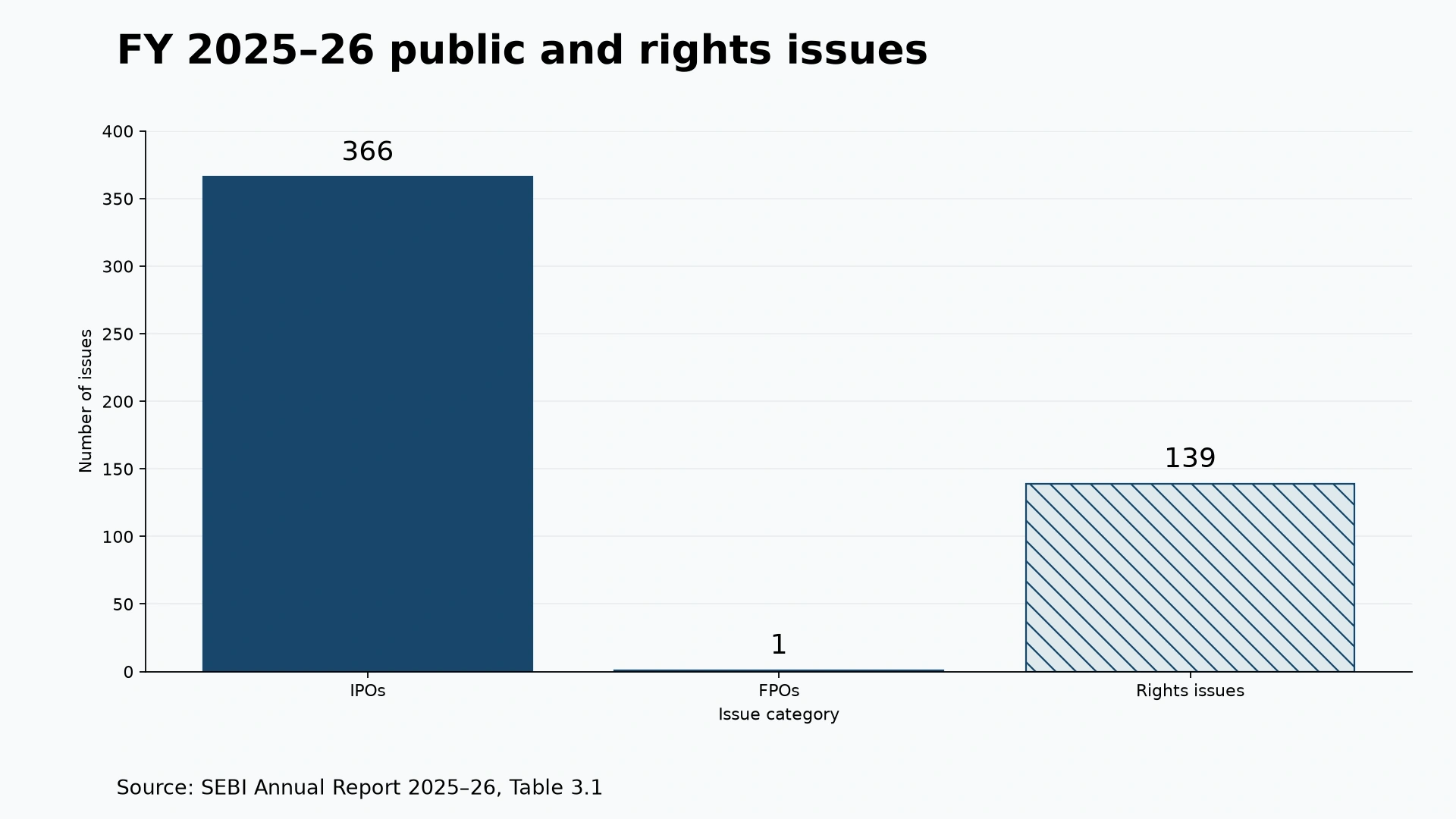
SEBI’s Annual Report 2025–26 records 367 public issues in 2025–26, including 366 IPOs and one FPO, while rights issues numbered 139. This activity does not measure an issuer’s disclosure quality. It does show why an indexed, reviewable diligence process helps advisers work through a busy primary-market pipeline. SEBI Annual Report 2025–26, Chapter 3, Table 3.1.
| Issue category | Number of issues |
|---|---|
| IPOs | 366 |
| FPOs | 1 |
| Rights issues | 139 |
| Public issues total | 367 |
Axes: the horizontal axis lists issue categories and the vertical axis counts issues; the zero baseline is visible. The values are FY 2025–26 counts from SEBI’s table, not an approval target or a data-room benchmark.
Inference: IPOs dominate the public-issue count in the report, while rights issues remain a separate disclosure route. An issuer should identify the proposed route early because the applicable offer-document and diligence requirements can differ.
Follow a controlled data-room workflow
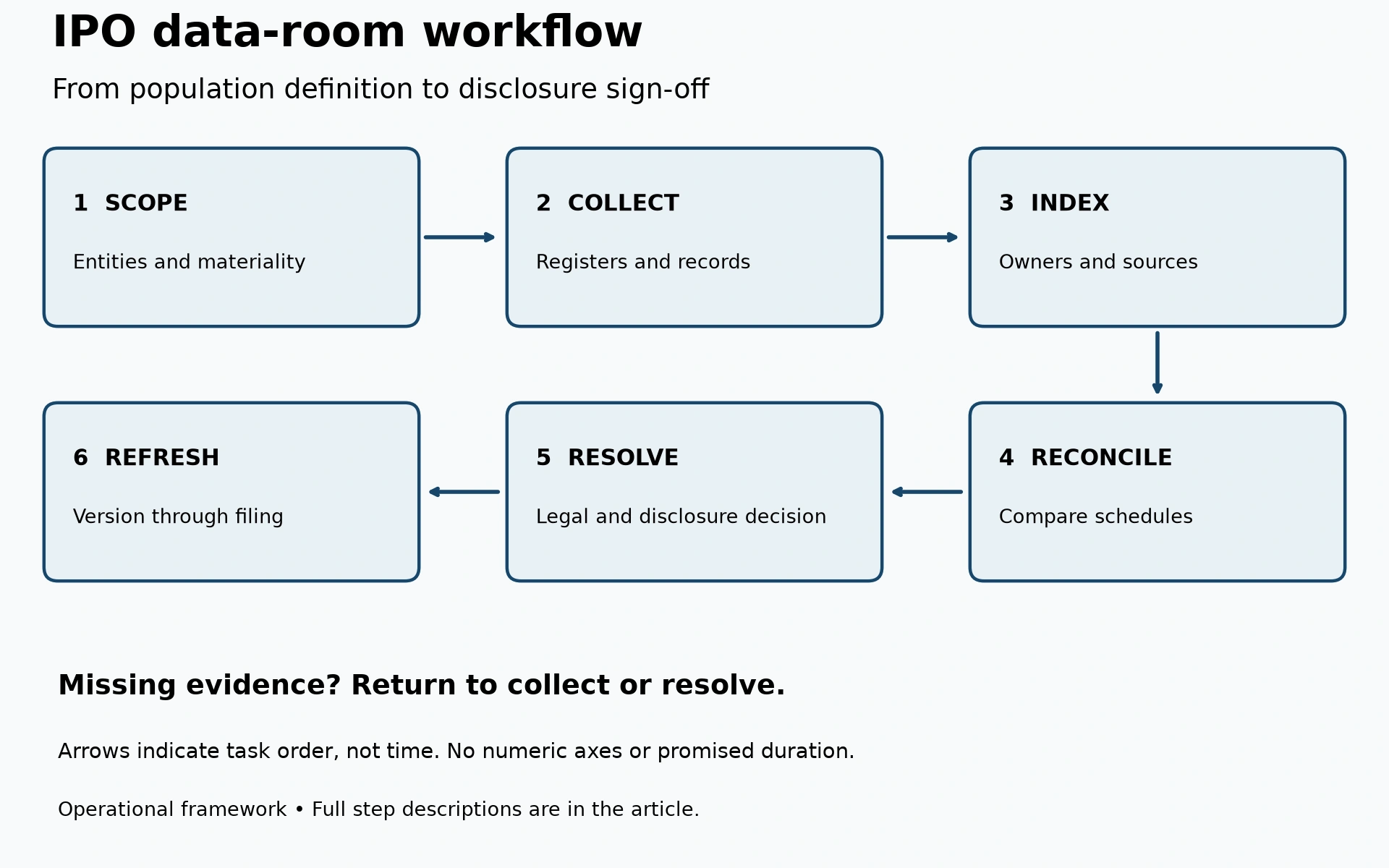
- Scope: agree entities, relationships, look-back period, materiality approach and issue route.
- Collect: obtain registers, agreements, accounts, filings, orders, declarations and ownership records through controlled access.
- Index: assign a stable identifier, owner, source date, confidentiality level and proposed disclosure location to every item.
- Reconcile: compare the data room with the cap table, financial statements, board minutes, related-party schedules and offer-document drafts.
- Resolve: document missing evidence, legal questions, quantification, approvals and the final disclosure decision.
- Refresh: lock a review date, monitor new contracts and matters, and preserve the version history through filing and listing.
The arrows indicate order, not a promised duration. The six numbered steps are the complete text equivalent for readers who do not use the workflow image.

Common data-room failures
- Treating a group chart as a substitute for ownership and control evidence.
- Omitting guarantees, leases, IP licences, side letters or change-of-control clauses.
- Reporting only cases filed by the issuer and ignoring relevant promoter or group-company matters.
- Describing a dispute as “not material” without recording the method and reviewer.
- Uploading multiple unsigned or superseded contract versions without clear status labels.
- Sharing unmasked identity, bank or KYC records through broad email circulation.
How Abhipra can assist
Preparing for an SME IPO or main-board IPO and need an RTA workstream? Abhipra can discuss shareholder-record reconciliation, demat and ISIN coordination, and an operational evidence index for the appointed advisers. Legal conclusions, materiality, disclosure and eligibility remain subject to issuer-specific review.
Contact Abhipra RTA Services, call 011-42390783 or +91-9818080700. Share only the company name, entity type, proposed platform, broad capital structure, shareholder count, existing ISINs and target timeline initially. Wait for a secure submission method before sending sensitive records. Do not email passwords, OTPs, unmasked PAN, bank details or signatures.
Source links and review date
SEBI ICDR Regulations, the Companies Act, SEBI Annual Report 2025–26 and NSE listing guidance were checked on 21 September 2026. Companies Act, 2013 — India Code. Recheck amendments, exchange instructions and the applicable issue chapter at the actual filing date.
Disclaimer
This article is general educational information and does not constitute legal, tax, accounting, investment or transaction advice. Applicability depends on the issuer’s facts and the law, regulations, circulars and exchange or depository instructions in force on the relevant date. Definitions, materiality, litigation disclosure, related-party treatment and IPO eligibility require review by the company secretary, legal counsel, auditors, merchant banker, RTA and other appointed advisers. Photographs are original AI-generated illustrations featuring fictional professionals.