Board, Committees and Governance Readiness Before an IPO
Reviewed on 20 September 2026 by Abhipra RTA Desk.
An IPO readiness review should test whether the board can make, record and explain decisions consistently. That means checking director appointments, independent-director records, committee charters, minutes, related-party controls, shareholder grievance handling and the evidence supplied to appointed advisers. A newly created IPO committee cannot repair gaps in the underlying governance record.

Start with the correct legal and listing scope
The SEBI (Issue of Capital and Disclosure Requirements) Regulations, 2018, as amended on 21 March 2026, apply differently to a main-board IPO, SME IPO and other issue routes. The draft offer document and later filings must be assessed under the route-specific chapter and current exchange requirements. The consolidated regulations are the primary source for that analysis; this article is an operational preparation guide, not an eligibility opinion.
The Companies Act, 2013 provides the corporate baseline. Sections 149, 177 and 178 address, among other matters, the board and independent directors, the Audit Committee, and the Nomination and Remuneration Committee and Stakeholders Relationship Committee. Section 134 links board-approved financial statements and the Board’s Report to prescribed disclosures. A company should map these provisions to its type, thresholds, exemptions and effective dates with its company secretary and counsel. Companies Act, 2013 — India Code.
Build a board evidence register
For every director, maintain a controlled record of appointment, consent, DIN and qualification evidence, tenure, resignation or reappointment, committee memberships, disclosures of interest and relevant evaluation records. Reconcile board minutes, resolutions, statutory registers, filings and the current organisation chart. Keep the original date and version of each document so later changes remain traceable.
For independent directors, preserve the declaration and eligibility assessment, appointment and member-approval records, tenure calculation, meeting attendance and evaluation trail. The company should document how independence was assessed on the facts existing at the relevant time. Do not assume a biography or a database entry proves independence.
Make committees operational before filing
The Audit Committee should have a dated charter, membership record, meeting calendar, agenda and minutes that show how financial reporting, auditor matters, internal controls, related-party transactions and risk questions were considered. The Nomination and Remuneration Committee should retain its criteria, appointment recommendations, performance-evaluation method and remuneration-policy records. The Stakeholders Relationship Committee should show an owned process for investor grievances and escalation.
An IPO committee may coordinate the offer, advisers, approvals, information requests and transaction timetable. Its charter should state what it may recommend or approve and what remains reserved for the full Board or shareholders. Avoid giving a transaction committee an ambiguous mandate that duplicates statutory committees.
Test the handoffs that an offer document depends on
Create a disclosure matrix with one row for each board member, KMP and senior-management person. Link the name, role, joining date, qualifications, previous experience, compensation, shareholding, family relationships, service arrangements and material changes to a source document and a responsible reviewer. Compare that matrix with the capitalisation table, related-party register, litigation register, employment records and proposed offer-document biographies.
Where records disagree, open a discrepancy item with an owner, evidence request, legal question and resolution. Never silently edit one dataset to match another. Keep pending, settled and disputed matters separate, and record the date on which a search or declaration was refreshed.
IPO activity is context, not a governance score
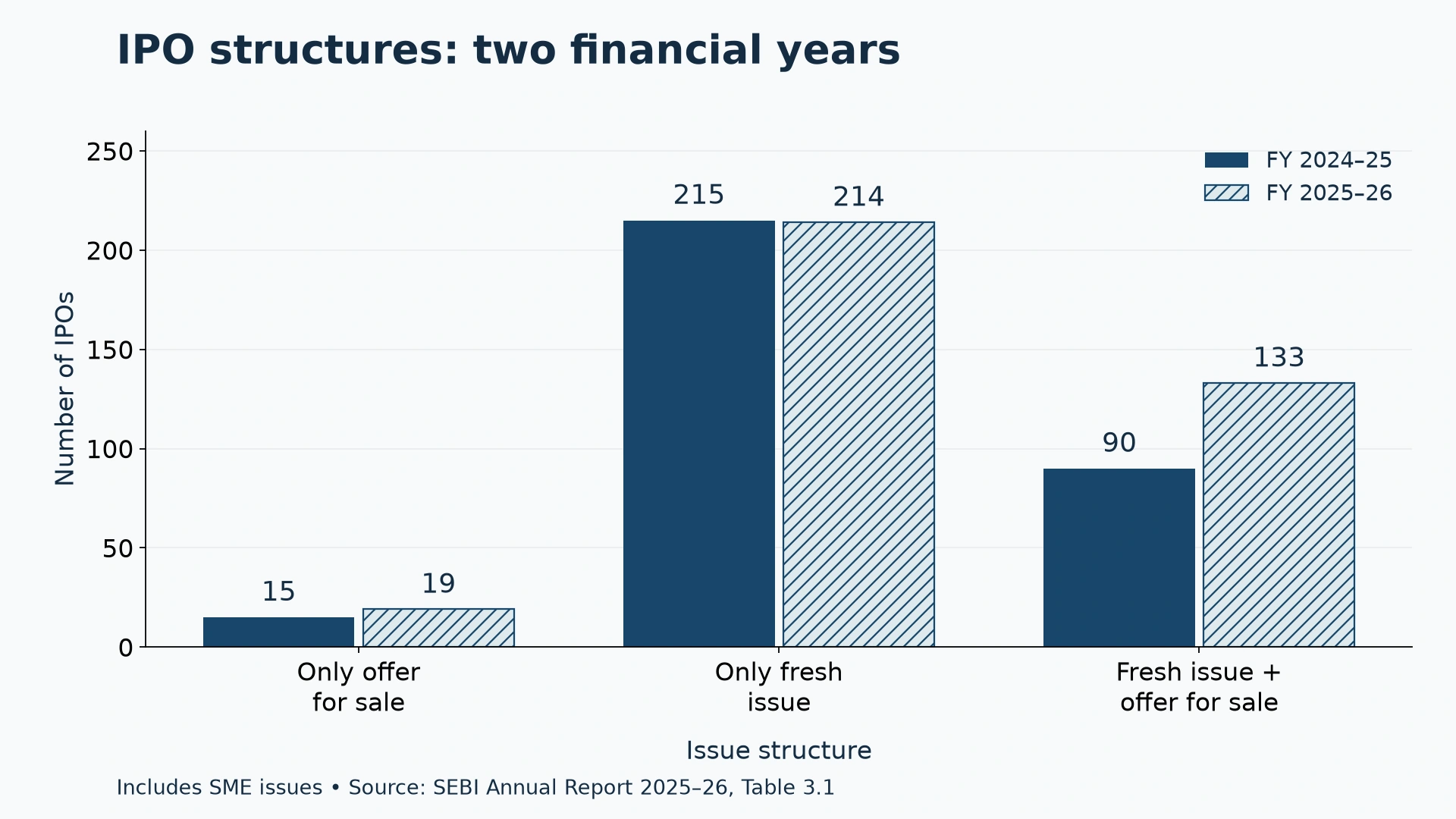
SEBI’s Annual Report 2025–26 reports 320 IPOs in FY 2024–25 and 366 in FY 2025–26, including SME issues. IPOs combining a fresh issue and an offer for sale rose from 90 to 133. The activity makes clean ownership, committee records and disclosure handoffs useful operational priorities; it does not predict approval or establish any issuer’s eligibility. SEBI Annual Report 2025–26, Chapter 3, Table 3.1.
| Structure | FY 2024–25 | FY 2025–26 |
|---|---|---|
| Only offer for sale | 15 | 19 |
| Only fresh issue | 215 | 214 |
| Fresh issue plus offer for sale | 90 | 133 |
| Total IPOs | 320 | 366 |
Axes: the horizontal axis groups the three structures; the vertical axis counts IPOs from zero. Solid bars identify FY 2024–25 and hatched bars identify FY 2025–26, with numeric labels so the comparison does not depend on colour.
Inference: the mixed fresh-issue/OFS category increased by 43 IPOs in the report’s comparison. Companies considering an OFS should prepare selling-shareholder, ownership and approval records alongside the issuer’s governance file. The data is descriptive and is not a readiness benchmark.
Use a repeatable governance-readiness workflow
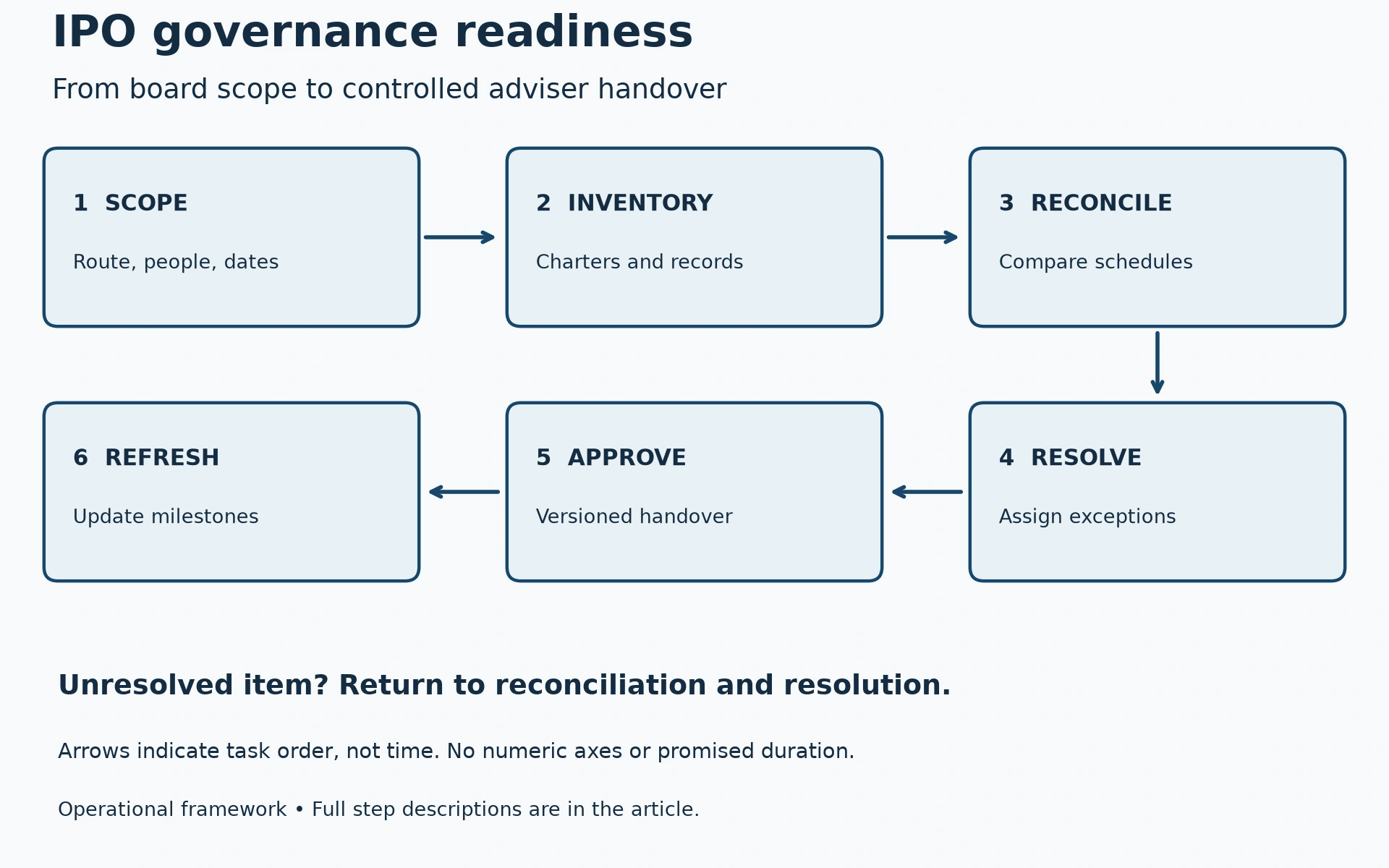
- Scope: identify the issue route, legal entity, relevant dates and board, committee, KMP and senior-management population.
- Inventory: list charters, resolutions, minutes, registers, declarations, policies, evaluations and filings.
- Reconcile: compare corporate records with HR, finance, ownership, litigation, related-party and offer-document schedules.
- Resolve: assign each exception an owner, source request and professional conclusion; preserve unresolved items.
- Approve: obtain approvals required for the actual matter and hand over a versioned evidence index to appointed advisers.
- Refresh: update the register at agreed filing milestones and when a person, committee, holding or material matter changes.
The arrows show task order, not a promised duration. If evidence does not reconcile, return to the resolution step. This workflow has no numeric axis; the numbered text is its complete accessible equivalent.

Common governance-readiness errors
- Treating a committee charter as proof that meetings and oversight actually occurred.
- Copying a director biography without checking current appointments, tenure and interests.
- Omitting changes in KMP or senior management from the agreed disclosure period.
- Mixing an investor grievance, commercial dispute and regulatory proceeding into one vague status.
- Allowing a transaction committee to approve matters reserved for the Board or shareholders.
- Sending identity documents, signatures or unmasked financial information through an uncontrolled email chain.
How Abhipra can assist
Preparing for an SME IPO or main-board IPO and need a Registrar-to-an-Issue/RTA workstream? Abhipra can discuss shareholder-record reconciliation, demat and ISIN coordination, and the operational evidence index within an agreed engagement. Eligibility, governance conclusions, offer disclosures and regulatory approvals remain subject to the applicable framework and appointed advisers.
Contact Abhipra RTA Services, call 011-42390783 or +91-9818080700. Share only the company name, entity type, proposed platform, broad capital structure, shareholder count, existing ISINs and target timeline for an initial discussion. Wait for a secure submission method before sending sensitive KYC records. Do not email passwords, OTPs, unmasked PAN, bank details or signatures.
Source links and review date
The SEBI ICDR consolidated regulations, Companies Act text, SEBI Annual Report 2025–26 and NSE public-issue eligibility guidance were checked on 20 September 2026. SEBI ICDR Regulations, amended 21 March 2026 and NSE public-issue eligibility should be rechecked at the actual filing date. The SEBI annual-report figures are historical statistics, not a legal requirement.
Disclaimer
This article is general educational information and does not constitute legal, tax, investment, accounting or transaction advice. Applicability depends on the issuer’s facts and the law, regulations, circulars and exchange or depository instructions in force on the relevant date. Board composition, committee compliance, independence, disclosure, litigation and IPO eligibility require issuer-specific review by the company secretary, legal counsel, auditors, merchant banker, RTA and other appointed advisers. Photographs are original AI-generated illustrations featuring fictional professionals.