Promoter, Director and KMP Due Diligence Before an IPO: Records to Prepare
By Abhipra RTA Desk. Sources checked: 19 September 2026.
Before an IPO, assemble a person-by-person evidence file that connects identity, appointments, ownership, interests and regulatory history to the proposed offer disclosures. A signed questionnaire is a starting point; the company and its appointed advisers still need to reconcile the answers with supporting records and investigate discrepancies.

Define the people and the review scope first
Promoter, director, key managerial personnel (KMP), senior management and selling shareholder are distinct roles. One person may occupy several roles. Ask the company secretary and legal counsel to confirm the classification list, including promoter-group relationships and corporate promoters, before circulating questionnaires. Do not label every shareholder a promoter or assume every senior employee is statutory KMP.
Separate a main-board IPO from an SME IPO at the outset. The applicable ICDR chapter, exchange requirements and transaction structure determine the checks; a generic checklist cannot establish eligibility. The suggestions below are an operational preparation framework, not a prescribed statutory form.
Complete eligibility checks before relying on declarations
For main-board IPOs, ICDR Regulation 5 addresses SEBI debarment affecting specified persons, links to other debarred companies, wilful-default or fraudulent-borrower status, and fugitive-economic-offender status. Its explanation includes a qualification for expired debarment periods. Counsel must examine the actual order, identity match, applicable dates and legal effect. SME issuers require review under their applicable chapter.
Schedule VI includes management disclosures concerning qualifications, experience, appointments, remuneration, relationships and shareholding; it also addresses certain KMP and senior-management changes over the preceding three years. Use the exact applicable disclosure requirements when setting the evidence period. SEBI ICDR consolidated regulations, last amended 21 March 2026.
A similar name in a search result is a lead for investigation, not proof against a person. Preserve the search date, source and resolution of each possible match. Pending proceedings, allegations, final orders and completed penalties should remain separately identified.
Build six evidence folders with named owners
1. Identity and role history
Create a controlled index containing each person's legal name, relevant role, appointment dates and document references. Record name variations so that corporate records and questionnaires can be reconciled. Obtain supporting identity material only through an approved secure channel; restrict full identifiers to authorised reviewers.
2. Appointments and statutory records
Collect relevant consents, appointment or reappointment resolutions, service agreements, filed forms and acknowledgements. Compare effective dates across these records. Companies Act sections 164, 170 and 184 respectively address director disqualification, the register of directors/KMP and shareholding, and directors' disclosure of interests. The company secretary should assess compliance, applicable exceptions and corrective action. Companies Act, 2013, official India Code text.
3. Ownership, demat and encumbrances
Build a dated holding schedule, with separate columns for registered ownership, beneficial ownership where relevant, security class, demat position and any pledge or other restriction. Link acquisitions and disposals to source documents. Ask advisers to determine promoter contribution, lock-in and offer-for-sale eligibility for the actual transaction; an operational reconciliation does not settle these legal questions.
The RTA can support record matching and authorised depository coordination within its engagement. Shareholders work with their DPs on account-level matters. Neither a demat balance nor a clean spreadsheet validates the entire capital history.
4. Interests and related-party connections
Map other directorships, partnerships, significant business interests and relevant family relationships. Compare declarations with the company's related-party schedules and contract records. Flag inconsistent descriptions for the company secretary, finance team and counsel; do not silently change a declaration to make two datasets agree.
5. Proceedings, defaults and regulatory history
Keep a matter register with party names, forum, case or order reference, current stage, latest document date, responsible adviser and next action. Request supporting orders and correspondence. The legal team should determine the disclosure and eligibility consequences; the operations team should track evidence and unresolved questions.
6. Qualifications, experience and remuneration
Support biographies with reliable evidence. Reconcile joining dates, prior employment, responsibilities, compensation, benefits and equity-linked arrangements with HR and finance records. Maintain a change log for appointments, departures and revised responsibilities during preparation of the offer documents.
IPO activity provides context, not a readiness score
SEBI reports 320 IPOs in FY 2024–25 and 366 in FY 2025–26, including SME issues. Of these, issues combining fresh capital and an offer for sale increased from 90 to 133. SEBI Annual Report 2025–26, Chapter 3, Table 3.1, printed page 30.
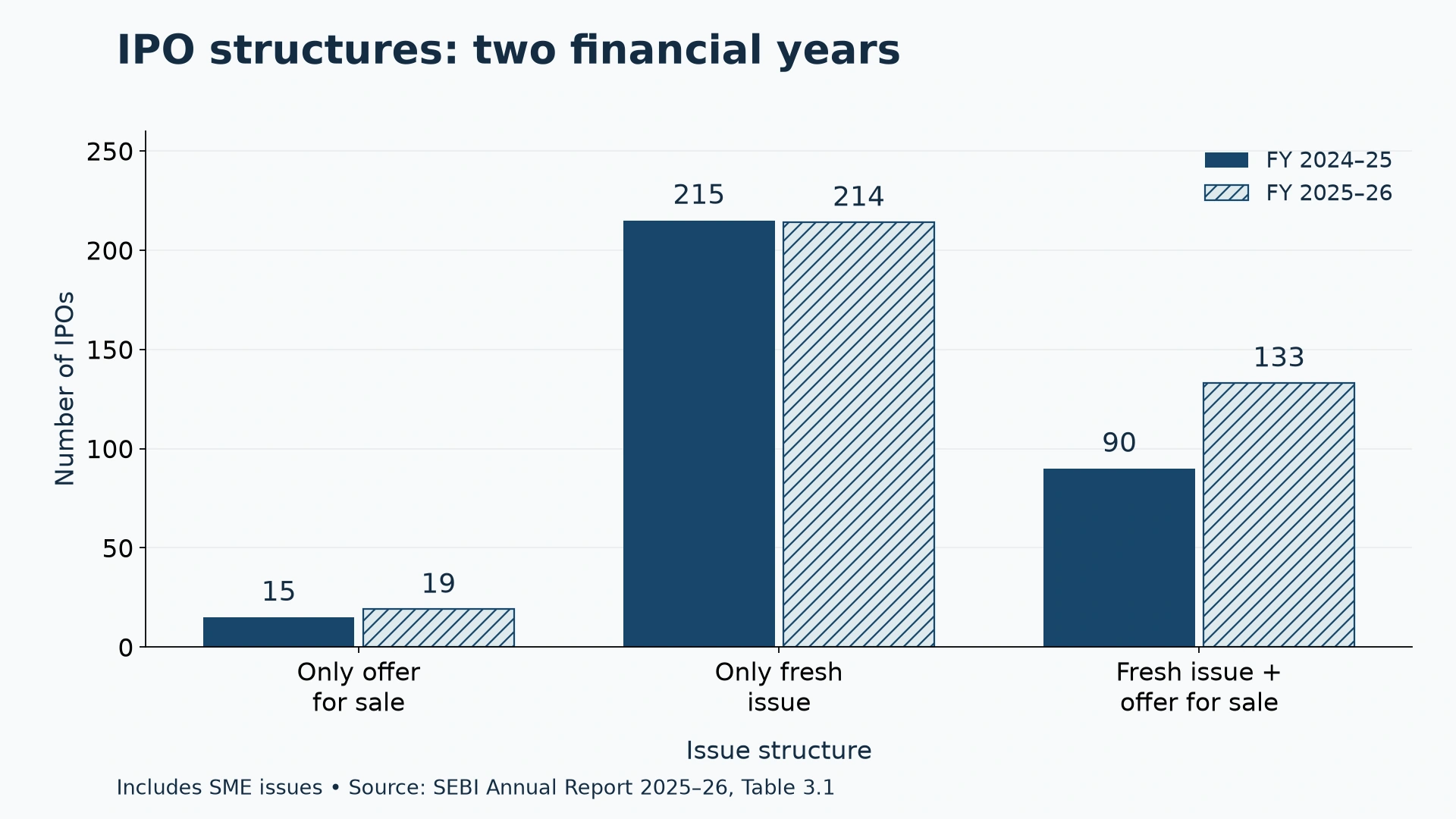
| Issue structure | FY 2024–25 | FY 2025–26 |
|---|---|---|
| Only offer for sale | 15 | 19 |
| Only fresh issue | 215 | 214 |
| Fresh issue and offer for sale | 90 | 133 |
| Total | 320 | 366 |
Axes: the horizontal axis groups IPOs by issue structure; the vertical axis counts IPOs and starts at zero. Labels and distinct bar patterns identify the two financial years.
Inference: mixed structures became more frequent in this comparison. An issuer contemplating shareholder sales should plan the selling-shareholder evidence work alongside its corporate review. The figures do not measure due-diligence failures, predict approval or establish a company's eligibility.
Move from declarations to a controlled filing handover
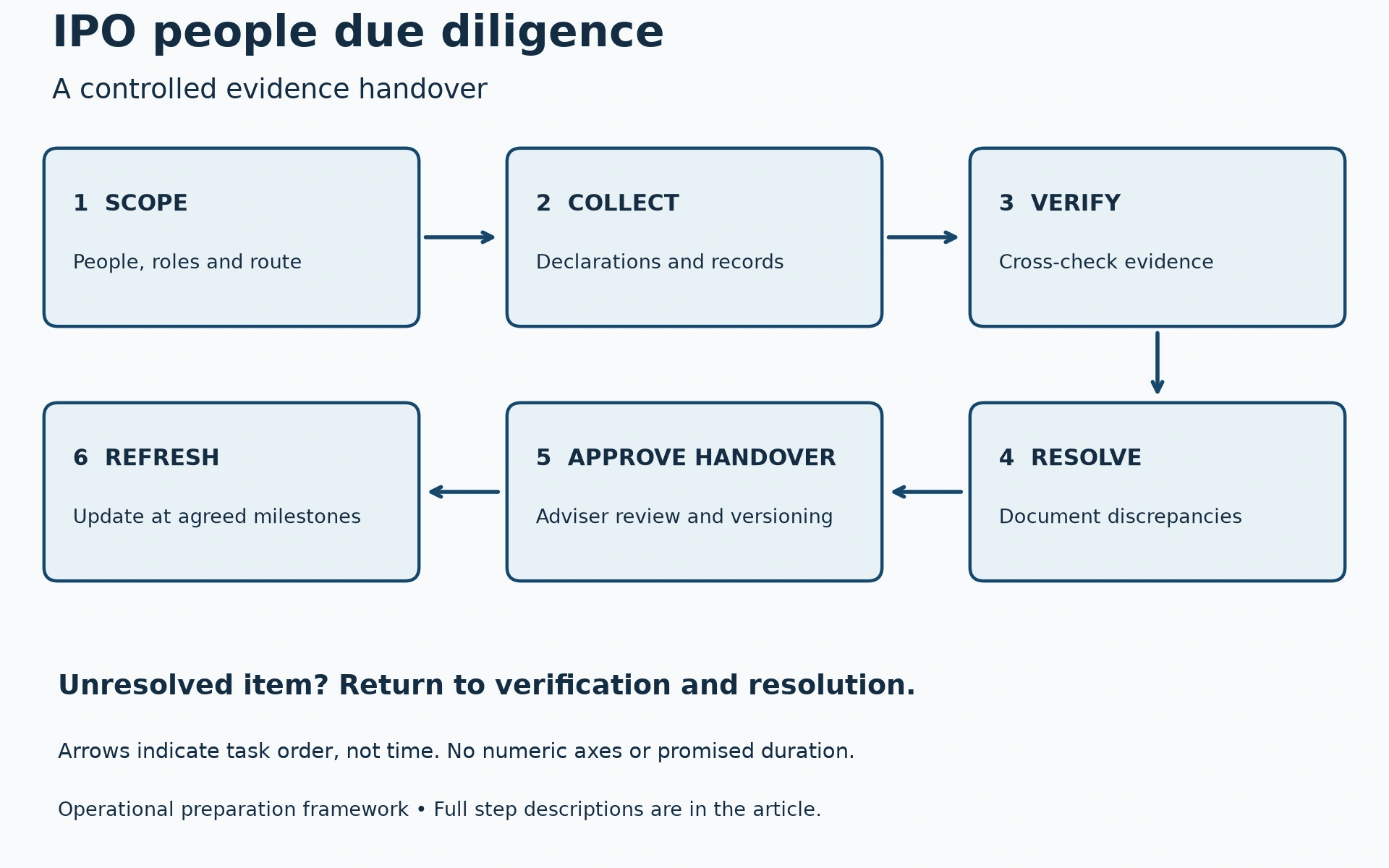
- Scope: issuer and advisers agree the people, roles, applicable route and evidence period.
- Collect: authorised owners obtain questionnaires and supporting records through controlled access.
- Verify: reviewers compare appointments, holdings, interests and matter registers with independent records where appropriate.
- Resolve: assign each discrepancy an owner, supporting evidence and a documented legal or factual conclusion. Keep unresolved items visible.
- Approve handover: appointed advisers review disclosure treatment; the issuer supplies the authorised, versioned evidence package.
- Refresh: update searches and declarations at milestones agreed with the advisers and record material changes before subsequent filings.
Reading the workflow: arrows show task order, not elapsed time. It has no numeric axes and promises no completion period. If a discrepancy remains unresolved, return to verification and resolution before treating the affected item as complete. Keeping this evidence trail makes later changes traceable.

Avoid these common preparation errors
- Accepting an undated declaration without identifying the period or entities it covers.
- Treating a questionnaire answer as conclusive when supporting documents disagree.
- Reusing a biography without checking current appointments or qualifications.
- Combining a pending case and a final finding into one ambiguous status.
- Assuming RTA record reconciliation replaces legal, secretarial or merchant-banker due diligence.
- Sending unrestricted identity records and signatures to a broad email distribution list.
How Abhipra can assist
Preparing for an SME IPO or main-board IPO and need a Registrar-to-an-Issue/RTA workstream? Abhipra can discuss shareholder-record reconciliation, demat and ISIN coordination, and the operational evidence handover within an agreed engagement. Eligibility, offer disclosures and regulatory approvals remain subject to the applicable framework and the appointed advisers' review.
Explore RTA Services, email Abhipra RTA Services, call 011-42390783 or +91-9818080700. For an initial discussion, share the company name, company type, proposed platform, latest audited financial year, broad capital structure, shareholder count, existing ISINs and target timeline. Wait for a secure submission method before providing sensitive KYC documents. Never email passwords, OTPs, unmasked PAN, bank details or signatures.
Source scope and review date
The official SEBI regulations, SEBI annual-report data and India Code provisions linked above were checked on 19 September 2026. The annual report is statistical context, not a legal instrument. The NSE main-board IPO eligibility criteria provide additional exchange context; criteria for other listing routes must be checked separately. Recheck amendments and exchange instructions at the relevant filing date.
Disclaimer
This article is for general educational information and does not constitute legal, tax, investment or transaction advice. Applicability depends on the company's and investor's facts and on the law, circulars and depository instructions in force on the relevant date. Issuer-specific classification, eligibility, litigation, lock-in and disclosure decisions require professional legal and merchant-banker review. Photographs are original AI-generated illustrations featuring fictional professionals.