Why Risk Management Beats Prediction In Trading
Every trader wants to know where the market will go next. The more useful question is different: what happens if the trade is wrong?

Prediction Is A View; Risk Management Is A System
A prediction says, "the index may rise" or "this stock may fall." A risk-management system says how much capital can be exposed, where the trade becomes invalid, how much margin buffer is needed, and when the position must be reduced.
The first statement depends on the market. The second depends on the trader’s discipline. That is why risk management usually matters more than a strong view, especially in leveraged futures and options trades.
SEBI’s investor education material asks investors to understand goals, risk appetite and the risk-return profile before investing. It also lists market risk, liquidity risk and volatility risk as key securities-market risks, and explains that risk can be mitigated through diversification, suitability and review. For traders, the same principle applies in a stricter form: decide the loss limit before entering the order.
What SEBI’s F&O Data Teaches
SEBI’s September 2024 study reported that 93% of individual traders incurred losses in equity F&O during FY22-FY24, with aggregate losses exceeding Rs 1.8 lakh crore over three years. SEBI’s July 2025 equity derivatives study reported that nearly 91% of individual traders incurred net losses in FY25, and that individual trader net losses widened to Rs 1,05,603 crore, up 41% from FY24.
This does not mean every derivative trade is unsuitable. It means prediction alone is a weak process. A trader can be right on direction and still lose because of position size, time decay, liquidity, costs, margin pressure or late exit.
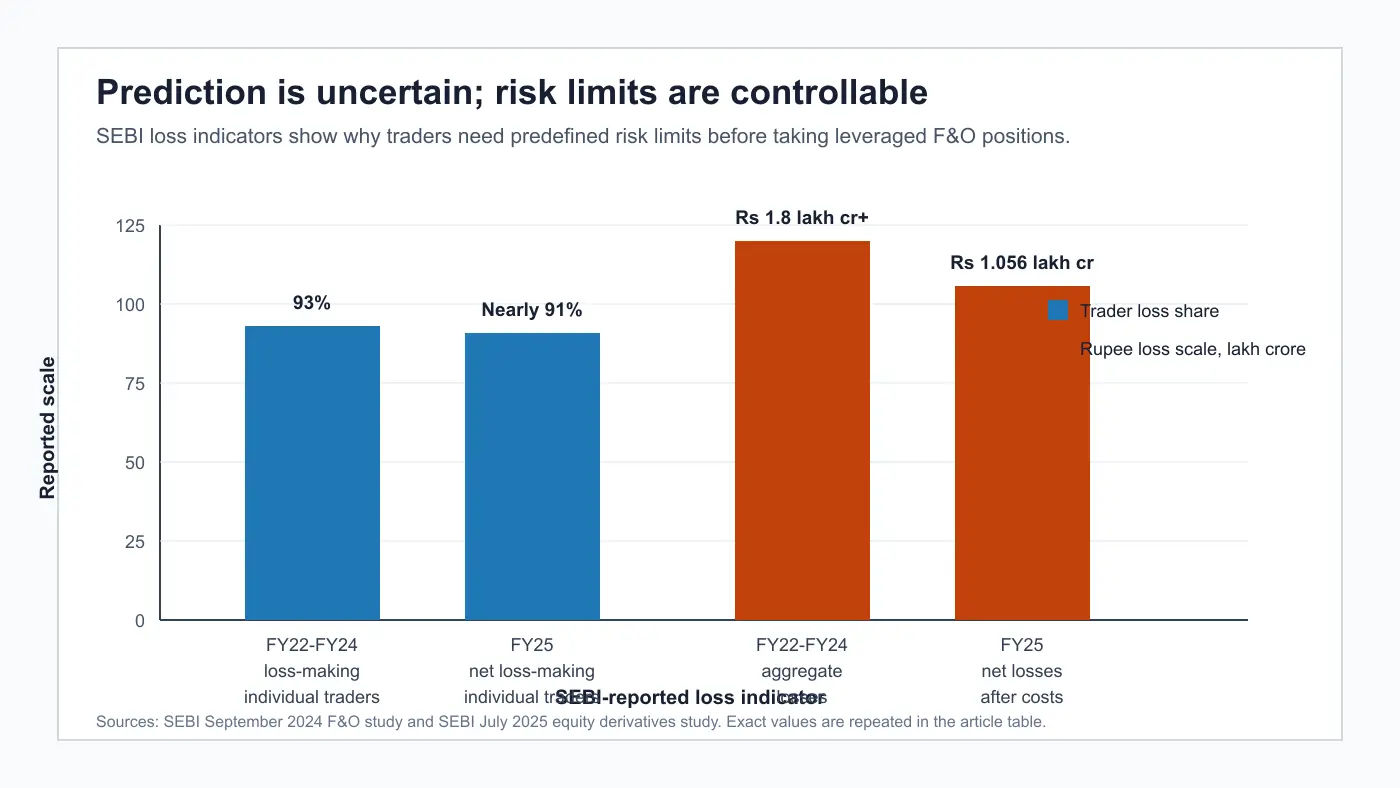
| Study period | Reported indicator | Figure | Risk-management lesson |
|---|---|---|---|
| FY22-FY24 | Individual traders incurring losses in equity F&O | 93% | A trading view should not override defined loss limits. |
| FY22-FY24 | Aggregate individual trader losses | More than Rs 1.8 lakh crore | Repeated small losses can become material without a risk budget. |
| FY25 | Individual traders incurring net losses in equity derivatives | Nearly 91% | More activity is not the same as better risk control. |
| FY25 | Individual trader net losses after costs | Rs 1,05,603 crore, up 41% from FY24 | Costs, leverage and expiry risk must be part of the trade plan. |
Four Rules Before Any Trade
- Define the maximum loss before entry.
- Size the position so that one wrong trade does not disturb family savings or emergency money.
- Keep margin and cash buffers separate from capital meant for long-term goals.
- Exit when the rule is triggered, not when hope returns.
NSE Clearing’s equity derivatives margin page explains that initial margin includes SPAN margin, delivery margins and margins on consolidated crystallized obligations, and that Extreme Loss Margin applies to derivatives exposure. This is why a trade plan should include margin stress, not only entry price and target price.
What The Infographic Shows

The visual shows a practical pre-trade sequence: position size first, risk budget second, margin buffer third, exit rule fourth, and prediction last. If the trade cannot survive this checklist, the better decision may be to reduce size or avoid the trade.
Common Mistakes
- Increasing trade size because the prediction feels strong.
- Moving the stop loss after the trade goes wrong.
- Treating margin availability as spare money.
- Ignoring brokerage, taxes, STT, liquidity and slippage.
- Trading weekly options without a written invalidation point.
- Using profits from one trade as permission to ignore limits in the next trade.
Investor Checklist
Before placing a leveraged trade, write down:
- Entry reason.
- Maximum loss.
- Position size.
- Margin buffer.
- Exit rule.
- Review rule after the trade closes.
If these six points are not clear, the trade is relying more on prediction than process.
Source Links
- SEBI Investor: How to manage investment risks
- SEBI Investor: Key risks in investing in securities market
- SEBI Investor: Understanding derivatives
- SEBI September 2024 study on individual equity F&O trader losses
- SEBI July 2025 study on equity derivatives trading after recent measures
- NSE Clearing equity derivatives margins
Reviewed by Abhipra Research / Compliance Team.
Disclaimer
This article is for educational and informational purposes only. It should not be considered investment advice, trading advice, tax advice or insurance advice. Investments in securities market are subject to market risks. Please read all related documents carefully before investing. Past performance is not indicative of future returns. Please consult a qualified financial advisor, tax advisor or insurance advisor before making any financial decision.