F&O Is Not A Shortcut To Wealth: Build The Risk Plan Before The Trade

Futures and options are often presented online as a fast route to income. For most retail traders, SEBI's data tells a different story: F&O can magnify losses faster than it builds wealth.
This does not mean derivatives have no use. SEBI's investor education material explains that derivatives may be used for hedging, speculation and arbitrage. The problem begins when a beginner treats a leveraged product as a shortcut, without understanding obligation, margin, liquidity, volatility and costs.
SEBI Data Should Slow Down The Trade
SEBI's September 2024 study reported that 93% of individual traders incurred losses in equity F&O during FY22 to FY24, with aggregate losses exceeding Rs 1.8 lakh crore over three years. SEBI's July 2025 update reported that individual trader net losses in equity derivatives widened from Rs 74,812 crore in FY24 to Rs 1,05,603 crore in FY25 after transaction costs, with over 91% of individual traders incurring net losses.
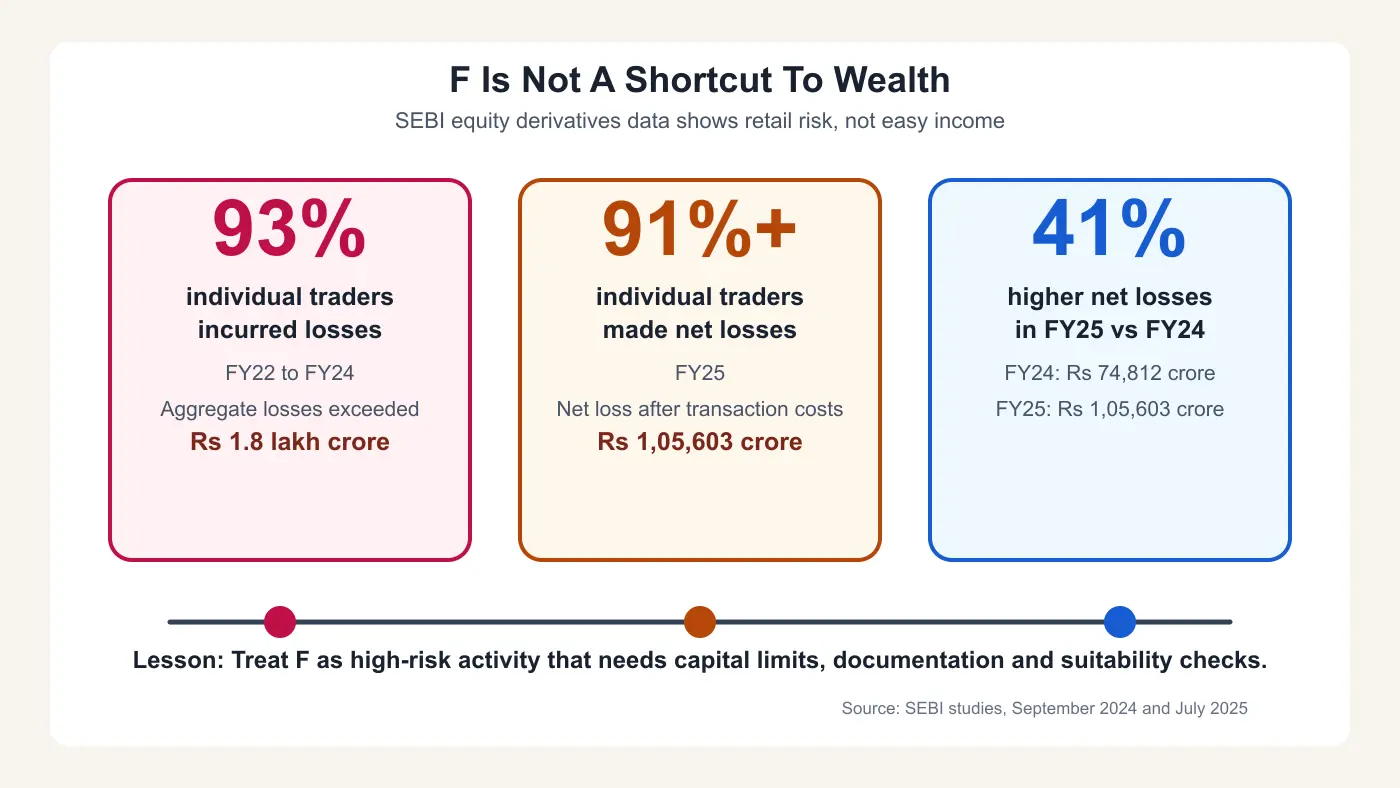
| SEBI data point | Reported value | Why it matters |
|---|---|---|
| Individual traders with equity F&O losses during FY22 to FY24 | 93% | A high loss rate is inconsistent with the idea of easy income. |
| Aggregate individual trader losses during FY22 to FY24 | Over Rs 1.8 lakh crore | Losses were large across several market years, not one isolated episode. |
| Individual trader net losses in FY25 | Rs 1,05,603 crore | Transaction costs and frequent activity can deepen outcomes. |
| Individual traders with net losses in FY25 | Over 91% | Most individual participants did not come out ahead. |
| Increase in individual trader net losses from FY24 to FY25 | 41% | Bigger participation does not automatically mean better discipline. |
The lesson is not "never learn derivatives." The lesson is that F&O should be approached as a high-risk activity, not as a wealth shortcut.
Why The Shortcut Mindset Is Dangerous
The shortcut mindset usually has four signs:
- The trade is entered because a quick profit looks possible.
- The trader focuses on premium or leverage, not total exposure.
- The stop, exit or adjustment rule is vague.
- Emergency money, borrowed money or family-goal money is exposed to market risk.
NSE's margin material explains that F&O uses SPAN-based margining, upfront margin collection and extreme loss margin as part of the risk-containment framework. Those controls exist because adverse price movement can create obligations quickly.
What F&O Can And Cannot Do
F&O can be used by informed participants for hedging, risk transfer and defined strategies. It can also be used for speculation. SEBI's investor education page explicitly warns that derivatives can multiply profits or losses because the amount payable can be small compared with the underlying exposure.
F&O cannot remove market risk. It cannot guarantee monthly income. It cannot compensate for weak capital discipline. It should not replace long-term investing, insurance, emergency savings or goal-based planning.
Keep Risk Capital Away From Family Money

The visual shows the discipline that should come before trading: separate high-risk trading capital from family goals, emergency money and long-term plans. A pen between the two groups acts as a boundary. If that boundary is unclear, the trader is not ready.
Before using F&O, decide the amount that can be lost without disturbing essential expenses, loans, education plans, retirement goals or insurance premiums. If the answer is uncomfortable, the trade size is too large.
Investor Checklist
Before placing an F&O order, write down:
- the purpose of the trade: hedge, adjustment, or speculation;
- the contract, lot size, expiry and liquidity condition;
- the maximum intended rupee loss;
- the stop, exit or adjustment rule;
- margin requirement and possible margin increase;
- brokerage, taxes, securities transaction tax and other charges;
- whether the trade uses emergency, borrowed or near-term goal money; and
- how the trade will be recorded and reviewed.
Common Mistakes
The first mistake is entering because a social media post made the trade look easy.
The second mistake is selling options only because premium is received, without understanding obligation and margin pressure.
The third mistake is increasing position size after losses in an attempt to recover quickly.
The fourth mistake is ignoring records. SEBI's investor do's and don'ts advise investors to keep contract notes, account statements, payment records and signed documents, and to avoid unregistered intermediaries, hot tips and sharing passwords.
Bottom Line
F&O is a leveraged risk product. It may have a role for informed traders and hedgers, but it is not a shortcut to wealth.
If the trade needs luck more than a written risk plan, it should wait.
Source Links
- SEBI press release: Updated study on individual traders in equity F&O, September 2024
- SEBI press release: Comparative study of growth in equity derivatives segment, July 2025
- SEBI Investor: Understanding derivatives
- SEBI Investor: Do's and Don'ts of Investing in Securities Market
- SEBI Investor: Key risks in investing in securities market
- NSE: Equity derivatives margins
- NSE: Margin collection and reporting FAQs
Disclaimer
This article is for investor education only and is not investment advice, trading advice, research recommendation, solicitation or an offer to buy or sell securities or derivatives. Equity derivatives are high-risk products and may not be suitable for all investors. F&O trades can result in loss of capital and additional obligations due to leverage, margins, volatility, liquidity and transaction costs. Please consult a SEBI-registered investment adviser or other qualified professional before taking investment or trading decisions. Reviewed by Abhipra Research / Compliance Team.