SEBI's Concern On Retail F&O: Lessons For Investors
Retail participation in futures and options has grown quickly, but SEBI's concern is not about learning derivatives. The concern is about repeated losses, leverage, expiry pressure and the way short-term trading can pull money away from long-term family goals.

What SEBI Is Warning Investors About
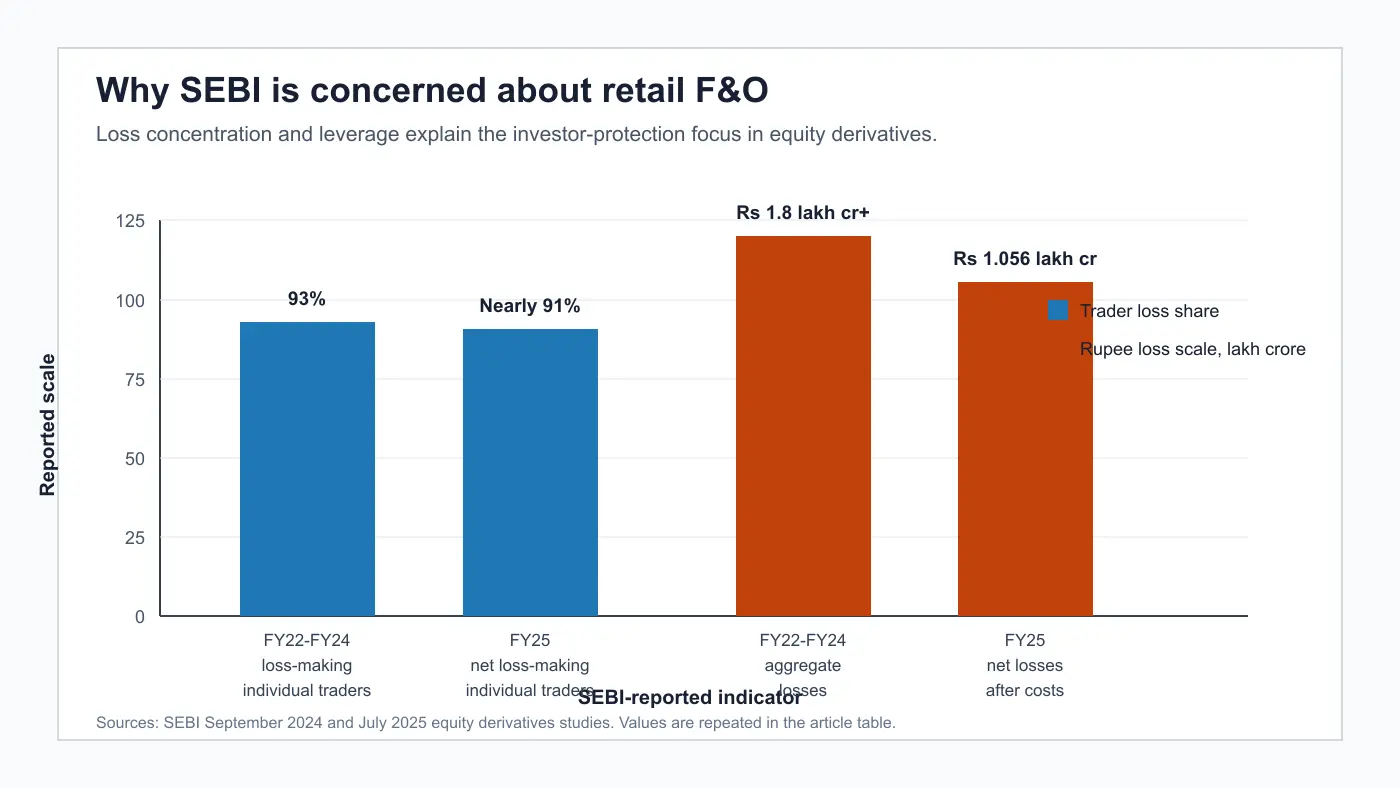
SEBI's September 2024 study reported that 93% of individual traders incurred losses in equity F&O during FY22-FY24, with aggregate losses exceeding Rs 1.8 lakh crore over three years. SEBI's July 2025 equity derivatives study reported that nearly 91% of individual traders incurred net losses in FY25 and that individual trader net losses widened to Rs 1,05,603 crore, up 41% from FY24.
These figures do not mean derivatives have no legitimate use. Futures and options can be used for hedging, risk transfer and portfolio management. The lesson is that retail traders should not treat leverage, weekly expiry and option premiums as shortcuts to wealth.
The Investor-Protection Measures
SEBI's October 1, 2024 circular on equity index derivatives introduced measures to strengthen investor protection and market stability. The measures included rationalising weekly index derivatives products, requiring upfront collection of option premium from buyers, increasing contract size over time, removing calendar-spread benefits on expiry day, applying additional Extreme Loss Margin on expiry day, and monitoring intraday position limits.
For a retail investor, the policy message is simple: if the product needs tighter safeguards, the trader needs tighter personal rules.
| Area | SEBI-reported point | Investor lesson |
|---|---|---|
| FY22-FY24 trading outcome | 93% of individual equity F&O traders incurred losses; aggregate losses exceeded Rs 1.8 lakh crore. | Do not enter F&O without a written loss limit and position-size rule. |
| FY25 trading outcome | Nearly 91% of individual equity derivatives traders incurred net losses; net losses were Rs 1,05,603 crore, up 41% from FY24. | More trading activity is not the same as better risk control. |
| Product design concern | SEBI rationalised weekly index derivatives products and recalibrated contract size. | Short expiry and small ticket perception should not drive trade frequency. |
| Risk-control concern | SEBI required upfront option premium collection, expiry-day ELM and intraday monitoring of position limits. | A trader should keep cash, margin and exit rules ready before placing orders. |
Lessons For Retail Investors
- Treat F&O as a high-risk product, not as a daily income plan.
- Decide the maximum loss before placing the trade.
- Keep family savings, emergency funds and borrowed money outside trading capital.
- Understand margin, premium, expiry, liquidity, brokerage, taxes, STT and slippage.
- Avoid trades that require averaging after losses to "recover" quickly.
- Use derivatives only when the purpose, risk and exit rule are clear.
SEBI's investor education pages also warn investors to understand derivatives, leverage, market risk, liquidity risk and risk appetite before taking market exposure. That is the behaviour retail investors should build before they think about complex option strategies.
What The Infographic Shows

The visual shows the practical correction SEBI's concerns point toward: reduce speculation, separate family money from trading capital, document the risk limit, and check whether the trade is suitable before entering it.
Common Mistakes
- Buying options only because the premium looks small.
- Trading weekly expiry contracts without understanding time decay.
- Using margin availability as permission to take larger positions.
- Following social media F&O tips without checking suitability.
- Ignoring repeated losses because one large winning trade is expected.
- Treating regulatory safeguards as enough protection without personal risk rules.
Source Links
- SEBI September 2024 study on individual equity F&O trader losses
- SEBI July 2025 study on equity derivatives trading after recent measures
- SEBI October 2024 circular on equity index derivatives investor-protection measures
- SEBI Investor: Understanding derivatives
- SEBI Investor: Key risks in investing in securities market
- NSE equity derivatives margins
Reviewed by Abhipra Research / Compliance Team.
Disclaimer
This article is for educational and informational purposes only. It should not be considered investment advice, trading advice, tax advice or insurance advice. Investments in securities market are subject to market risks. Please read all related documents carefully before investing. Past performance is not indicative of future returns. Please consult a qualified financial advisor, tax advisor or insurance advisor before making any financial decision.