Margin Calls Explained: What Traders Should Know Before Using Leverage
A margin call is not just a broker notification. It is a signal that the money or collateral supporting a leveraged position is no longer enough for the risk being carried.

What A Margin Call Means
In simple terms, margin is the money or approved collateral kept aside to support a trade. When the market moves against a position, or when the exchange or clearing corporation changes the margin requirement, the required margin can rise. If the available margin is lower than the required margin, the trader must bring in additional funds or collateral, reduce the position, or face square-off and penalties depending on the situation and broker policy.
SEBI’s investor education material explains that derivatives can multiply both profits and losses because the amount paid upfront is small compared with the value of the underlying exposure. That is why a margin call should be treated as a risk-control warning, not as a routine inconvenience.
The Margin Pieces In F&O
NSE’s margin guidance says that in the F&O segment, trading members must collect SPAN margin and Extreme Loss Margin from clients upfront, in advance of trade. Delivery margin and margin on consolidated crystallized obligation are to be collected from clients by T+1 day. NSE also explains that NSE Clearing uses a portfolio-based SPAN system for F&O margining, and that initial margin is collected upfront for open positions.
For a trader, this means the trade size should be decided after checking the margin requirement, the possible mark-to-market movement, and the spare liquidity available after the trade. A position that uses almost all available collateral leaves very little room for a fast market move.
How A Margin Call Can Build Up
Consider a trader with a leveraged F&O position. If the market moves sharply against the position, the broker’s risk system may ask for additional margin. If the trader cannot provide funds or eligible collateral on time, the broker may reduce or square off the position under its risk policy. If required margins are short or incorrectly reported, penalties may apply under clearing corporation rules.
NSE’s margin collection FAQ also notes that where a penalty for short reporting is passed on to a client, the member should provide relevant supporting documents and maintain an audit trail.
| Reference point | Reported rule or figure | What it means for a trader |
|---|---|---|
| Capital market upfront margin | Minimum 20% upfront margin in lieu of VaR and ELM. | Cash-market leverage also needs a buffer; it is not only an F&O issue. |
| F&O upfront margin | SPAN margin and Extreme Loss Margin are required upfront. | Do not place a trade using the last rupee of available collateral. |
| F&O post-trade collection | Delivery margin and margin on consolidated crystallized obligation are to be collected by T+1 day. | A position can demand cash after the trade, not only before entry. |
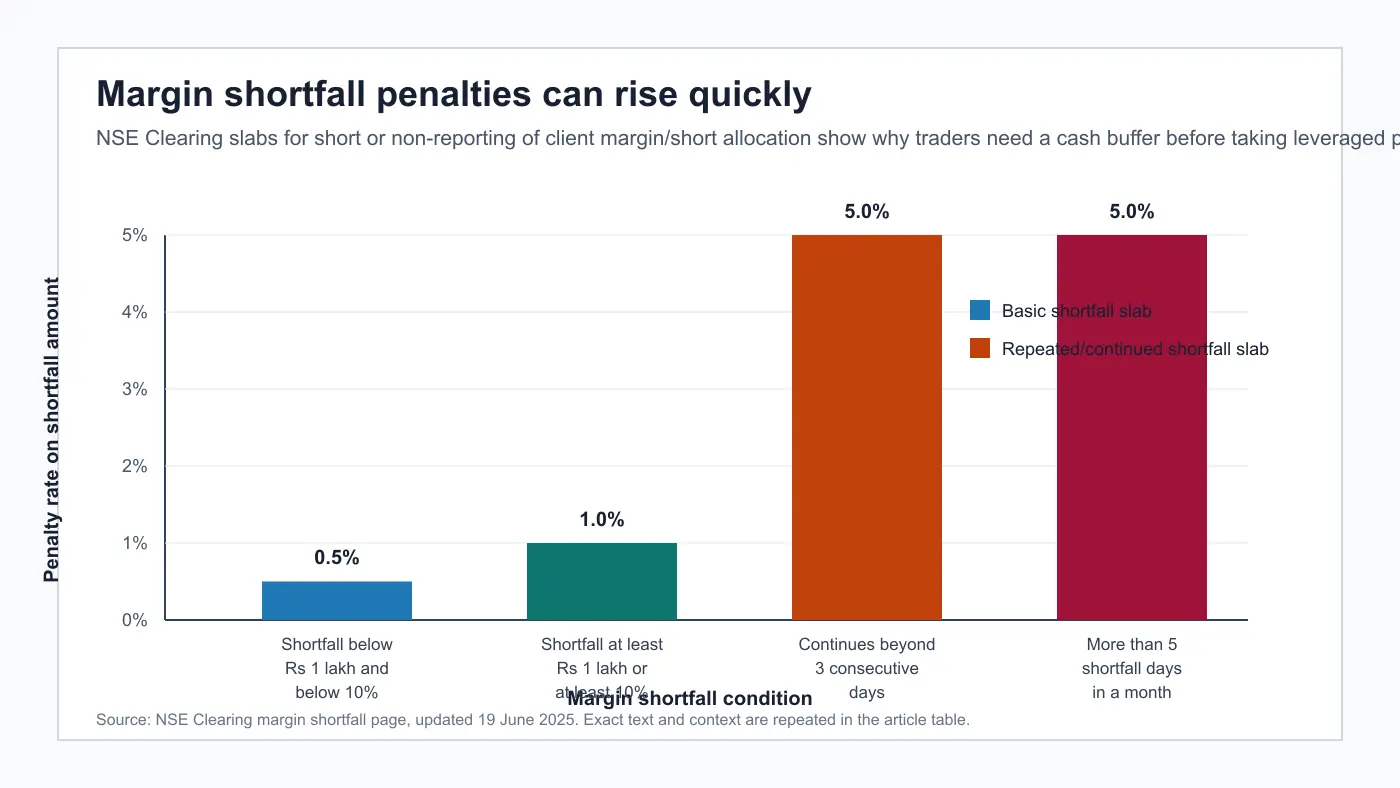
| Smaller short collection slab | 0.5% penalty where short collection is below Rs 1 lakh and below 10% of applicable margin. | Even a smaller shortfall can have a cost. |
| Larger short collection slab | 1.0% penalty where short collection is at least Rs 1 lakh or at least 10% of applicable margin. | Penalty risk rises when the shortfall is material. |
| Repeated or continued shortfall | 5% of the shortfall amount can apply after more than 3 consecutive days or beyond the 5th shortfall day in a month, as specified by NSE Clearing. | Repeated margin stress is a portfolio warning, not just an operational delay. |
Build A Margin Buffer Before The Trade
Before entering an F&O position, ask three practical questions:
- What is the current margin requirement?
- How much extra cash or approved collateral is available if the requirement rises?
- What position will be reduced first if the buffer is used up?
A sensible buffer depends on the product, volatility, liquidity and the investor’s risk capacity. It should not come from emergency money, loan funds or money reserved for family obligations.
What The Infographic Shows

The visual shows the sequence a trader should follow: read the margin statement, identify the open exposure, check the spare buffer, and reduce leverage before a forced square-off becomes the only option.
Common Mistakes
- Treating available margin as the maximum trade size.
- Ignoring delivery margin, MTM movement and crystallized obligations.
- Assuming pledged securities will always be liquid enough after haircut.
- Waiting for a broker call instead of monitoring margin daily.
- Adding positions after a margin warning.
- Using family savings or borrowed money to defend a losing leveraged trade.
Investor Checklist
- Read the daily margin statement.
- Keep cash separate from pledged securities.
- Check haircut and liquidity of collateral.
- Know the broker’s square-off policy before trading.
- Avoid carrying positions that cannot survive a sharp adverse move.
- Keep records if any margin penalty is passed on.
Source Links
- NSE margin collection and reporting FAQ
- NSE equity derivatives margins
- NSE equity derivatives client margin reporting
- NSE Clearing margin shortfall page
- SEBI Investor: Understanding derivatives
- SEBI Investor: Key risks in investing in securities market
Reviewed by Abhipra Research / Compliance Team.
Disclaimer
This article is for educational and informational purposes only. It should not be considered investment advice, trading advice, tax advice or insurance advice. Investments in securities market are subject to market risks. Please read all related documents carefully before investing. Past performance is not indicative of future returns. Please consult a qualified financial advisor, tax advisor or insurance advisor before making any financial decision.