Common Mistakes In F&O Trading: What Retail Traders Should Fix First

Futures and options can be useful for hedging and risk management, but many retail traders use them as a shortcut for fast profits. That mismatch is where most mistakes begin.
SEBI's recent studies make the risk visible. In September 2024, SEBI reported that 93% of individual traders incurred losses in equity F&O during FY22 to FY24, with aggregate losses exceeding Rs 1.8 lakh crore over three years. In July 2025, SEBI reported that individual trader net losses in the equity derivatives segment widened from Rs 74,812 crore in FY24 to Rs 1,05,603 crore in FY25 after transaction costs, while over 91% of individual traders incurred net losses.
Mistake 1: Trading F&O Without Knowing The Product
The first mistake is treating futures and options as ordinary buy-and-sell products. SEBI's investor education material explains that derivatives derive value from an underlying asset, and that futures and options have different payoff and obligation structures.
A futures position carries an obligation. An option buyer pays a premium for a right, while an option seller takes on obligations that can become large if the market moves sharply. Before trading, a participant should understand contract size, expiry, premium, margin, liquidity, volatility and settlement.
Mistake 2: Ignoring How Often Retail Traders Lose
The data should be treated as a warning label, not as background noise.
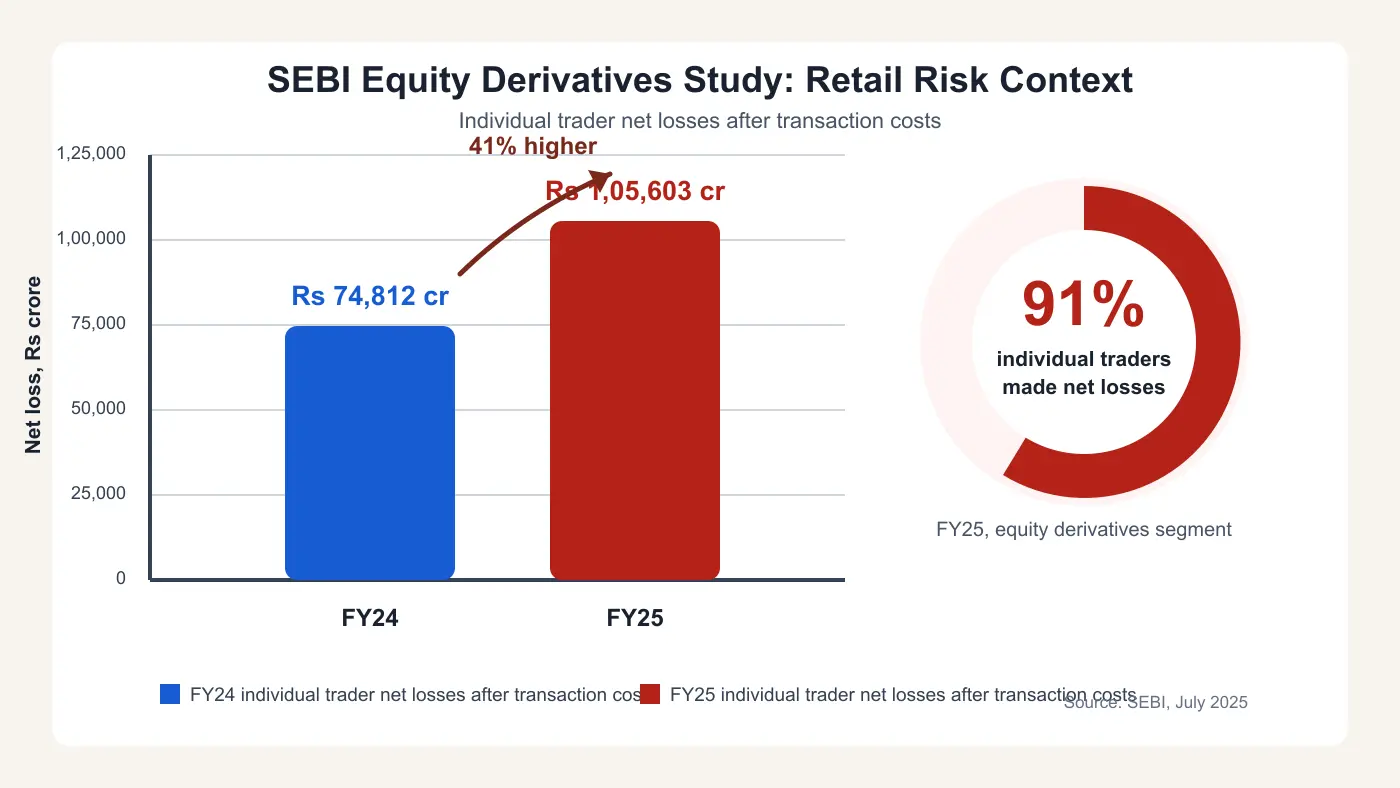
| SEBI indicator | Reported value | What it means for traders |
|---|---|---|
| Individual trader net losses in FY24 | Rs 74,812 crore | Losses were already very large before the FY25 increase. |
| Individual trader net losses in FY25 | Rs 1,05,603 crore | SEBI reported a 41% widening from FY24 after transaction costs. |
| Individual traders with net losses in FY25 | Over 91% | F&O should not be treated as an easy income product. |
| Individual traders with losses during FY22 to FY24 | 93% | The loss pattern has persisted across multiple years. |
These numbers do not say that risk management is optional. They say the opposite.
Mistake 3: Selling Options Without Understanding Obligation
Many beginners focus on premium received and ignore the obligation behind the trade. An option seller can face large mark-to-market pressure, margin changes and sharp losses when volatility or price movement expands.
NSE's equity derivatives margin material explains that NSE Clearing uses an online margining system and SPAN-based risk calculations, and that upfront margins such as SPAN margin and extreme loss margin are part of F&O risk containment. A trader should therefore ask whether the trade can survive an adverse move, not only whether the entry looks attractive.
Mistake 4: Trading Too Large For The Account
Position size is often the silent mistake. A trade can look small because the premium is small, but the exposure, lot size, margin requirement and possible gap risk may be much larger than expected.
Before entering a trade, write down:
- capital available only for high-risk trading;
- maximum rupee loss acceptable on one trade;
- stop or adjustment rule;
- margin requirement and possible margin increase;
- liquidity and bid-ask spread;
- transaction costs and tax impact; and
- a rule for stopping after a loss limit is reached.
Mistake 5: Averaging Losses And Moving The Stop
Adding to a losing F&O trade without a fresh, written risk reason can turn one error into a capital-damaging event. Moving the stop only because the trade is uncomfortable is not risk management.
A disciplined trader should know where the idea is wrong before placing the trade. If that level arrives, the decision should not depend on hope, social media commentary or the desire to recover immediately.
Mistake 6: Ignoring Records, Charges And Complaints Process
SEBI's investor do's and don'ts advise investors to keep contract notes, account statements, records of payments and documents signed, and to check trades and balances regularly. These are not only administrative tasks. They help detect unauthorized trades, unexpected charges, margin issues and unsuitable activity.
Investors should also avoid unregistered intermediaries, hot tips, cash dealing and sharing passwords. If there is a dispute, records make escalation easier.
What A Better F&O Review Desk Looks Like

The visual shows the right mindset: a trading journal, risk worksheet, calculator, margin papers and colored risk markers before the next order. The trade comes after the risk review, not before it.
For every F&O trade, keep the written answer to three questions:
- What is the risk if this trade is wrong?
- What event forces an exit or adjustment?
- Is this trade still suitable after costs, margin and liquidity are considered?
Investor Checklist
Before taking an F&O position, check:
- Do I understand whether this is a futures, option-buying or option-selling position?
- Have I read the contract specifications and margin requirement?
- Is the trade size small enough for the capital at risk?
- Do I know the maximum intended loss and the action if that level is reached?
- Have I checked liquidity, bid-ask spread and expiry risk?
- Am I using F&O for a documented hedge or only for speculation?
- Can I afford the loss without using emergency money or borrowed funds?
Bottom Line
The most common F&O mistakes are not only technical. They are behavioral: overconfidence, oversized trades, weak documentation, ignoring costs and refusing to exit.
F&O trading requires preparation before prediction. If the risk plan is unclear, the trade is not ready.
Source Links
- SEBI press release: Updated study on individual traders in equity F&O, September 2024
- SEBI press release: Comparative study of growth in equity derivatives segment, July 2025
- SEBI Investor: Understanding derivatives
- SEBI Investor: Do's and Don'ts of Investing in Securities Market
- NSE: Equity derivatives risk management
- NSE: Equity derivatives margins
Disclaimer
This article is for investor education only and is not investment advice, trading advice, research recommendation, solicitation or an offer to buy or sell securities or derivatives. Equity derivatives are high-risk products and may not be suitable for all investors. F&O trades can result in loss of capital and additional obligations due to leverage, margins, volatility, liquidity and transaction costs. Please consult a SEBI-registered investment adviser or other qualified professional before taking investment or trading decisions. Reviewed by Abhipra Research / Compliance Team.