Algo Trading For Retail Investors: What To Know Before You Automate
Algo trading can make order execution faster, but speed does not make a trading idea suitable, profitable or safe. For a retail investor, the useful question is not "Can I automate this?" It is "Can I explain the strategy, control the loss, protect my login, and trace every order?"

What Algo Trading Means For A Retail Investor
SEBI's 2012 algorithmic trading circular defines algorithmic trading as any order generated using automated execution logic. In simple terms, the system decides when to place, modify or cancel orders based on pre-set rules.
That can help with disciplined execution, but it can also magnify a bad idea. An error that a human might place once can be repeated many times if the code, data feed, broker API connection or risk limit is wrong.
The Regulatory Position Changed In 2025
SEBI issued a retail-algo framework on 4 February 2025 to facilitate safer participation of retail investors in algorithmic trading through brokers. The framework places responsibility on brokers and exchanges, and it covers broker APIs, algo tagging, exchange registration, empanelled providers, authentication, surveillance and kill-switch controls.
SEBI later extended the implementation path. Its 30 September 2025 circular states that brokers ready with systems could go live from 1 October 2025, sets milestones up to 3 January 2026, restricts non-compliant brokers from onboarding new retail clients for API-based algo trading from 5 January 2026, and makes the framework applicable for all stock brokers from 1 April 2026.
The Guardrail Chart
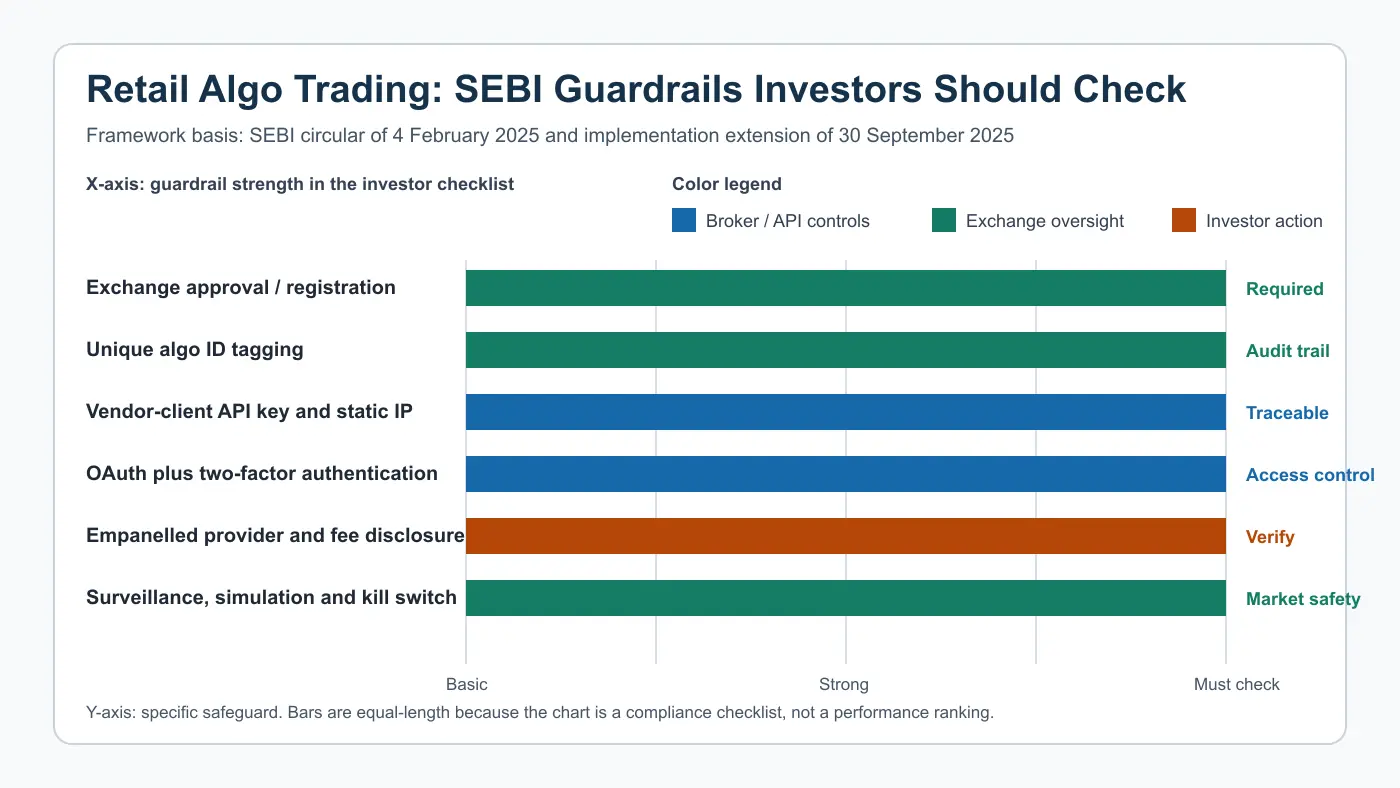
The chart maps six checks a retail investor should verify before using any API-based algo facility. It is not a return chart. The equal bars show that each item is part of the minimum safety stack: exchange approval or registration, unique algo ID tagging, broker-controlled API access, OAuth and two-factor authentication, empanelled provider oversight, and exchange surveillance with kill-switch capability.
| Investor check | What it means in practice | Why it matters |
|---|---|---|
| Exchange approval or registration | Broker-provided algo facilities need exchange permission for each algo; some self-developed high-order-rate algos also need registration through the broker. | It creates a formal checkpoint before automation enters the market. |
| Unique algo identifier | Algo orders through broker APIs must be tagged with a unique identifier provided by the exchange. | It supports audit trail and post-event review if something goes wrong. |
| API access controls | SEBI requires brokers not to permit open APIs and to allow access only through unique vendor-client API keys and static IP whitelisting. | It improves traceability of the algo provider and end investor. |
| OAuth and two-factor authentication | The broker API access model is expected to use OAuth-based authentication and two-factor authentication. | Investors should not share broker passwords or static credentials with third-party tools. |
| Empanelled provider and fee disclosure | Algo providers using broker APIs need exchange empanelment, and brokers must handle related complaints. Charges must be prominently disclosed. | It reduces the risk of untraceable vendors, undisclosed costs and unclear accountability. |
| Surveillance and kill switch | Exchanges are expected to supervise algo orders, simulate-test algos, monitor behaviour and retain kill-switch capability. | It provides a market-safety backstop if an algorithm malfunctions. |
Questions To Ask Before Using Any Algo
- Can you explain the rule in plain language without relying on the vendor's promise?
- Is the strategy white-box, where the logic is disclosed and understandable, or black-box, where the logic is not visible to you?
- What is the maximum loss per trade, per day and per month?
- What happens if the internet connection, data feed, broker app or vendor server fails?
- Can you pause or stop the algo immediately?
- Are all fees, brokerage, subscription charges and conflicts disclosed?
- Do you have a complete order and trade audit trail?
Common Mistakes Retail Investors Should Avoid
Do not share your broker login password with any app, vendor or informal group. Do not run an algo on borrowed money or emergency savings. Do not treat back-tested results as proof of future performance. Do not use leverage unless you fully understand margin calls, order rejection, gap risk and the possibility of fast losses.
Also avoid running multiple strategies just because automation makes it easy. More rules can mean more hidden interactions, more open orders and more operational risk.
What The Infographic Shows

The visual shows the practical sequence before automation: keep API credentials controlled, define risk limits, maintain an audit trail, separate trading capital from family savings, and keep an emergency stop process ready. If any one of these is missing, the investor should pause before activating the algo.
Practical Abhipra Checklist
Use algo trading only after the product, broker API, provider, charges and risk controls are clear. Treat automation as an execution tool, not as investment advice. A suitable investment or trading decision still depends on capital, experience, risk appetite, time horizon, tax impact and ability to absorb losses.
Reviewed by Abhipra Research / Compliance Team.
Source Links
- SEBI circular dated 4 February 2025 on safer participation of retail investors in algorithmic trading
- SEBI circular dated 30 September 2025 extending the retail algo implementation timeline
- SEBI broad guidelines on algorithmic trading, 30 March 2012
- NSE page on algorithmic trading
Disclaimer
This article is for educational and informational purposes only. It should not be considered investment advice, trading advice, tax advice or insurance advice. Investments in securities market are subject to market risks. Please read all related documents carefully before investing. Past performance is not indicative of future returns. Please consult a qualified financial advisor, tax advisor or insurance advisor before making any financial decision.