How To Use Options For Hedging, Not Gambling
Options can be a useful risk-management tool, but the purpose of the trade matters. A hedge starts with an existing risk that needs protection. A gamble usually starts with a market view, leverage, and the hope that a short-term move will rescue the trade.

Start With The Risk You Already Own
Before choosing a call, put, spread or collar, write down the exposure you are trying to protect. For example, an investor who already owns a concentrated stock position may be worried about a sharp fall over the next few weeks. A trader who has no such exposure but buys weekly options only because the premium looks small is not hedging; that is a directional bet.
SEBI’s investor education material explains that derivatives are primarily used for hedging and minimising price risk, while also noting their use in speculation and arbitrage. It also warns that leverage can multiply losses when the decision is wrong.
A Hedge Has Three Boundaries
A practical option hedge should define three limits before the order is placed:
- The asset or portfolio being protected.
- The time period for which protection is needed.
- The maximum premium, margin, or opportunity cost that the investor is willing to bear.
A protective put can reduce downside risk in a stock or portfolio, but the premium is a real cost. A covered call may collect premium against shares already held, but it can cap upside if the share rises sharply. A collar combines a long put and a short call, which may reduce net cost but also limits the outcome on both sides. None of these structures removes the need to understand liquidity, expiry, taxes, brokerage, STT and margin obligations.
Why The Gambling Mindset Is Dangerous
SEBI’s published studies show why retail investors should be careful with equity derivatives. In September 2024, SEBI reported that 93% of individual traders incurred losses in equity F&O during FY22-FY24, with aggregate losses exceeding Rs 1.8 lakh crore over the three years. In July 2025, SEBI’s follow-up equity derivatives study reported that nearly 91% of individual traders incurred net losses in FY25 and that individual trader net losses widened to Rs 1,05,603 crore, up 41% from FY24.
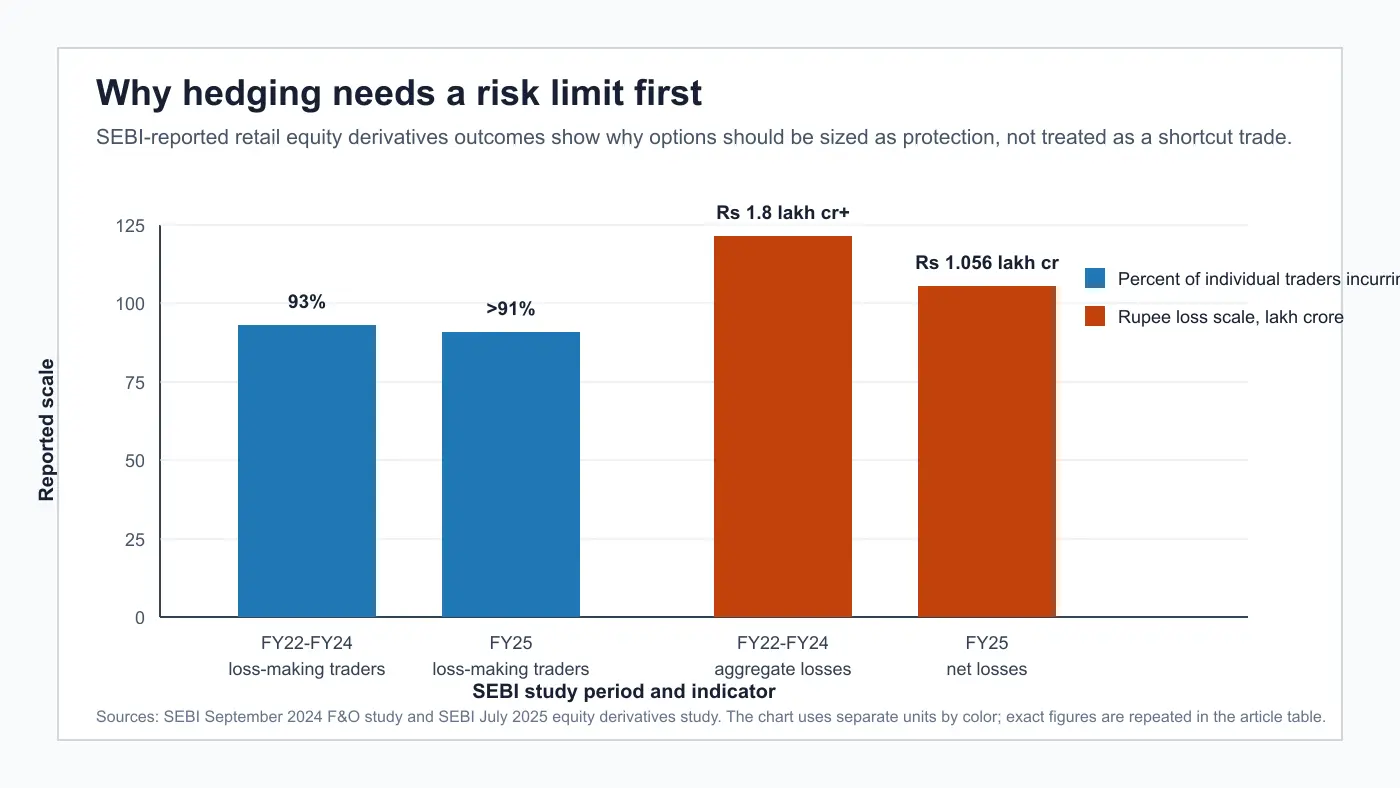
| Study period | Indicator | Reported figure | Investor lesson |
|---|---|---|---|
| FY22-FY24 | Individual traders incurring losses in equity F&O | 93% | Use options only when the risk being hedged is clear. |
| FY22-FY24 | Aggregate individual trader losses | More than Rs 1.8 lakh crore | Small premiums can still lead to large repeated losses. |
| FY25 | Individual traders incurring net losses in equity derivatives | Nearly 91% | Do not confuse frequent trading with a controlled risk plan. |
| FY25 | Individual trader net losses after costs | Rs 1,05,603 crore, up 41% from FY24 | Costs, expiry pressure and leverage must be counted before trading. |
A Simple Hedge Checklist
Use this checklist before placing an option order:
- What existing holding or liability is being protected?
- What fall or adverse move would hurt the portfolio?
- Which option structure reduces that specific risk?
- What is the premium, margin, brokerage, STT and tax impact?
- What happens if the market rises, falls, or stays flat?
- Can the position be exited in a liquid market before expiry?
- Is the maximum loss acceptable without borrowing or disturbing family savings?
If the answer to the first question is unclear, the trade is probably not a hedge.
What The Infographic Shows

The visual shows the correct order of thinking: portfolio exposure first, protection objective second, option structure third, and trade size last. A disciplined hedge should feel like buying protection for a known risk, not like chasing a quick profit from volatility.
Common Mistakes
- Buying options only because the premium looks affordable.
- Using weekly expiry contracts without a written risk reason.
- Treating margin availability as permission to take a larger position.
- Ignoring time decay, liquidity and transaction costs.
- Adding more trades after losses instead of reviewing the original thesis.
- Calling a directional bet a hedge after the trade has already gone wrong.
Source Links
- SEBI Investor: Understanding derivatives
- SEBI Investor: Key risks in investing in securities market
- SEBI September 2024 study on individual equity F&O trader losses
- SEBI July 2025 study on equity derivatives trading after recent measures
- NSE equity derivatives margin information
- CFA Institute refresher reading on options strategies
Reviewed by Abhipra Research / Compliance Team.
Disclaimer
This article is for educational and informational purposes only. It should not be considered investment advice, trading advice, tax advice or insurance advice. Investments in securities market are subject to market risks. Please read all related documents carefully before investing. Past performance is not indicative of future returns. Please consult a qualified financial advisor, tax advisor or insurance advisor before making any financial decision.