
Who Can Establish an AIF in India? Applicant, Sponsor, Manager and Legal-Structure Requirements
Reviewed on: 3 November 2026. Reviewed by Abhipra RTA Desk.
An Alternative Investment Fund (AIF) is not established simply by forming an entity. Under the SEBI AIF Regulations, an AIF is a privately pooled vehicle established or incorporated in India as a trust, company, LLP or body corporate, subject to registration and the applicable eligibility conditions. The applicant, sponsor, manager, investment team, constitutional documents and proposed strategy must fit the current framework.

Start with the applicant and legal form
The AIF Regulations recognise a trust, company, LLP or body corporate. The constitutional document must permit AIF activity; it must not invite the public to subscribe. A trust instrument must be a registered deed, while an LLP must be duly incorporated and have its deed filed as required. The final structure should be selected with legal, tax and operational advice rather than treated as a standard template.
Sponsor, manager and investment team
The sponsor sets up the AIF; for a company this includes its promoter, and for an LLP its designated partner. The manager is the person or entity appointed to manage investments and may also be the sponsor. SEBI assesses the applicant, sponsor and manager under fit-and-proper criteria. The manager/sponsor must have necessary infrastructure and manpower, and the manager’s key investment team must meet the current certification and professional-qualification conditions, subject to the regulations’ applicable exceptions.
What the registration evidence needs to address
| Area | Why it matters | Evidence to validate |
|---|---|---|
| Legal form | Establishes the applicant vehicle | Constitutional document and registrations |
| Roles | Allocates responsibility and oversight | Sponsor, manager and key-team records |
| Operating capacity | Supports the activity proposed | Infrastructure, manpower and controls |
| Fund proposition | Lets SEBI assess the application | Objective, targeted investors, corpus, strategy and tenure |
The regulations require the applicant to clearly describe its investment objective, targeted investors, proposed corpus, investment style/strategy and proposed fund or scheme tenure at registration. A future AIF should therefore build a reviewable evidence pack before treating launch timing as committed.
Formation workflow before seeking registration
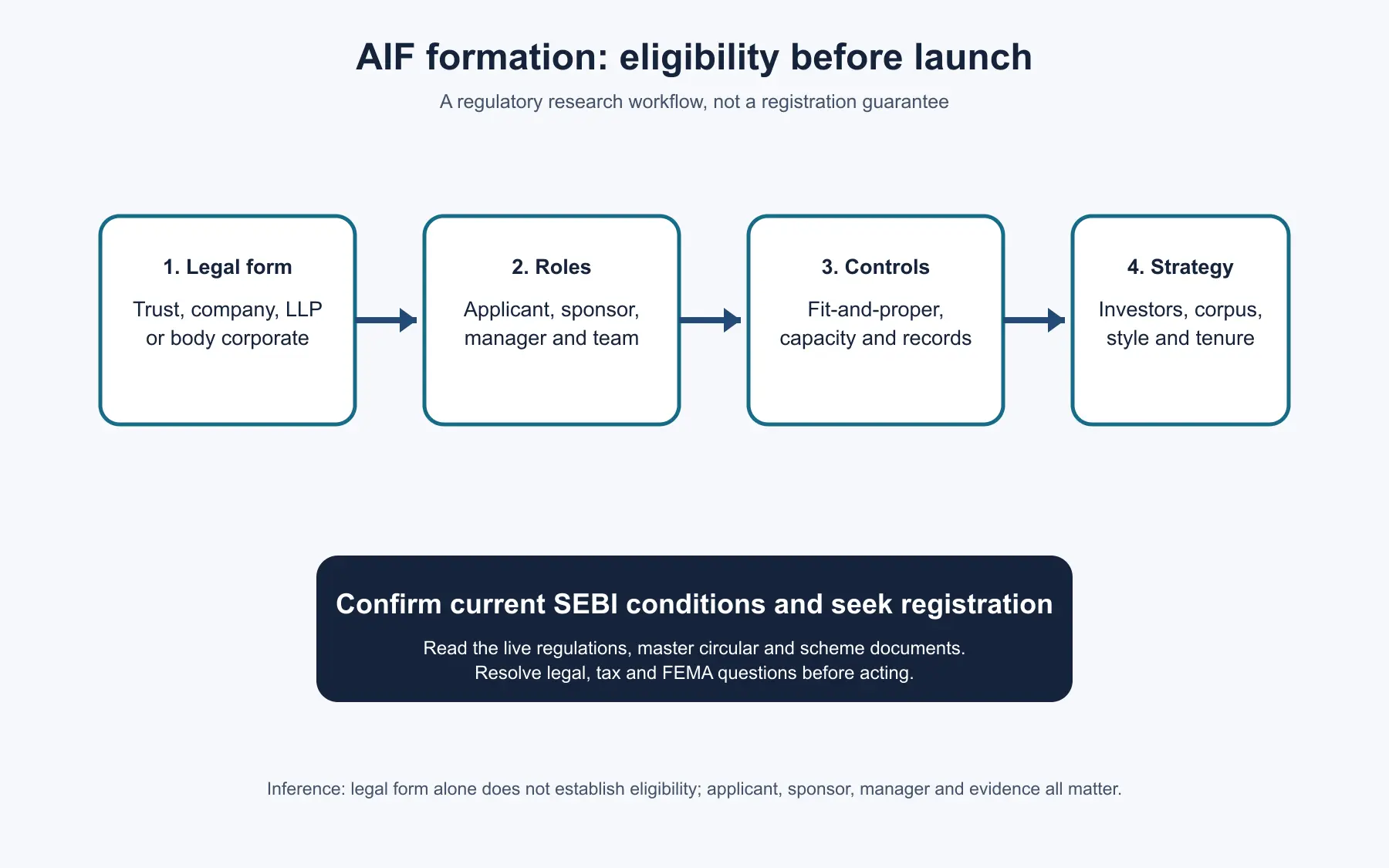
This workflow has no numerical axis because it maps eligibility evidence rather than performance. Its inference is that choosing a legal form is only the first step: eligibility depends on the applicant, sponsor, manager, controls and the documented proposition. Current regulations and SEBI communications remain authoritative.
RTA and operational readiness
An RTA may support unit-holder records, investor communications, unit workflows and depository-facing operations within its mandate after the relevant structure and scheme processes are established. It does not replace the manager, sponsor, trustee, custodian, valuer, auditor, legal adviser, tax adviser or regulatory approvals. Do not send passwords, OTPs, unmasked PAN, bank details or signatures by email; wait for a secure submission route.

How Abhipra can assist
Setting up or operating an AIF and evaluating RTA, dematerialised-unit, ISIN, depository or unit-holder servicing support? Contact Abhipra RTA Services at rtaservices@abhipra.com, call 011-42390783, or contact +91-9818080700. Share only high-level, non-sensitive details until a secure submission route is confirmed.
Official sources
- SEBI AIF Regulations, 2012—consolidated through 15 October 2026
- SEBI Master Circular for Alternative Investment Funds, 3 June 2026
- SEBI guidelines on first close, tenure and sponsor/manager changes
Disclaimer
This is general regulatory education, not legal, tax, accounting, valuation, FEMA or investment advice. Registration, structure, eligibility, documents and investor arrangements depend on the current law and facts. Obtain professional advice before acting.