
Category I, II and III AIFs: Key Differences in Strategy and Regulation
Reviewed on: 30 October 2026. Reviewed by Abhipra RTA Desk.
Alternative Investment Funds (AIFs) are SEBI-regulated, privately pooled investment vehicles. The Category I, Category II and Category III labels matter because they connect a scheme’s actual mandate with its investment conditions, leverage treatment, disclosure rhythm and operating controls. They do not rank funds by safety, quality or likely return. Read the placement memorandum and current SEBI framework before making, marketing or operationalising an AIF decision.

The category is a regulatory fit, not a performance rating
SEBI’s consolidated AIF Regulations, last amended on 15 October 2026, require an AIF to register in a category. At a high level, Category I covers specified development-oriented areas; Category II is the category for funds that do not fall within Category I or III and do not take leverage or borrowing except as permitted for day-to-day operations; and Category III is for diverse or complex trading strategies that may employ leverage, including through listed or unlisted derivatives.
The distinction should start with the scheme’s written investment strategy—not a fund’s name, a recent return or an investor’s tax preference. A promoter, manager and professional adviser should map the proposed strategy to the current regulations, the placement memorandum and each applicable SEBI circular. A retail-style “best category” answer would be misleading.
Category I: specified development-oriented mandates
Category I AIFs invest in start-ups or early-stage ventures, social ventures, SMEs, infrastructure or other sectors or areas that the Government or regulators consider socially or economically desirable. The regulations include venture capital, SME, social-impact and infrastructure-focused sub-categories within the Category I framework, subject to their current conditions.
For an operations team, the practical question is whether the stated investment focus, portfolio controls and scheme disclosures genuinely support the selected sub-category. A Category I label is not a guarantee of public support, tax treatment, liquidity or portfolio performance. Those outcomes depend on the prevailing rules and the particular scheme.
Category II: the residual private-capital category
Category II is the regulatory home for an AIF that is neither Category I nor Category III and does not undertake leverage or borrowing except for permitted day-to-day operational requirements. Private-equity and debt-style strategies are commonly discussed in this context, but the legal classification must be tested against the live text and the individual scheme terms.
The absence of a Category I or Category III feature is not enough by itself. Managers should document why the proposed investment mandate, borrowing policy, valuation process, conflicts controls and investor disclosures fit the Category II conditions. Investors should examine lock-in/tenure, drawdown, transfer, valuation and exit terms rather than assuming that “Category II” describes a uniform risk profile.
Category III: complex trading and leverage-sensitive controls
Category III AIFs employ diverse or complex trading strategies and may employ leverage, including through investment in listed or unlisted derivatives. The regulations allow Category III funds to invest in listed or unlisted securities, derivatives, units of other AIFs and complex or structured products, subject to the applicable conditions. They also require periodic disclosure of leverage information and identify distinct operating and prudential areas for this category.
That makes the control environment especially important: independent NAV calculation from the fund-management function, documented leverage measurement, clear investor disclosures, limits monitoring and incident escalation should be designed before a scheme is offered. A Category III strategy can be open-ended or close-ended under the applicable framework; it should never be described as inherently liquid or suitable for every investor.
A practical comparison for the board, manager and investor
| Question | Category I | Category II | Category III |
|---|---|---|---|
| Regulatory focus | Specified early-stage, SME, social, infrastructure or other designated areas | Neither Category I nor III; no leverage/borrowing other than permitted operations | Diverse or complex trading strategies; leverage may be used subject to conditions |
| Common planning lens | Mandate and sub-category fit | Private-capital or credit mandate and leverage restriction | Trading design, derivatives and leverage governance |
| Control emphasis | Mandate evidence and scheme disclosures | Borrowing restriction, valuation and conflicts controls | NAV independence, leverage measurement and periodic disclosure |
| Investor inference | No category is a promise of return, liquidity, tax outcome or suitability. Check the placement memorandum and seek appropriate professional advice. | ||
Category-selection workflow before a scheme launch
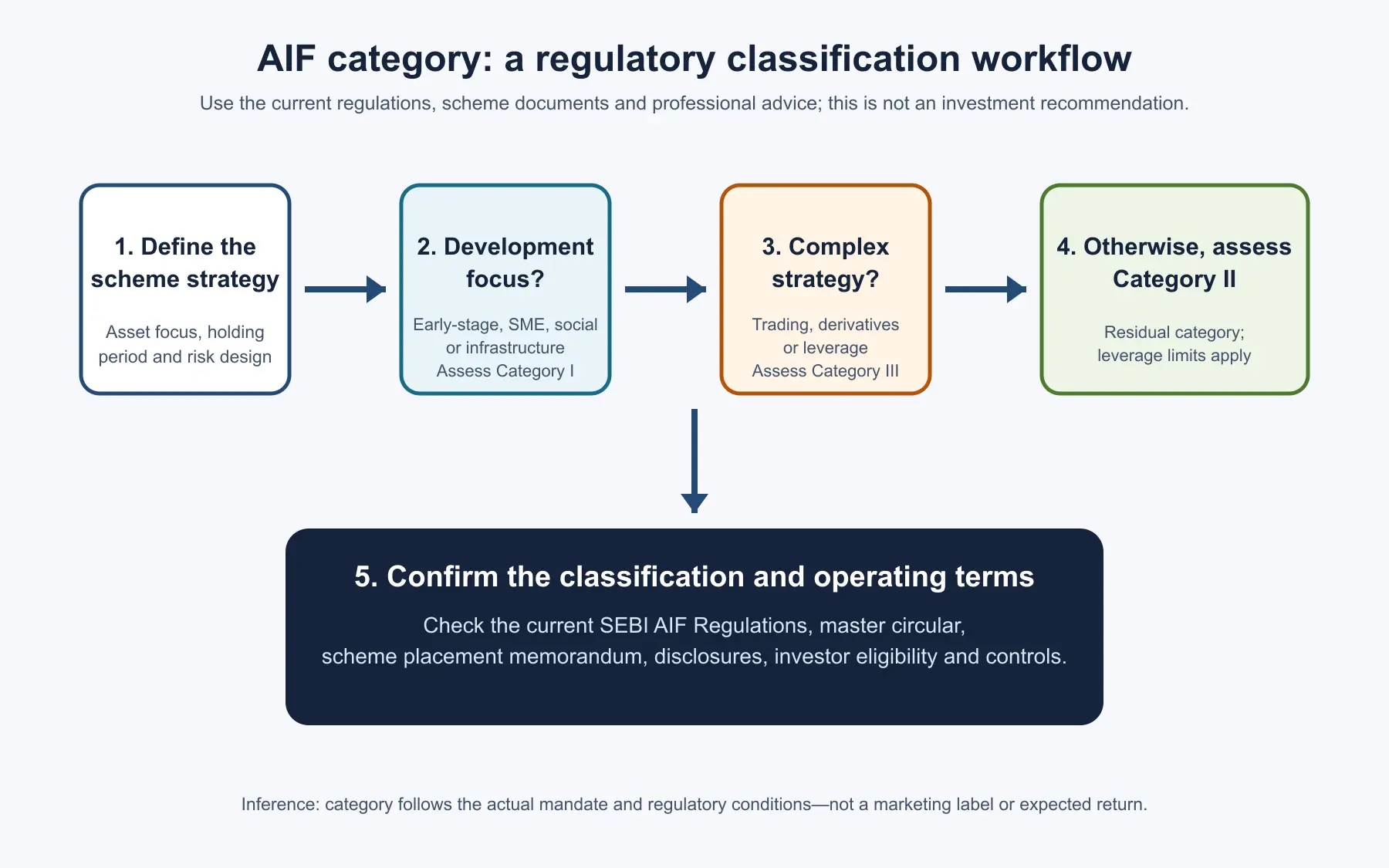
Start by defining the actual investment mandate, asset focus, holding period and risk design. If the focus is within the development-oriented Category I areas, assess that category and the relevant sub-category conditions. If the strategy uses complex trading, derivatives or leverage-sensitive features, assess Category III. If neither applies, assess whether the Category II conditions are met—including its restriction on leverage or borrowing other than permitted day-to-day operational requirements. In every path, conclude with a documented review of the current regulations, master circular, scheme placement memorandum and investor disclosures.
This is a decision workflow, not a chart of returns: it has no numeric axes because it compares regulatory conditions. Its inference is that classification follows the true strategy and applicable conditions, not a label chosen for marketing.
Records and RTA-ready operating controls
After classification, the manager’s operating design should connect investor onboarding, unit-holder records, unit issue/transfer/redemption instructions, valuation/NAV communications, complaints handling and reporting obligations. An RTA can support unit-holder records, scheme-level workflow controls, investor communications and depository-facing processes within its mandate. It does not replace the AIF manager, sponsor, trustee, custodian, valuer, auditor, legal adviser, tax adviser or SEBI-required approvals.

Useful evidence includes an approved placement memorandum, category rationale, investment-policy controls, documented valuation and disclosure calendar, investor communications record, maker-checker approvals and reconciled unit-holder data. Avoid sending unmasked PAN, bank-account information, signatures, passwords or OTPs over email; wait for a secure submission method.
How Abhipra can assist
Setting up or operating an AIF and evaluating RTA, dematerialised-unit, ISIN, depository or unit-holder servicing support? Contact Abhipra RTA Services at rtaservices@abhipra.com, call 011-42390783, or contact +91-9818080700. Share only high-level, non-sensitive details until a secure submission route is confirmed.
Official sources
- SEBI AIF Regulations, 2012—consolidated version last amended 15 October 2026
- SEBI Master Circular for Alternative Investment Funds, 3 June 2026
- SEBI GARUDA circular, 30 July 2026
- SEBI circular on reporting AIF unit values to depositories, 6 February 2026
Disclaimer
This article is general regulatory and operational education, not investment, legal, tax, accounting, valuation or FEMA advice. AIF suitability, classification, marketing, investor eligibility, tax treatment, leverage, valuation, liquidity and disclosure obligations depend on the current law, scheme documents and facts. Obtain advice from appropriately qualified professionals and have the applicable documents reviewed before acting.