
What Is an Alternative Investment Fund (AIF) in India—and Who Is It Designed For?
Reviewed on: 28 October 2026. Reviewed by Abhipra RTA Desk.
An Alternative Investment Fund (AIF) is a privately pooled investment vehicle established or incorporated in India. It collects money from sophisticated investors—Indian or foreign—and invests under a defined investment policy for those investors’ benefit. It is not the same as a mutual fund, and a SEBI registration or a professional fund manager does not make an AIF suitable for every investor.

The regulatory starting point
SEBI’s AIF Regulations, 2012 define the framework. SEBI’s current consolidated version is dated 15 October 2026. The June 2026 Master Circular remains an important operating reference, but readers should check it alongside later amendments and circulars before acting.
In broad terms, an AIF is privately pooled and follows a stated strategy. It is not a public mutual-fund offer. The fund documents—not an advertisement or a past return—set the strategy, fees, tenure, liquidity terms, governance and investor rights.
The three AIF categories at a glance
| Category | Regulatory direction in simple terms | Illustrative strategies | Investor question to resolve |
|---|---|---|---|
| Category I | Funds with positive economic or social spillover that may receive regulatory or government incentives | Venture capital, SME, social venture, infrastructure | Can I bear long holding periods and the risk of early-stage or specialised assets? |
| Category II | Funds that do not fall in Category I or III and generally do not undertake leverage other than for permitted temporary funding needs | Private equity, debt and real-estate strategies | Do I understand concentration, valuation, drawdown and exit risk? |
| Category III | Funds that employ complex or diverse trading strategies and may use leverage, including through listed or unlisted derivatives | Hedge-fund-style and other trading strategies | Do I understand leverage, volatility, liquidity and the manager’s risk controls? |
Examples are descriptive, not a recommendation or a complete classification test. A scheme’s Private Placement Memorandum (PPM) and applicable SEBI requirements are controlling.
Who may find an AIF worth evaluating?
An AIF may be relevant to a sophisticated investor who can assess private-market or specialised-strategy risk, can commit capital under the fund’s terms, and has the time and expertise (or qualified regulated advice) to review the PPM, contribution agreement and fee model. It may also be used by institutional, family-office and other eligible investors seeking an allocation outside conventional public-market products.
That is a suitability discussion, not a return forecast. Illiquidity, delayed exits, concentration, valuation uncertainty, capital calls, conflicts and strategy-specific risk can be material. A fund’s minimum commitment, tenor and transfer terms must be checked in the current PPM; do not rely on generic internet summaries.
A decision workflow before making a commitment
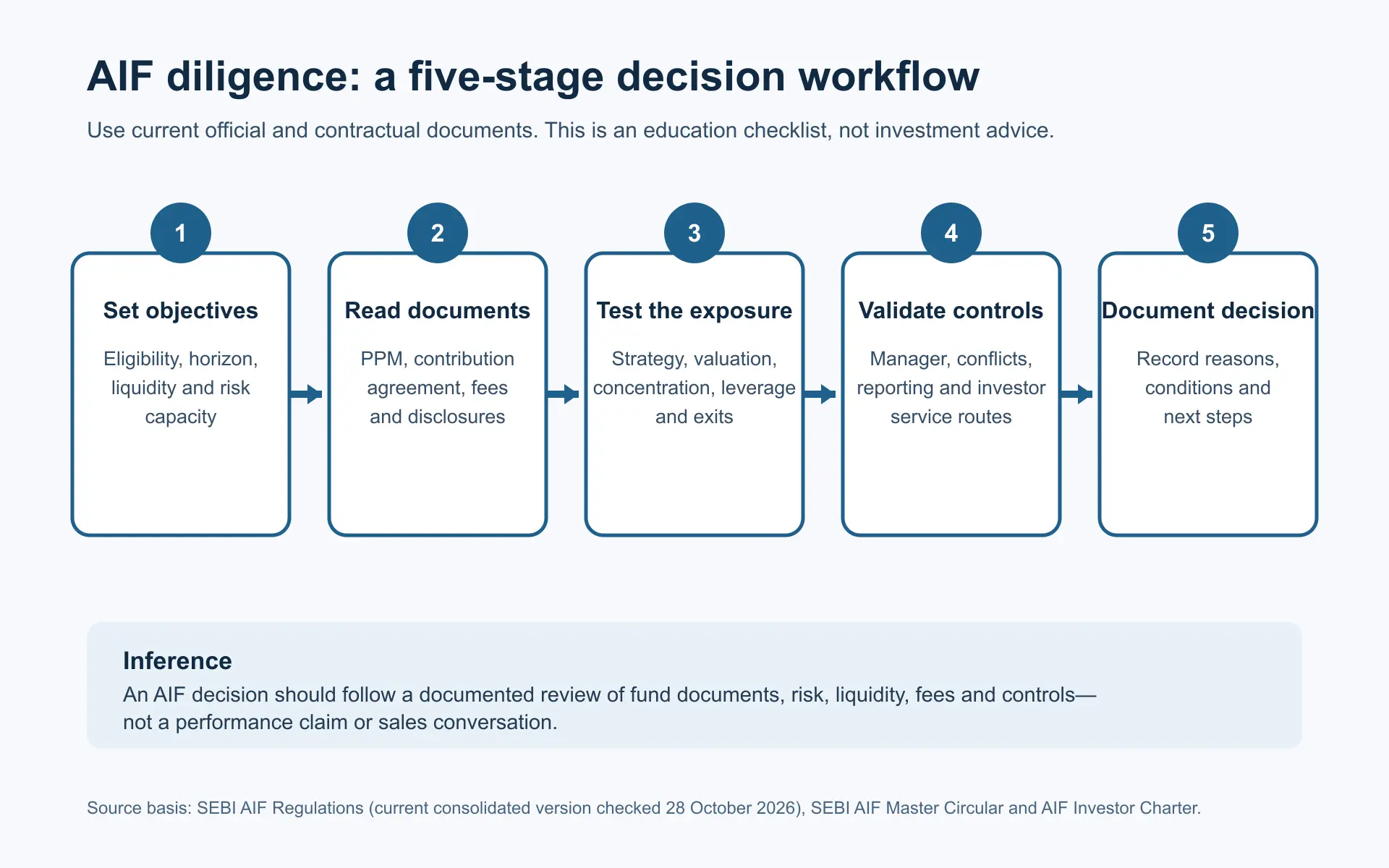
Start with eligibility and objectives. Then compare the written strategy with the investor’s risk capacity, liquidity needs and existing exposure. Read the PPM and contribution agreement carefully, including conflicts, fees, valuation, leverage where relevant, drawdown mechanics, reporting and grievance routes. Finally, validate the manager, fund administration and operational counterparties using current official and contractual information.
| Diligence area | Evidence to request or review | Why it matters |
|---|---|---|
| Strategy and mandate | Current PPM, investment policy and category | Tests whether the proposed exposure matches the stated fund mandate. |
| Economics and liquidity | Fees, expenses, capital-call process, tenure, transfer and exit terms | A return headline alone does not capture cash-flow timing or total cost. |
| Governance | Manager and sponsor roles, conflicts, valuation and reporting policy | Helps the investor assess oversight and decision accountability. |
| Investor service | Investor Charter, complaint process, contacts and periodic reporting | Makes communication and escalation channels clear before commitment. |
Investor protections and questions that should not be skipped
SEBI’s AIF Investor Charter requires registered AIFs to provide fund documents, supports disclosure of material risks and conflicts, and describes grievance-redressal routes. It also says investors should understand the fund documents, risks and fees, keep KYC information current, and recognise that terms do not guarantee future performance or returns.
Ask for a secure, authorised channel before sharing KYC or financial documents. Never send passwords, OTPs, unmasked PAN, bank details or signatures by ordinary email or messaging apps.
How Abhipra can assist
Abhipra’s RTA and depository-facing teams can help issuers, fund managers and eligible investors understand the operational records, dematerialised-unit, KYC and servicing workstreams that may arise around alternative-investment-fund structures. We do not replace an investor’s independent suitability assessment, a SEBI-registered investment adviser, legal counsel, tax adviser or the fund’s official documents. Contact Abhipra to arrange an appropriate, secure discussion.

Source links
- SEBI AIF Regulations, 2012—consolidated version last amended 15 October 2026
- SEBI Master Circular for AIFs, 3 June 2026
- SEBI’s AIF Investor Charter and complaint-disclosure circular
- SEBI GARUDA circular, 30 July 2026
Disclaimer
This article is general investor education, not investment, legal, tax, accounting or FEMA advice, and is not an offer, solicitation or recommendation to invest in any AIF. Regulations, circulars, scheme documents and eligibility conditions can change. Obtain current written documents and appropriate professional advice before any decision.