
IPO Investor Grievances, Application Queries and Issue-Period Communications: Registrar Workflow
Reviewed on: 26 October 2026. Reviewed by Abhipra RTA Desk.
An IPO query should be routed by its subject, not merely by the closest email address. The registrar to the issue can help manage application, allotment and issue-period records, but ASBA blocking or unblocking, UPI bids, issuer disclosures and formal complaints may involve different entities. Use the contact details in the specific offer document and keep a dated, traceable record of every hand-off.

Start with the correct issue contact
The offer document identifies the issuer, registrar, lead manager, banks and other relevant contacts for that particular issue. As a practical routing guide, application or allotment-status questions may be directed to the registrar using the issue-specific channel; ASBA blocking or unblocking issues may need the relevant self-certified syndicate bank (SCSB); and UPI-bid matters may need the sponsor-bank route shown in the offer material. Do not assume that a generic contact route is current for every issue.
| Query or grievance type | Likely first route | Evidence that helps the case owner |
|---|---|---|
| Application, bid, allotment or issue communication | Registrar-to-the-issue contact in the offer document | Application/reference number, investor contact details and issue-specific acknowledgement |
| ASBA block or unblock | Relevant SCSB / designated bank route | Application reference and bank/channel acknowledgement; do not email account credentials |
| UPI bid or mandate issue | Sponsor-bank / issue-specific channel | Application reference, UPI-app acknowledgement and time of attempt; do not share an OTP |
| Offer-document or issuer disclosure concern | Issuer / lead manager channel in the offer document | The specific page, statement, source and a concise factual description |
| Unresolved complaint against a SEBI-regulated entity | Concerned entity first, then SCORES if unresolved | Prior correspondence, dates, reference IDs and only the documents requested through an approved channel |
A controlled route from query to escalation
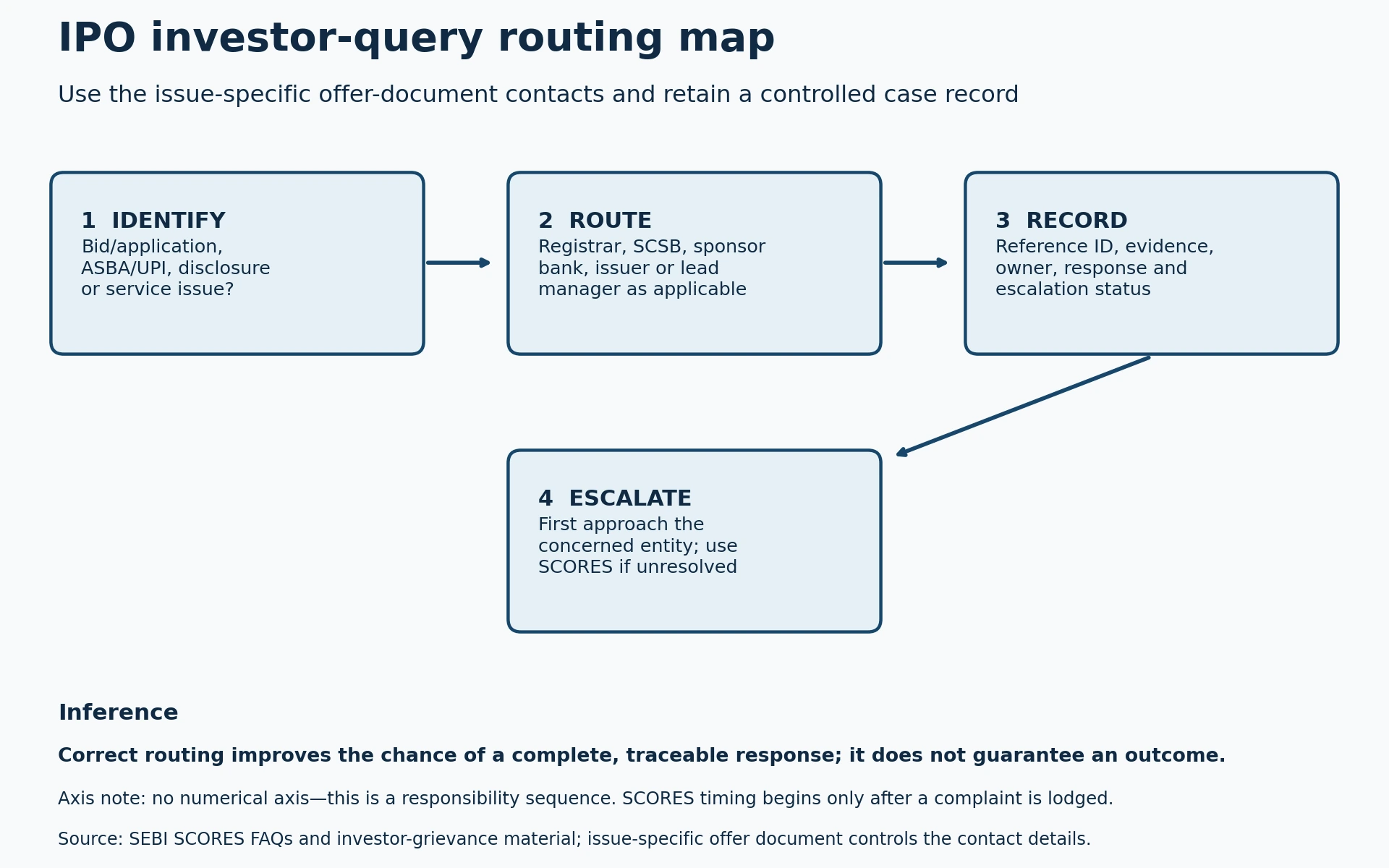
This is a responsibility sequence, so it has no numerical axis. Its inference is that correct routing improves the likelihood of a complete, auditable response but does not guarantee a resolution or override the issue-specific process. The timing rules on the SCORES platform apply only after a complaint is lodged there.
When SCORES is relevant
SEBI describes SCORES as a platform to facilitate complaints against listed companies, registered intermediaries and market-infrastructure institutions. SEBI’s investor guidance says to approach the concerned entity first. SCORES FAQs state that an entity must resolve the complaint and upload its Action Taken Report within 21 calendar days of receipt; the platform then supports review and escalation steps. Those platform timelines do not convert a routine application-status query into a SCORES complaint.
For a securities-market matter, SCORES requires a registered complaint workflow and prescribed KYC information. Never ask an investor to send passwords, OTPs, unmasked PAN, full bank details, signatures or account credentials by ordinary email. Direct the investor to the official portal or the approved contact/channel for the specific issue.

Controls for the issuer, lead manager and registrar
- Give every investor contact a reference ID, received time, owner and classified category.
- Preserve the original request, response, source system lookup, outbound communication and escalation reason.
- Use role-based access and minimise exposure of PAN, bank, demat and application data in service tools and logs.
- Tell investors what can be confirmed, what needs another entity and which contact is authoritative for the issue.
- Do not promise an allotment, refund, unblock, listing result or response time outside the applicable process.
How Abhipra can assist
Abhipra can help issuers and intermediaries design an investor-communication register, RTA hand-off map, escalation evidence pack and privacy-conscious operating checklist for an IPO workstream. Actual complaint handling, bank/depository actions, allotment outcomes and disclosure obligations remain with the appointed entities and the applicable issue documents and regulations.
Source links
- SEBI investor grievance redressal guidance — official overview of first approaching the concerned entity and then using SCORES if needed.
- SCORES FAQs — current official platform FAQs, including the 21-calendar-day Action Taken Report process and complaint workflow.
- SCORES home — official registration, complaint, status-tracking and review overview.
- NSE complaint guidance — official exchange options for investor complaints against listed companies and trading members.
- SEBI investor charter for SME IPOs/FPOs — official role-routing reference; use the relevant current offer document for actual issue contacts.
Disclaimer
This article is general educational information reviewed on 26 October 2026. It is not legal, regulatory, merchant-banking, banking, tax or investment advice and is not a promise of grievance resolution. The correct contact, evidence, scope and process depend on the offer document, entity and issue facts. Obtain issue-specific assistance from the appointed entities and suitably qualified professionals. REQUIRES HUMAN LEGAL AND EDITORIAL REVIEW before publication.