
SME IPO Draft Offer Documents and Public Comments: Understanding the Current Filing Route
Reviewed on: 25 October 2026. Reviewed by Abhipra RTA Desk.
For an SME IPO, the draft offer document is not simply an internal working file. The current SME framework requires it to be made public for comments for at least 21 days after filing with the SME exchange. The issuer, lead manager and RTA need a controlled record of the version filed, comments received and changes made; public availability is not an approval, investment recommendation or confirmation that the issue will open.

What the SME draft stage requires
Under Regulation 247 of the SEBI ICDR Regulations, the draft offer document filed with the SME exchange must be hosted for public comments for at least 21 days from filing on the issuer’s, proposed SME exchange’s and associated lead manager’s websites. The issuer must also make the required public announcement within two working days of filing, inviting comments on the disclosures.
After that comment period, the lead manager must file with the SME exchange the comments received by it or the issuer and any consequential changes required in the draft offer document. The obligation is to capture, assess and document relevant input—not to accept every comment or treat the comment process as a vote.
| Stage | Primary owner | Minimum control evidence |
|---|---|---|
| Draft filing | Issuer and lead manager | Filed version, filing acknowledgement, version register and supporting source pack |
| Public access | Issuer, SME exchange and lead manager | URLs, access/date check and preserved public-announcement evidence |
| Comment intake | Issuer and lead manager | Dated log, source/channel, subject, owner and response decision |
| Consequential changes | Lead manager with issuer and advisers | Change log, reviewer approvals and revised disclosure evidence |
| Issue readiness | Appointed intermediaries | Current exchange, RoC, SEBI and statutory filing confirmation for the actual issue route |
Timing map for public availability and feedback
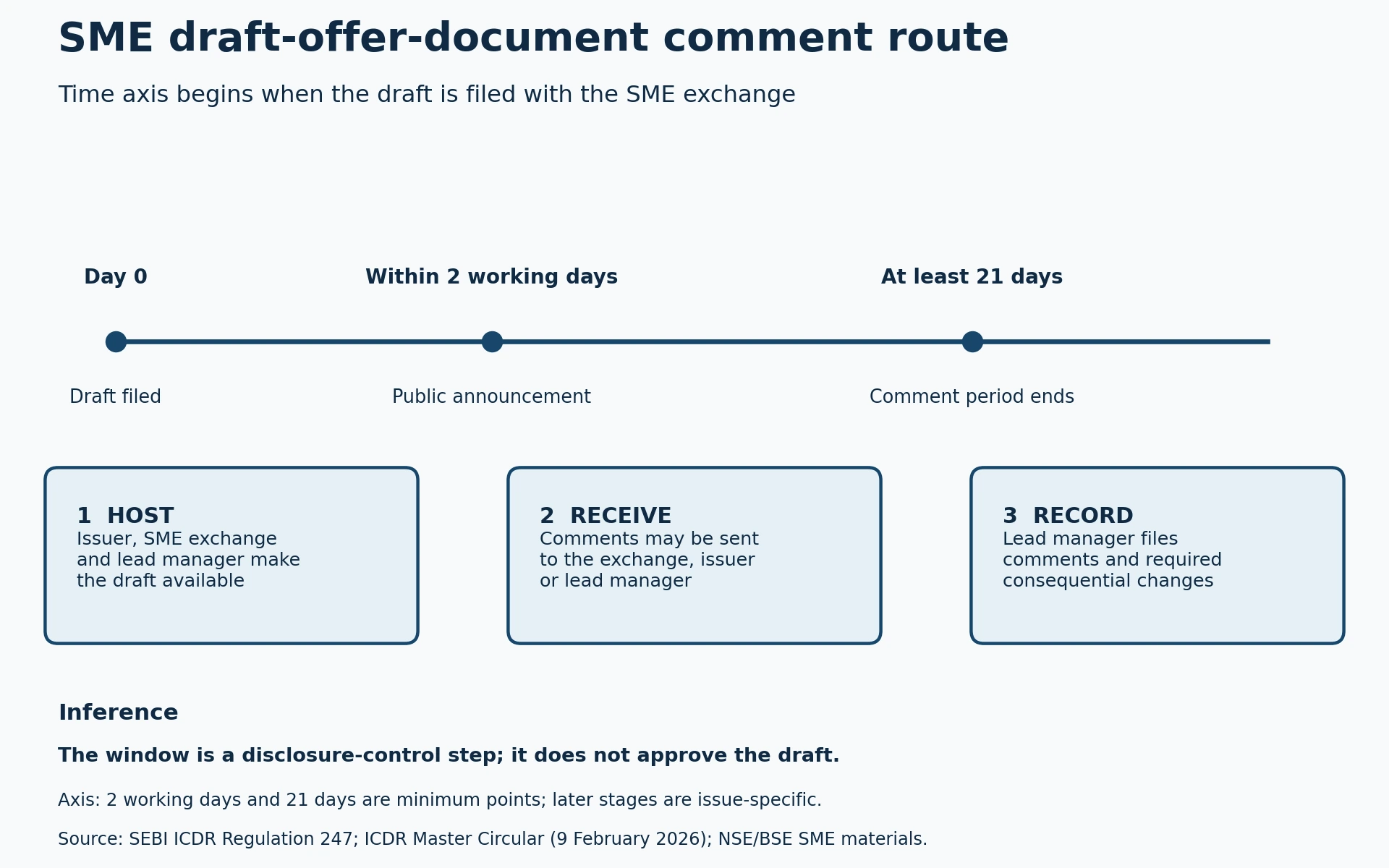
The horizontal axis starts on the filing date with the SME exchange. Its labelled points are the two-working-day deadline for the public announcement and the minimum 21-day public-comment period. The inference is that the early filing window is an auditable disclosure-control stage; it is not a universal IPO calendar. Exchange vetting, observations, updates, approvals and issue-opening dates must be confirmed for the particular transaction.
Public comments are about disclosures, not market sentiment
Comments should be handled through the channels identified in the applicable public announcement or exchange notice. A sound issuer-side process separates three questions:
- Does the input identify a factual error, missing material information or an unclear disclosure?
- Which appointed professional owns the assessment and what evidence supports the decision?
- Does the assessment require a consequential change, clarification, addendum or a documented no-change rationale?
Do not solicit, circulate or rely on grey-market-premium claims, price predictions, subscriber forecasts or promotional content outside the applicable offer-document and publicity framework. SEBI’s 2026 enforcement order concerning an SME IPO underscores the risk of public communications that are misleading or not contained in the offer document.

Keep the document and data trail controlled
- Maintain one authoritative draft, with a version number, owner, timestamp and evidence links.
- Reconcile promoter/shareholding, capital-structure, litigation, financial and corporate-action inputs before a revised draft is released.
- Ensure the proposed registrar-to-the-issue can map the application, allotment, investor-communication and depository workstreams without receiving unnecessary sensitive data.
- Preserve comments, responses, approvals and final filing evidence in access-controlled transaction records.
- Do not send passwords, OTPs, unmasked PAN, bank details, signatures or investor files by ordinary email. Wait for an approved secure submission channel.
A current consultation is not a rule change
SEBI published an SME-IPO consultation paper on 14 October 2026. It contains proposals, including potential changes to parts of the SME framework, but it is not final law or an operative amendment. This article therefore describes the current Regulation 247 route and flags the consultation only for monitoring. REQUIRES HUMAN LEGAL REVIEW before any live filing decision.
How Abhipra can assist
Abhipra can help an issuer establish the evidence register, shareholder-data and capital-structure reconciliation, draft-version controls, RTA hand-offs and secure document-request process that support an SME IPO workstream. Eligibility, disclosure conclusions, filing strategy, public communications and issue timing must be settled with the appointed merchant banker, legal advisers, auditors and the relevant exchange.
Source links
- SEBI Master Circular for Issue of Capital and Disclosure Requirements — dated 9 February 2026; check the current ICDR consolidation and later amendments for every transaction.
- NSE Emerge requirements and process — current exchange process page; it says an issuer files the draft prospectus with the IPO-vetting checklist and cautions that exchange perusal is limited to listing requirements.
- BSE SME draft-offer-document notice example — official exchange notice illustrating the 21-day public-comment availability and identified comment channel.
- SEBI order concerning public communications in an SME IPO — final enforcement order published in May 2026; cited for publicity-control context, not as a general eligibility rule.
- SEBI’s SME-IPO consultation paper — published 14 October 2026; consultation only, not a final amendment.
Disclaimer
This article is general educational information reviewed on 25 October 2026. It is not legal, regulatory, merchant-banking, accounting, tax or investment advice, and it is not an invitation or recommendation to apply for securities. Rules, exchange procedures, document content and timing can change and depend on the issue structure. Obtain transaction-specific advice from appropriately appointed professionals. REQUIRES HUMAN LEGAL AND EDITORIAL REVIEW before publication.