
IPO Due Diligence: Corporate Records Merchant Bankers Commonly Request
Reviewed on: 22 October 2026. Reviewed by Abhipra RTA Desk.
Before an IPO filing, a merchant banker generally needs evidence that the proposed disclosures are accurate, complete and traceable. The exact request list varies by the issuer, issue type, exchange platform and professional engagement; it should be agreed with the lead merchant banker and legal advisers rather than treated as a universal statutory checklist.

Why record readiness matters before a draft offer document
SEBI’s ICDR framework places due-diligence responsibility on the lead merchant banker. The current ICDR Master Circular, dated 9 February 2026, consolidates relevant directions in force through 31 December 2025. Its due-diligence formats connect the draft offer document to the documents, materials and papers relevant to the issue. In practical terms, a company needs a controlled evidence trail—not just a collection of files.
Core corporate-record groups to prepare
1. Constitutional and corporate-history records
- Certificate of incorporation, current memorandum and articles, and the history of amendments.
- Board, committee and member approvals that support material capital, governance and transaction events.
- Statutory-register extracts and filings relevant to the proposed disclosures.
- A document index identifying the version, owner, date and source location for every key record.
2. Capital structure and shareholder evidence
- A current capitalisation table reconciled to the register of members and underlying approvals.
- Evidence for allotments, transfers, splits, bonus issues, consolidations, conversions, ESOP exercises, liens or pledges where relevant.
- Dematerialisation, ISIN and depository/RTA reconciliation records where they apply.
- Promoter, director and other material-holder records required for the disclosure and lock-in analysis.
The RTA can help reconcile the shareholder register, corporate-action history and depository-facing evidence. It does not replace the lead merchant banker’s diligence, the company’s disclosures or legal advice.
3. Financial, commercial and risk-supporting records
- Audited financial statements, restatement support and records supporting material financial disclosures.
- Material contracts, borrowings, security documents and related-party arrangements.
- Litigation, regulatory correspondence, intellectual-property and material commercial-dispute records where relevant.
- Details and approvals for the objects of the issue, use of proceeds and material business developments.
These categories are deliberately broad. A merchant banker may request additional evidence, explanations, confirmations and independently verifiable sources based on the issuer’s facts and the offer-document requirements.
A controlled five-stage record workflow
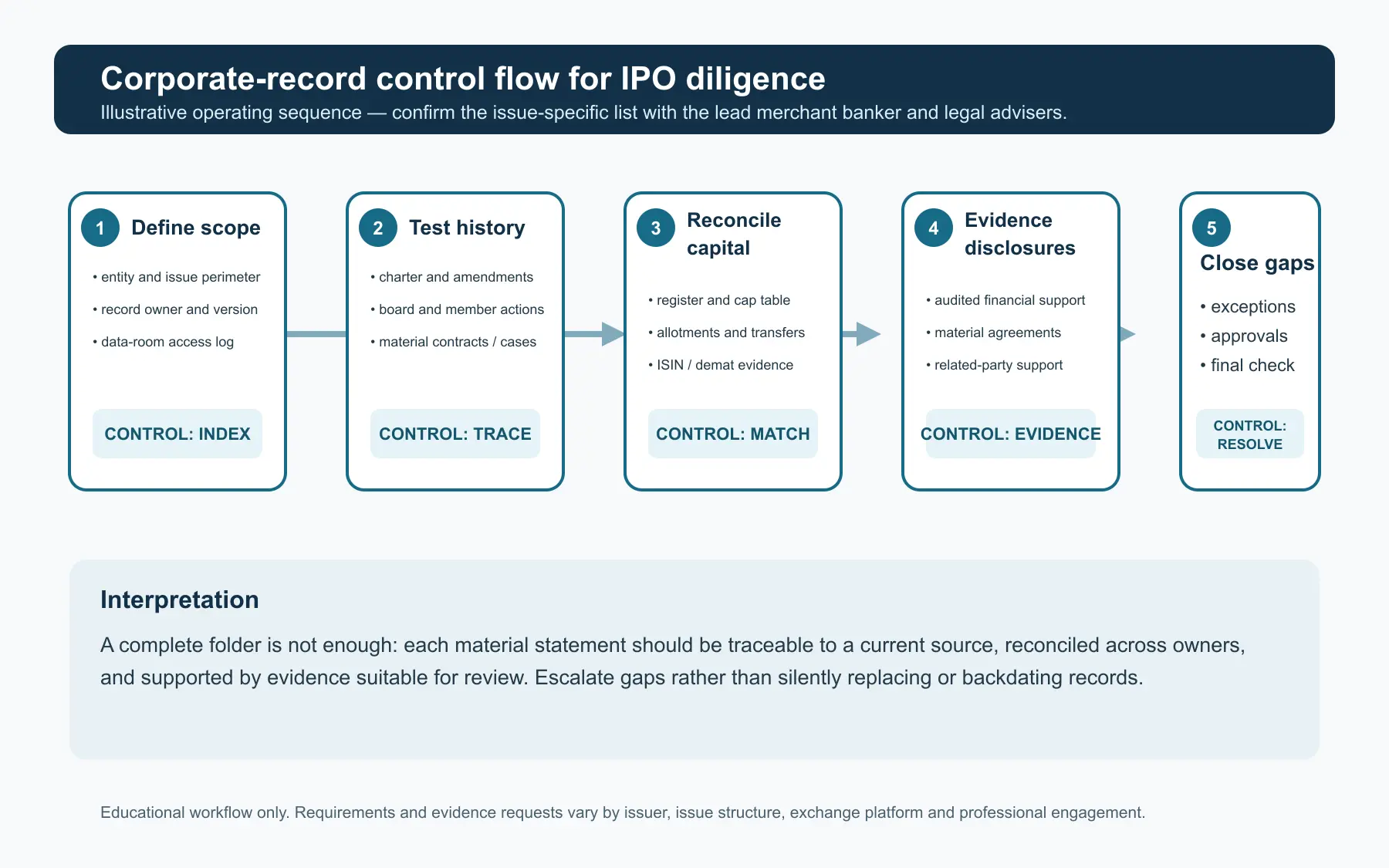
Start with an access-controlled index. Give each record a responsible owner, source and current-version status. Then trace corporate history, reconcile the capital and shareholder trail, match proposed disclosures to evidence, and log exceptions through resolution.
The workflow has no numerical axis because it is a sequence, not a measurement chart. Its inference is simple: reliability improves when the same fact can be traced across the corporate, financial and securities records, and unresolved differences are escalated before drafting.
Common avoidable problems
- Using an undated or superseded cap table when the statutory register or demat evidence differs.
- Filing scans without a document index, source owner or approval trail.
- Treating board approval as proof that a transaction was completed, without corresponding allotment, transfer or filing evidence.
- Leaving historical corporate actions, related-party items or material disputes to be reconciled late in drafting.
- Sharing sensitive shareholder or KYC material through unsecured email, unprotected public links or informal messaging channels.
A practical secure-request protocol
Use a role-based virtual data room or another approved secure channel. Limit access to the assigned diligence team, retain download and change logs, send only the minimum necessary personal data, and keep a query-and-response tracker. Do not email passwords, OTPs, unmasked PAN, bank details, signatures or sensitive KYC documents. Wait for an approved secure submission method.
How Abhipra can assist
Abhipra’s RTA team can help issuers structure a shareholder-record readiness pack, reconcile share-capital and corporate-action evidence, coordinate ISIN/demat workstreams and maintain an auditable handover for the appointed issue professionals. Scope, timing and evidence requirements must be confirmed with the issuer, lead merchant banker and legal advisers.
Source links
- SEBI Master Circular for Issue of Capital and Disclosure Requirements, 9 February 2026
- SEBI ICDR Master Circular PDF, updated 9 February 2026
- SEBI ICDR Regulations index and due-diligence certificate formats
- SEBI Merchant Banker sample formats repository
Disclaimer
This article is for general information and operational education. It is not legal, accounting, securities-law, merchant-banking or investment advice, and it is not a substitute for an issuer-specific diligence plan. IPO eligibility, disclosure, documentation and filing requirements must be confirmed with the appointed SEBI-registered merchant banker, legal advisers, auditors and other relevant professionals.