
Post-Listing Shareholder Servicing: Transition From Issue Registrar to Ongoing RTA
Reviewed on: 21 October 2026. Reviewed by Abhipra RTA Team.
Listing closes the public-issue workstream, but it begins a longer operational obligation: maintaining accurate shareholder records and providing a dependable route for shareholder service requests. A well-planned handover helps an issuer move from issue-period data and allotment records to an auditable, shareholder-facing RTA operating model.

The two roles are connected, but not interchangeable
For a public issue, the registrar to the issue supports issue-period activities such as application processing, basis-of-allotment support, refunds or ASBA unblocking coordination, and allotment communications. After listing, the ongoing share transfer agent workstream focuses on shareholder records and the servicing process under the applicable regulatory framework and the issuer's arrangements.
The exact allocation of responsibilities must be confirmed in the issuer's agreements and offer documents. It should not be assumed that the same operational team, system or service scope continues automatically after listing.
Start the handover before the listing date
An issuer, its registrar to the issue and its appointed RTA should agree a controlled transition plan. The plan normally identifies the source records, the permitted recipients, the timing, data-quality checks, investor communication channels and escalation owners.
| Handover area | Practical control | Why it matters |
|---|---|---|
| Allotment and holder records | Reconcile approved issuer, depository and issue records before go-live | Reduces avoidable shareholder-record exceptions |
| Contact and service channels | Publish only verified contact routes and escalation information | Helps investors find the correct service path |
| Access and data protection | Use role-based access, secure transfer and event logging | Limits inappropriate access to shareholder data |
| Request processing | Document maker-checker review and exception handling | Supports consistent, auditable decisions |
| Ongoing reporting | Set a calendar for reconciliations, corporate actions and management reporting | Keeps data and responsibilities current |
Shareholder requests after listing
The RTA workflow can cover requests such as contact-detail updates, transmission, nomination-related documentation, investor communications, dividend or corporate-action support and other permitted servicing actions. The supporting documents and route vary with the request, security type, holding mode and current SEBI/depository requirements.
Holders should use the issuer's or RTA's verified channels and never send OTPs, passwords, unmasked PAN details or bank credentials over ordinary email. If secure document submission is needed, wait for the authorised route and verify its authenticity independently.
A six-stage service-continuity workflow
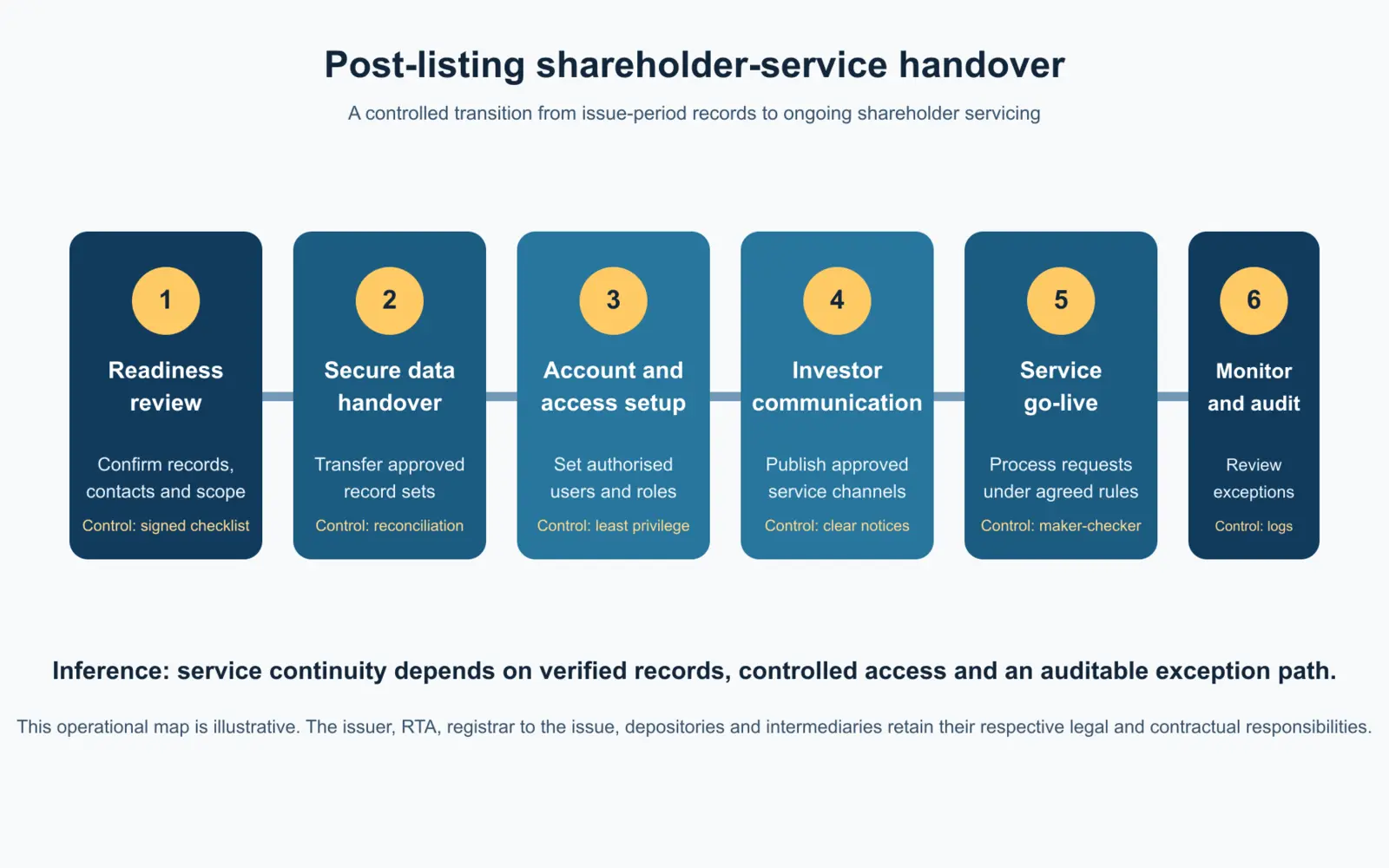
The workflow begins with a readiness review, then moves through secure record transfer, least-privilege access setup, investor communications, controlled go-live and monitoring. The visual is an illustrative operational sequence, not a substitute for the legal, exchange, depository, RTA or issuer-specific procedure that applies to an individual request.
What the board and management team should monitor
Management reporting should focus on data quality, open exceptions, request ageing, escalation themes, corporate-action readiness and evidence that access and approvals are working as intended. A small number of meaningful measures is more useful than a volume-only dashboard: for example, requests pending because information is incomplete should be distinguishable from items awaiting an external confirmation.
For regulated or sensitive actions, preserve the underlying request, approval trail, decision rationale and completion evidence. This supports internal oversight and makes it easier to investigate a shareholder query without exposing unrelated personal data.

How Abhipra can assist
Abhipra can help issuers plan an RTA handover, establish a records and reconciliation checklist, define secure shareholder-service channels and prepare an operational calendar for ongoing servicing. The appropriate sequence depends on the issuer's capital structure, listing route, appointed intermediaries and existing record quality.
Contact Abhipra RTA Services for an initial operational discussion. Please do not include passwords, OTPs, unmasked PAN, bank details, signatures or other sensitive personal information in an enquiry.
Source links
- SEBI ICDR Regulations, 2018 — consolidated text last amended 21 March 2026
- SEBI legal register — current regulations
- SEBI Master Circular register
- SEBI RTA Regulations, 2025
- SEBI FAQs on investor service requests processed by RTAs, 5 January 2026
Disclaimer
This article is for general information and operational education only. It is not legal, securities-law, tax, investment or transaction-specific advice, and it does not replace the current requirements of SEBI, the stock exchanges, depositories, the issuer's governing documents or professional advice. Requirements and procedures can change; obtain professional review for a specific issue, offer document, corporate action or shareholder request.