
IPO Refunds, ASBA Unblocking and Allotment Communications: RTA Responsibilities in Public Issues
Reviewed on: 20 October 2026. Reviewed by Abhipra RTA Desk.
In a public issue, an applicant may see funds blocked, partly retained or released after the basis of allotment. These are connected steps, but they are not all performed by the same participant. The registrar to the issue coordinates application data, reconciliation, allotment outputs and approved communications; the relevant banking or UPI participant carries out the applicable block, debit or unblock action. The issue’s offer document and the applicable SEBI framework control the exact process and timetable.

Why “refund” is not always the right description
For an ASBA application, the application money remains in the applicant’s bank account until the basis of allotment is finalised. NSE describes the SCSB process as accepting and verifying applications, blocking the bid amount, unblocking after the basis of allotment, and transferring the amount for allotted shares to the issuer. In practical conversation, people often say “refund”; for ASBA outcomes, the relevant action is commonly release or unblocking of funds that were blocked rather than a transfer back of money that had already left the account.
The operating result depends on the final outcome:
| Application outcome | Fund action at a high level | Communication / evidence to check |
|---|---|---|
| Full allotment | The appropriate amount follows the applicable allotment settlement path. | Allotment information, bank / UPI record and demat-credit status as applicable. |
| Partial allotment | The amount connected with allotted securities is retained; excess is unblocked under the applicable process. | Allotment quantity, bid details and the banking / UPI status. |
| No allotment | The blocked amount is released under the applicable process. | Basis-of-allotment information and the bank / UPI status. |
This table is a role-and-outcome guide, not a promise of a particular time period. The investor should follow the issue-specific offer document, application platform notifications and the official grievance contacts.
The registrar’s post-issue control role
The SEBI ICDR framework places post-issue responsibility with the post-issue merchant banker through the point at which subscribers receive securities, demat credit or refund of application money and listing/trading permission is obtained. It also requires close coordination with the registrar to the issue and other intermediaries after closure until the basis of allotment, relevant dispatches and listing are completed.
Within that control environment, a registrar to the issue typically supports an auditable sequence:
- Receive and process the issue application dataset through the permitted issue infrastructure.
- Reconcile records and identify exceptions for resolution with the appropriate intermediary.
- Produce the allotment-related outputs after the applicable basis-of-allotment process.
- Provide approved information for allotment, release / unblock and investor communications.
- Maintain a traceable record so that a query can be routed to the correct owner rather than handled through insecure, informal channels.
An RTA should not present itself as the bank, UPI app, depository or merchant banker. Clear ownership is a control: it avoids a registrar giving banking-status assurances it cannot independently make, and it helps applicants reach the right escalation channel.
Application-to-communication hand-offs
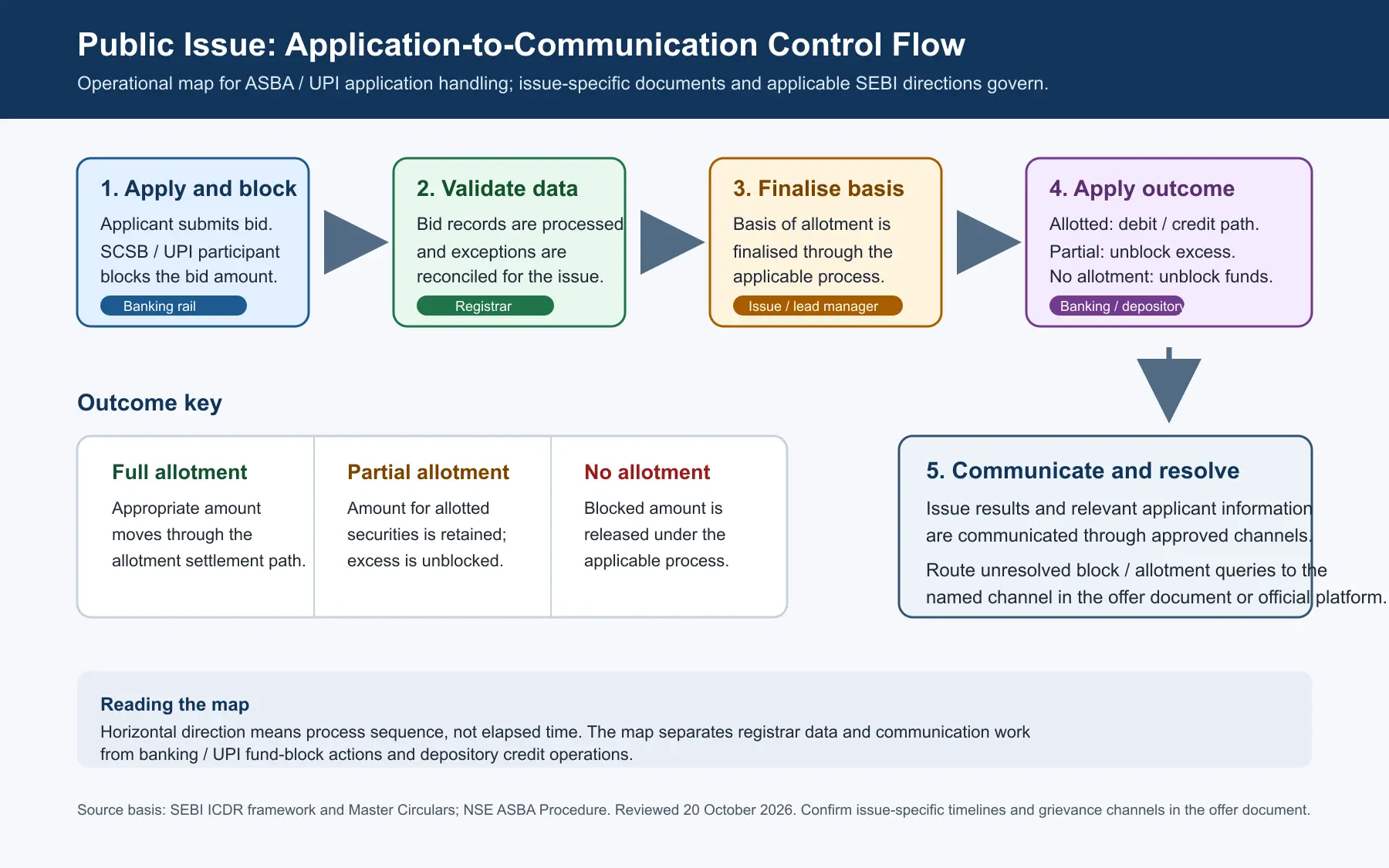
The workflow reads left to right as process sequence, not elapsed time. It separates the registrar’s application-data and communication work from banking / UPI fund-block actions and depository credit operations. The three outcome cards correspond to full allotment, partial allotment and no allotment. This provides the text equivalent of the workflow: partial allotment means excess blocked funds are expected to be released under the applicable process, while a non-allotted application moves to the release / unblock path.
Applicant communications that reduce avoidable queries
Clear, consistent communication should identify the issue and application reference without disclosing sensitive data. The message should tell an applicant where to verify the allotment result, where to check a block or release status, and which channel owns a particular issue.
For a suspected delayed unblock or an application-status mismatch, applicants should use the complaint or escalation route named in the offer document, the relevant SCSB / UPI participant, the registrar or the stock-exchange route as applicable. SEBI’s current framework contains specific arrangements for certain UPI-mechanism complaints, including delayed unblocking and multiple or excess blocks. The exact remedy, liability and timeline are fact-specific; they must be checked against the current issue documents and applicable SEBI directions.
Do not send an OTP, UPI PIN, banking password, full PAN, signature or unmasked bank details by ordinary email or chat to resolve an IPO query. Abhipra can advise on a secure document-submission route where an issuer-side engagement requires records.

Issuer checklist before the issue opens
- Agree the responsibility matrix among the issuer, lead manager, registrar, bankers / UPI participants, depositories and other intermediaries.
- Reconcile the communication templates, helpdesk routing and escalation contacts with the offer document.
- Define a maker-checker approval trail for allotment files, applicant notices and exception queues.
- Test an issue-specific query path without using production applicant data.
- Keep incident records, release / unblock exception evidence and final communications available for post-issue review.
How Abhipra can assist
Abhipra’s RTA desk can support issuer-side readiness for public issues, including controlled application-data workflows, reconciliation planning, communication governance and post-issue shareholder-service handover. Engagement scope, regulatory responsibility and operational timing should be agreed with the issuer, lead manager and other appointed intermediaries.
Source links
- SEBI: Master Circular for Registrars to an Issue and Share Transfer Agents, 6 February 2026
- SEBI: Issue of Capital and Disclosure Requirements Regulations, 2018 — listed as last amended on 21 March 2026
- SEBI ICDR text: post-issue responsibility, coordination and post-issue advertisement requirements
- NSE: Application Supported by Blocked Amount (ASBA) Procedure
Disclaimer
This article is general operational education, not legal, regulatory, banking, investment or issue-specific advice. Public-issue procedures, participant responsibilities, timelines, remedies and communications depend on the current SEBI framework, the offer document and the facts of the issue. Obtain advice from the appointed merchant banker, legal advisers, registrar and other authorised intermediaries before acting. REQUIRES HUMAN LEGAL REVIEW before any transaction-specific use.