
How Application Data, Basis of Allotment and Demat Credits Connect in an IPO
Reviewed on: 18 October 2026. Reviewed by Abhipra RTA Desk.
In an IPO, a successful demat credit is the final output of a controlled chain—not simply the result of submitting an application. Application data must be valid, accepted bids need reconciliation, the disclosed basis of allotment must be finalised, and account details must validate before securities can be credited. The exact timetable and allocation mechanics are set out in the relevant offer document and applicable law.

Where the registrar connects the IPO hand-offs
The Registrar to the Issue (RTI) helps maintain the operational record across the post-issue process. This includes working with the issuer, lead manager, designated stock exchange, Self Certified Syndicate Banks (SCSBs), sponsor banks where relevant, and depositories. The RTI's work is not a substitute for the responsibilities of those parties; it is a controlled hand-off process.
NSE describes ASBA as a process in which application money remains blocked in the investor's account until the basis of allotment is finalised. Its explanation also notes that SCSBs verify and upload application details, then unblock funds and transfer the amount for allotted shares. Read NSE's ASBA procedure.
Application data: what needs to align
The information submitted through the permitted application channel needs to align across the bid, investor category, payment route and beneficiary account. An operational team should retain evidence of validation, exceptions and resolution decisions. It should not treat a data field as correct merely because it is present.
| Hand-off | Main operational question | Evidence worth retaining |
|---|---|---|
| Application capture | Is the bid data complete and consistent with the application route? | Source record, validation outcome and exception log |
| Issue-close reconciliation | Do accepted applications reconcile to the post-issue dataset? | Reconciliation report, rejected or duplicate-treatment record |
| Allotment preparation | Does the category-wise output follow the approved basis? | Basis-of-allotment working papers and approvals |
| Funds instruction | Are unblock or transfer instructions tied to the allotment result? | Bank or sponsor-bank instruction and reconciliation evidence |
| Demat credit | Can the beneficiary account be validated for the credit instruction? | Depository acknowledgement, failure queue and closure evidence |
Basis of allotment is a governed allocation step
SEBI's ICDR Regulations state that allotment to applicants other than anchor investors is on a proportionate basis within specified investor categories, subject to the stated provisions. The Regulations also place responsibility on the designated stock exchange's executive or managing director, post-issue lead merchant bankers and registrars to the issue to ensure that the basis of allotment is finalised fairly and properly in accordance with the applicable procedure. Review the consolidated ICDR Regulations and SEBI's 9 February 2026 ICDR Master Circular.
The basis is therefore not a discretionary spreadsheet outcome. It must be linked to the issue structure, valid demand, category rules, lot size and the approved allocation procedure. Specific issue terms must always be checked in the final offer document.
From approved allotment to electronic credit
After the basis is finalised and allotment is recorded, funding and securities actions occur through their respective systems. A 2026 NSE-hosted basis-of-allotment announcement illustrates the sequencing: its allotment result records consultation with the designated exchange, instructions for fund unblocking or transfer, uploading allotted shares for credit, account-detail validation with depositories, and listing application steps. This is an example of operational sequencing—not a universal deadline template. View the example announcement.
Depository and participant activities operate within the SEBI Depositories and Participants Regulations framework. Read the SEBI regulations page.

Six controls that connect the process
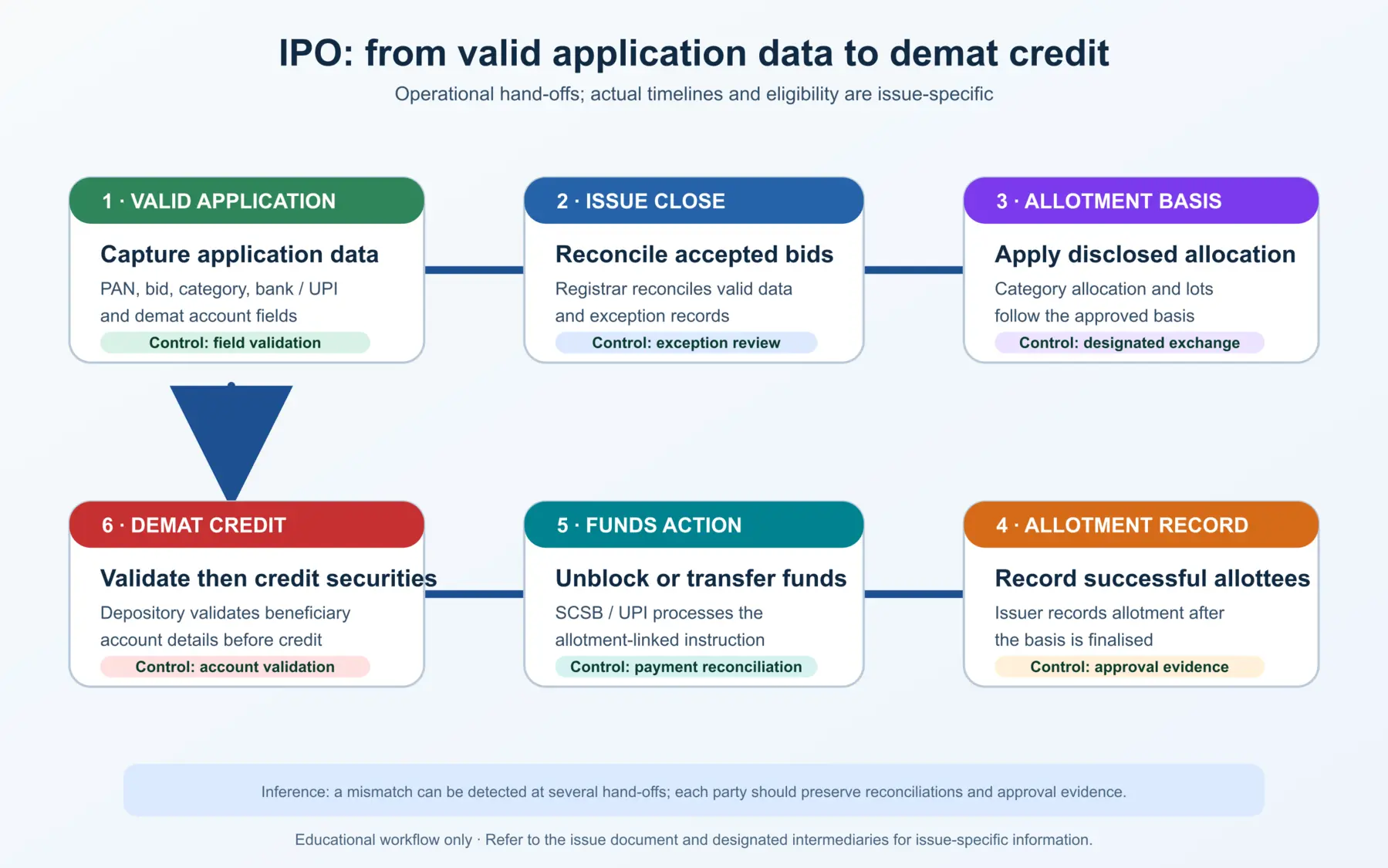
The workflow is a process map, so it has no numerical axes. Read the cards in sequence, then follow the arrows. Its inference is practical: a mismatch can be found at more than one hand-off, and the party responsible for a hand-off should preserve its reconciliation and approval evidence. The graphic is supported by the table above and is not the only source of information.
- Validate application data before it becomes part of the post-issue dataset.
- Reconcile accepted bids and separately investigate exceptions.
- Apply the disclosed and approved basis of allotment.
- Preserve the issuer's allotment record and approval trail.
- Match fund-unblocking or transfer instructions to the allotment output.
- Validate beneficiary-account details before the depository credit is completed.
Common issuer-side mistakes to avoid
- Treating bid acceptance, allotment, funds settlement and demat credit as one untested event.
- Losing version control over the file that supports the basis of allotment.
- Failing to keep an exception register for duplicate, invalid or account-detail issues.
- Assuming an illustrative issue announcement creates a deadline for every other issue.
- Asking investors to share OTPs, passwords or unmasked sensitive information by email. Use the designated, secure channel and issue-specific instructions instead.
How Abhipra can assist
Abhipra's RTA Desk can help issuers map their IPO or public-issue operational hand-offs, establish reconciliations and evidence controls, and coordinate the registrar-facing workstream with the appointed intermediaries. Engagement scope, eligibility, timelines and responsibilities remain subject to the issue documents, contracts and applicable regulatory requirements.
Source links
- SEBI ICDR Regulations, 2018—consolidated through 21 March 2026
- SEBI Master Circular for ICDR, 9 February 2026
- NSE ASBA procedure
- NSE-hosted 2026 basis-of-allotment announcement
- SEBI Depositories and Participants Regulations page
Disclaimer
This article is general educational information, not legal, regulatory, accounting, tax, investment or issue-management advice. IPO terms, allocation rules, operational responsibilities and timetables are issue-specific and may change. Issuers and investors should rely on the applicable offer document, designated intermediaries and qualified professional advice. REQUIRES HUMAN LEGAL REVIEW before reliance on any issuer-specific application of the regulatory framework.