ASBA and UPI in IPO Applications: How the Payment and Application Data Flow Works
Reviewed on: 16 October 2026. Reviewed by Abhipra RTA Desk.
ASBA keeps an IPO applicant’s money blocked in the linked account until allotment is finalised; it is not debited merely because the bid is placed. For eligible individual applications using UPI, the bid data and UPI ID travel through the permitted public-issue workflow, and the applicant must approve the mandate in time. The exact eligibility, application cap, cut-off and permitted app/handle should always be confirmed from the current offer document and exchange notice.

ASBA first: what happens to the application amount
Application Supported by Blocked Amount (ASBA) is the payment architecture used for public issues. The amount corresponding to the application is blocked in the applicant’s account while the issue process runs. If shares are allotted, the appropriate amount is debited; if the applicant receives no allotment, the blocked amount is unblocked. SEBI’s investor education material notes that the blocked amount remains in the investor’s account until allotment and continues to earn interest, subject to the bank’s applicable terms.
This distinction matters operationally. A bid record, a successful block, allotment and debit are separate events. An applicant should not assume that a submitted bid is complete until the required ASBA/UPI confirmation has occurred.
Where UPI fits for eligible individual applicants
UPI is a payment mechanism within the ASBA workflow; it does not replace the application and validation steps. SEBI’s investor guidance says the applicant enters bid details and a UPI ID, a permitted intermediary uploads the bid to the exchange platform, and the sponsor/escrow-bank route generates the mandate request. The applicant then authorises the block using the UPI PIN.
SEBI’s investor page currently describes UPI for retail individual investors with a ₹5 lakh per-transaction limit, and says a third-party UPI ID or third-party bank account will not be considered for allocation. Eligibility and limits can change, so readers should check the applicable offer document and current SEBI/exchange guidance before applying.
Application flow and control gates
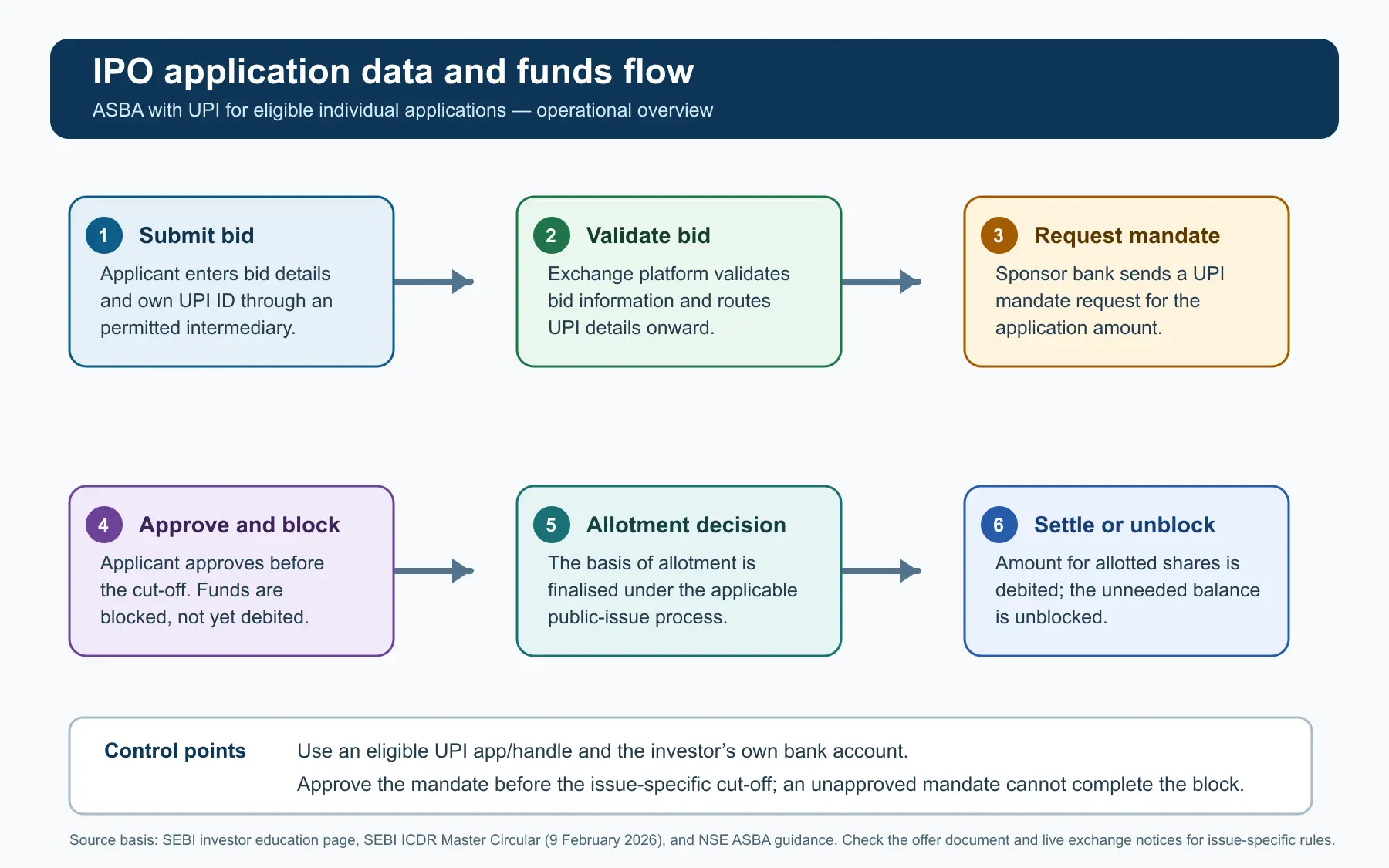
The workflow has six operational stages:
- The applicant submits bid details and their own UPI ID through a permitted intermediary.
- The exchange platform validates the bid data and routes the required UPI information.
- The sponsor-bank route initiates the UPI mandate request for the application amount.
- The applicant approves the mandate before the issue-specific cut-off; funds are blocked rather than immediately debited.
- The public-issue process reaches the basis-of-allotment stage.
- The allotted amount is debited and any balance is unblocked.
The image uses a sequence rather than a numeric chart because the authoritative sources describe event dependencies, not a universal service-level duration. Its inference is straightforward: a missing or late mandate approval interrupts the funding-control step even if bid details were entered earlier.
What the registrar, exchanges, banks and depositories each do
| Participant | Operational contribution | Practical control point |
|---|---|---|
| Applicant | Enters accurate bid and payment details; approves the UPI mandate where applicable | Use the applicant’s own eligible account and UPI ID; do not share PINs or OTPs. |
| Permitted intermediary | Captures and uploads bid details | Submit only through authorised public-issue channels. |
| Stock exchange | Operates the electronic bidding platform and validates/processes bid records | Correct data errors during the permitted window, if any. |
| Sponsor bank / SCSB route | Supports mandate/blocking and later debit or unblock activity under the applicable process | Check the mandate status and issue-specific cut-off. |
| Registrar to the issue | Supports issue operations, application reconciliation and allotment-related processing within its mandate | Maintain complete, reconciled records and resolve exceptions through the authorised process. |
| Depository / DP | Supports demat-credit and account-side records after allotment under the applicable settlement process | Ensure the demat-account details in the application are accurate. |

Common reasons an application can fail operational checks
- The UPI mandate is not approved before the applicable cut-off.
- The UPI ID or linked bank account does not meet the issue’s permitted route or eligibility conditions.
- PAN, demat-account or bid information is inconsistent with the submitted application.
- The applicant uses a third-party payment account or relies on an informal payment request.
- An investor treats a social-media message, QR code or unsolicited payment request as an authorised IPO route.
Use only the application channels, applications and UPI handles identified in current official guidance. Never disclose a UPI PIN, OTP, password, full bank credentials or unmasked PAN to a caller, chat group or unverified link. If an application requires correction, use the official intermediary or issue helpdesk route rather than sharing sensitive documents by ordinary email.
How Abhipra can assist issuers and issue teams
For an issuer, reliable application processing depends on clear interfaces between the registrar, bankers, sponsor-bank workflow, exchanges, depositories and permitted intermediaries. Abhipra RTA Services can support the registrar-to-an-issue workstream, including operational readiness, data-reconciliation planning and controlled communication routes, subject to the applicable engagement and regulatory framework.
Preparing for an SME IPO or main-board IPO and need a Registrar-to-an-Issue/RTA workstream? Contact Abhipra RTA Services at rtaservices@abhipra.com, call 011-42390783, or contact +91-9818080700. Share the company name, current company type, proposed listing platform, latest audited financial year, capital structure, shareholder count, existing ISINs and target issue timeline for an initial operational discussion. Eligibility, merchant-banker advice and regulatory approvals remain subject to the applicable framework.
Source links
- SEBI investor education: Apply in IPO through ASBA
- SEBI investor guidance: UPI in IPO applications
- SEBI Master Circular for ICDR, 9 February 2026
- NSE ASBA procedure and registered workflow resources
- NSE issue information and current public-issue notices
Disclaimer
This article is general educational information, not investment, legal, tax, banking or transaction advice. IPO eligibility, investor category, application limits, cut-offs, permitted UPI applications and allotment procedures must be checked against the current offer document, applicable SEBI/exchange requirements and the investor’s authorised intermediary. Abhipra does not ask readers to send passwords, OTPs, UPI PINs, full bank details, signatures or unmasked PAN by email or message.