Pre-Issue ISIN, Promoter Lock-In and Depository Coordination: A Practical Control Map
Reviewed on: 15 October 2026. Reviewed by Abhipra RTA Team. REQUIRES HUMAN LEGAL REVIEW before reliance on any issuer-specific lock-in, pledge or offer-document position.
Before an IPO or SME IPO can move cleanly through the issue process, the issuer needs more than a draft offer document. Its security-class data, ISIN and depository arrangements, promoter-holding records, lock-in treatment and registrar reconciliation need to tell the same story. A late mismatch can create avoidable disclosure, operational or allotment-readiness work. This guide sets out a practical control sequence; it is not a substitute for advice from the merchant banker, legal advisers, depositories or the exchange.

Start with the capital structure, not the filing date
The current SEBI ICDR Regulations are the primary legal framework for a public issue. The SEBI ICDR Master Circular dated 9 February 2026 consolidates operational requirements and should be checked with later amendments and exchange instructions.
Build one controlled capital-structure workbook that reconciles authorised, issued, subscribed and paid-up capital; each security class; corporate actions; promoter and pre-issue holdings; and the ISIN/depository status of each relevant class. Keep an exception log with an owner, evidence reference, decision and closure date. The registrar can help reconcile operational datasets, but the issuer remains responsible for the accuracy of its records and disclosures.
ISIN and depository readiness: establish the evidence trail
An ISIN identifies a specific security. Do not assume that one ISIN covers every instrument: equity shares, preference shares and convertible or debt instruments can need separate analysis and operational treatment. Confirm the applicable depository arrangements, issuer/RTA onboarding evidence and the current process with the selected depositories and registrar.
For an SME issue, NSE’s current Emerge requirements and process page says that an issuer must take specified pre-listing steps and submit the draft prospectus with the IPO-vetting checklist. NSE also makes clear that its review is from the listing-requirements perspective and is not an approval under every other applicable law.
Evidence checklist before issue opening
| Control | Practical question | Accountable owner | Evidence to retain |
|---|---|---|---|
| Security-class map | Are all issued instruments, corporate actions and conversions mapped? | Company secretary / finance | Reconciled capital schedule and board records |
| ISIN and connectivity | Is the relevant ISIN and depository/RTA setup confirmed for the contemplated issue? | Issuer / RTA / depository | Acceptance, agreement and test evidence |
| Promoter holdings | Do pre-issue holding records match the cap table and proposed disclosures? | Issuer / merchant banker | Reconciliation, demat statements and exception log |
| Pledge review | Are any relevant securities pledged or otherwise constrained? | Issuer / lender / legal advisers | Charge, lender and depository correspondence |
| Disclosure control | Do the offer-document statements match the final operational position? | Issuer / merchant banker / legal advisers | Reviewed disclosure checklist |
Promoter lock-in and pledged shares: identify exceptions early
Lock-in analysis is fact-specific. It depends on the current ICDR provisions, security history, issue route and any applicable exemption or condition. A practical pre-issue review should identify relevant promoter and other pre-issue holdings, confirm demat details, and trace how proposed lock-in instructions will be applied.
SEBI’s 8 April 2026 circular on pledged-share lock-in explains a mechanism for specified securities where lock-in cannot be created: depositories may record them as non-transferable for the applicable lock-in period. The circular refers to depository frameworks and calls out, among other things, suitable articles provisions, lender/pledgee intimations and offer-document disclosures. It does not mean every pledge or lock-in question has the same answer.
Use a focused exception register for each potentially affected holding:
- holder and security-class reference;
- demat account and depository reference, handled through secure internal channels;
- pledge or other encumbrance status;
- proposed lock-in mechanism and supporting legal/operational confirmation;
- lender or pledgee communication, where applicable; and
- disclosure owner and final sign-off.
Do not send unmasked account details, signatures, PAN, passwords, OTPs or complete KYC files by ordinary email. Wait for a secure document-submission method agreed with the relevant intermediary.
Where the handoffs become most sensitive
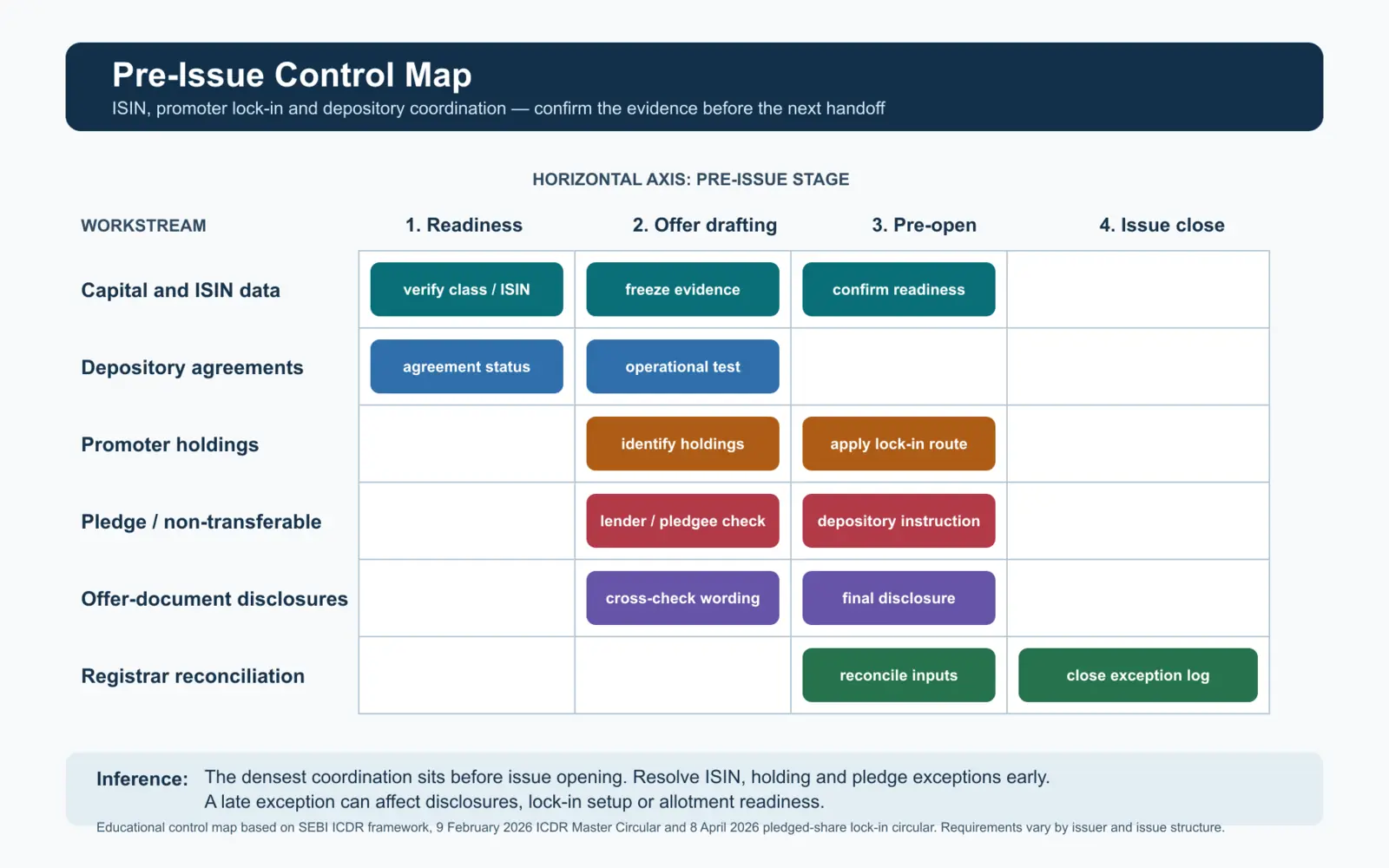
The chart’s horizontal axis is the four pre-issue stages: readiness, offer drafting, pre-open and issue close. Its vertical axis is the six control workstreams. A filled block means that the team should obtain an accountable confirmation in that phase, rather than treating it as a one-time tick-box. The key inference is that the most concentrated work occurs before issue opening: ISIN evidence, promoter records and any pledge-related route should be resolved early enough for disclosure and depository instructions to remain aligned.
A practical five-step workflow
- Create the security-class and holder baseline. Reconcile capital records, corporate actions and pre-issue holdings against controlled source documents.
- Confirm the operating route. Coordinate issuer, registrar and depository requirements for the contemplated security and issue structure; retain written evidence of each confirmation.
- Run the promoter and pledge exception review. Escalate mismatches, encumbrances, missing demat details and unclear lock-in treatment to the merchant banker and legal advisers.
- Freeze disclosure inputs with version control. Match the final facts to the draft offer document and record who approved each exception.
- Reconcile before the issue opens and again at the close. Keep a signed exception log and a controlled handoff to the registrar’s application, allotment and credit workstreams.
How Abhipra can assist
Preparing for an SME IPO or main-board IPO and need a Registrar-to-an-Issue/RTA workstream? Contact Abhipra RTA Services at rtaservices@abhipra.com, call 011-42390783, or contact +91-9818080700.
For an initial operational discussion, share only non-sensitive summary information such as the company name, current company type, proposed listing platform, latest audited financial year, capital structure, shareholder count, existing ISINs and target issue timeline. Eligibility, lock-in treatment, merchant-banker advice and regulatory approvals remain subject to the applicable framework.
Source links
- SEBI ICDR Regulations, 2018 — last amended 21 March 2026
- SEBI ICDR Master Circular — 9 February 2026
- SEBI circular HO/49/(17)2026-CFD-POD2/I/8965/2026 — 8 April 2026
- NSE Emerge requirements and process
Disclaimer
This article is general educational information, reviewed on 15 October 2026. It is not legal, regulatory, tax, FEMA, merchant-banking, investment or depository advice and does not determine IPO/SME IPO eligibility, lock-in treatment or listing approval. Requirements can vary by issue structure, security history, depository instructions, exchange criteria and later regulatory changes. Obtain issuer-specific advice and professional approvals before acting.