Appointing the Registrar to an IPO: When the RTA Workstream Should Start
Reviewed on: 13 October 2026. Reviewed by Abhipra RTA Team.
An issuer should not wait for the issue period to start its Registrar-to-an-Issue workstream. The practical starting point is when the IPO route, advisers, capital-record review and offer-document timetable are being scoped, so shareholder and issue data can be tested before execution deadlines tighten.

Appointment is a controlled workstream, not only a vendor selection
SEBI’s recognised-intermediary register identifies registered Registrars to an Issue and Share Transfer Agents. The registrar’s role in a public issue connects with the merchant banker, issuer, bankers, depositories, exchanges and other intermediaries, but does not replace the issuer’s or merchant banker’s regulatory responsibilities.
For an SME IPO, NSE Emerge says the issuer files the draft prospectus together with the documents in its IPO-vetting checklist. NSE also states that its review of the draft prospectus is for listing-requirement purposes and is not approval under all applicable laws. That makes early ownership of source records, evidence and exception handling important.
Start before the draft prospectus is treated as final
Early engagement can help an issuer organise the operational layer of the transaction:
- map authorised, issued, subscribed and paid-up capital to the working cap table;
- reconcile allotments, transfers, corporate actions, security classes and ISIN/depository records;
- identify promoter, lock-in, pledge or restriction information that needs authorised review;
- agree controlled owners for investor and issue data, evidence versions and exception escalation; and
- plan handover from issue-period activities to post-listing shareholder servicing.
These are planning controls, not a statement that a company is eligible to list. Applicability, documents, timing and allocation mechanics depend on the issue type, exchange route, current rules and the issuer’s facts.
Five-stage RTA engagement map
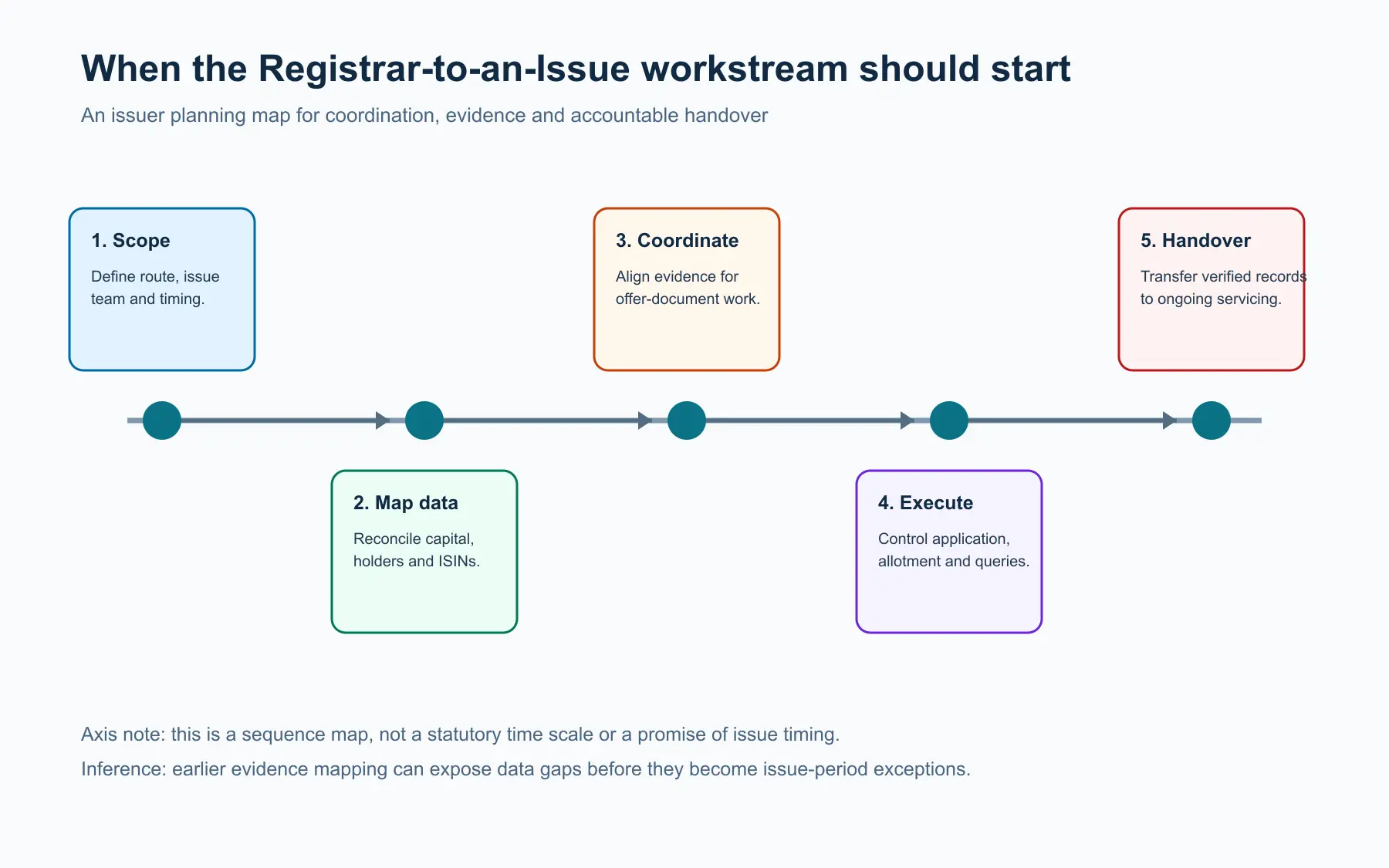
The workflow has no numerical axis: it is a process sequence, not a statutory timeline. Its inference is that earlier evidence mapping can identify an unresolved holder, capital-record or depository-data issue before it becomes a late exception in the offer-document or issue-period workstream. Each stage should retain approved evidence, named owners and an escalation path.
Questions to settle before appointment is finalised
- Which public-issue route and exchange platform are in scope?
- Which adviser owns each data set, and who approves exceptions?
- Which entity is the SEBI-registered Registrar to an Issue for the proposed engagement?
- Which historical capital changes require reconciliation before offer-document drafting relies on them?
- How will application, allotment, refund or unblocking, demat-credit and investor-query controls be documented for the chosen issue structure?
- Which post-listing RTA services, data-retention arrangements and handover records will be needed?
Do not send unmasked PAN, bank details, signatures, passwords, OTPs or shareholder KYC documents by ordinary email. Use a secure submission route only after the responsible intermediary confirms the necessary documents and method.
How Abhipra can assist
Preparing for an SME IPO or main-board IPO and need a Registrar-to-an-Issue/RTA workstream? Contact Abhipra RTA Services at rtaservices@abhipra.com, call 011-42390783, or contact +91-9818080700. Share high-level company and issue details for an initial operational discussion. Do not send sensitive shareholder records until a secure submission channel is provided.
Official source links
- SEBI recognised Registrar to an Issue and Share Transfer Agent register
- SEBI Regulations index, including RTA Regulations, 2025
- SEBI ICDR Regulations, consolidated through 21 March 2026
- SEBI Master Circular for ICDR, 9 February 2026
- NSE Emerge requirements and process
Disclaimer
This article is general educational information, not legal, investment, tax, transaction, listing or merchant-banking advice. Registrar appointment, issue sequencing and issuer eligibility depend on current rules, the engagement terms and the issuer’s facts. REQUIRES HUMAN LEGAL REVIEW for transaction-specific conclusions.