Corporate Actions and Shareholder Data for an SME IPO Draft Offer Document
Reviewed on: 10 October 2026. Reviewed by Abhipra RTA Team.
Before an SME IPO draft offer document is finalised, the issuer needs one controlled version of its capital and shareholder records. That means reconciling corporate actions, share classes, allotments, transfers, encumbrances and promoter/group holdings with the records used for the offer-document process. An RTA can support the data-control workstream; the issuer and lead manager retain their respective legal, disclosure and due-diligence responsibilities.

Start with a capital-structure baseline
SEBI’s ICDR framework requires material capital-structure and promoter-holding disclosures in the offer-document process. For an SME issuer, the relevant details and evidence should be aligned before tables are circulated: authorised, issued, subscribed and paid-up capital; share classes; recent allotments or transfers; and the pre-issue shareholder records used by the authorised transaction team.
Do not treat an old cap table, a board-paper extract and a depository report as interchangeable. Differences may be legitimate, but each needs an owner, explanation, source record and approved resolution path.
Corporate actions that need controlled reconciliation
- allotments, including any preferential issue or conversion;
- bonus issues, rights issues, splits, consolidations or changes in denomination;
- transfers, transmissions and corrections to shareholder records;
- pledges, other encumbrances and applicable lock-in information; and
- changes that affect promoter, promoter-group, director or material-holder information.
The applicable disclosure scope is transaction-specific. A board resolution or RTA record is evidence for a process; it is not by itself a conclusion that a disclosure, listing or eligibility condition has been met.
A worked control sequence before the draft is frozen
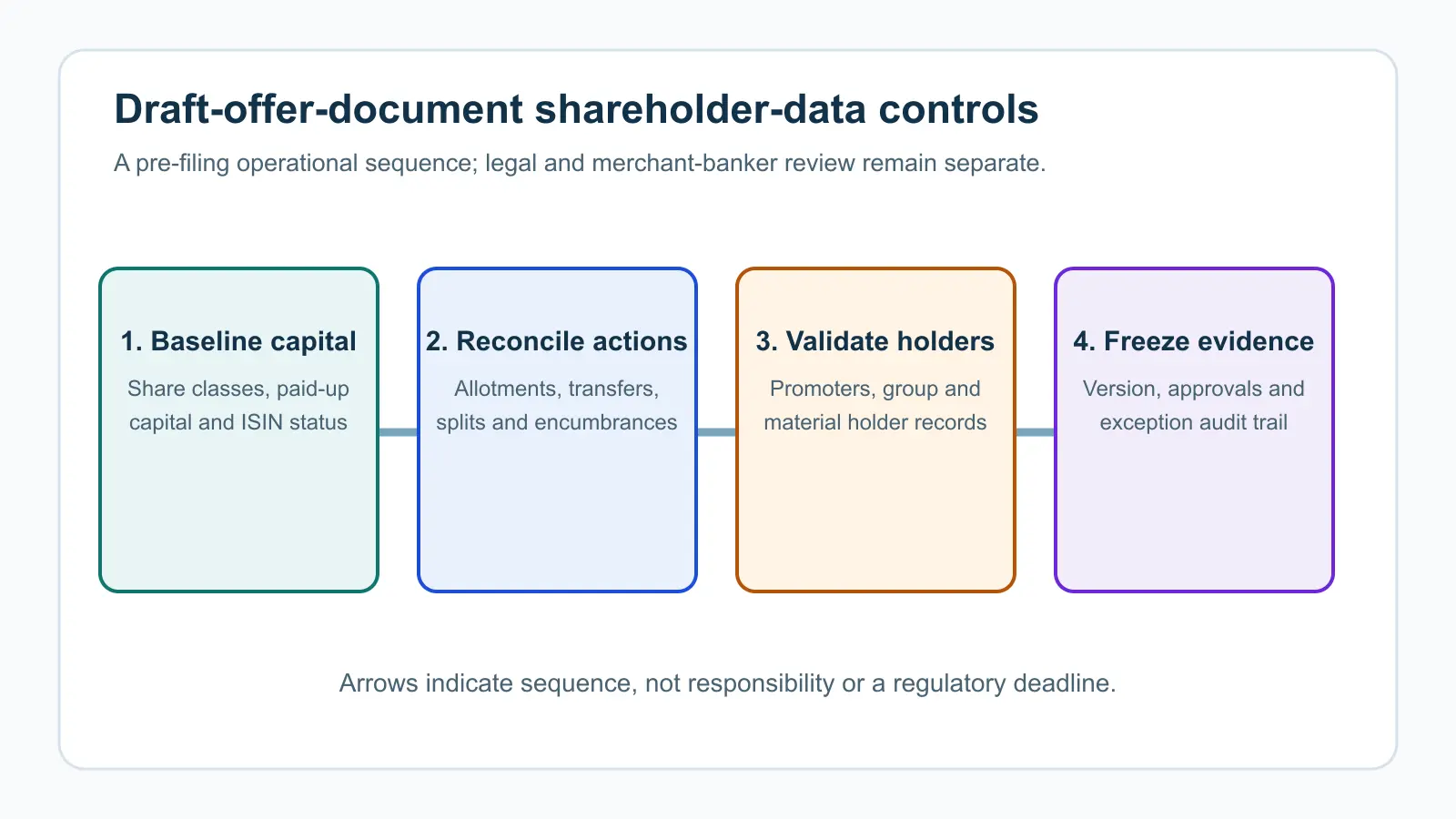
The workflow has no numeric axis because it is a control sequence, not a data series or statutory timetable. The boxes move from baseline information to corporate-action reconciliation, holder validation and retained evidence. The inference is practical: a later-stage mismatch is easier to investigate when every action and source record has already been tied to a controlled version.
1. Establish the baseline
Confirm the relevant security classes, paid-up capital, ISIN/depository readiness where applicable, and the reporting cut-off date. Record the source and version for every table.
2. Reconcile corporate actions
Map each material action to its approval, effective date, securities impact and supporting record. Escalate unexplained differences rather than silently overwriting a schedule.
3. Validate shareholder information
Use the approved records to test promoter and promoter-group details, material shareholding, recent changes and disclosed encumbrances. The lead manager and other authorised advisers should decide the legal disclosure treatment.
4. Preserve evidence and approvals
Keep a dated version trail, review comments, approvals and exception closure record. Share personal or shareholder information only through authorised secure channels. Do not send unmasked PAN, bank details, signatures or login credentials by ordinary email.
Avoidable delays
- multiple teams working from different cap-table versions;
- corporate-action records without a clear effective date or approval reference;
- shareholder identifiers that do not match the authorised source record;
- no owner for a variance between issuer, RTA and depository data; and
- treating a draft-offer-document table as final before the authorised review is complete.
How Abhipra can assist
Preparing for an SME IPO or main-board IPO and need a Registrar-to-an-Issue/RTA workstream? Contact Abhipra RTA Services at rtaservices@abhipra.com, call 011-42390783, or contact +91-9818080700. Share company and high-level transaction information for an initial operational discussion. Do not send sensitive KYC or shareholder documents until a secure submission channel is provided.
Official source links
- SEBI ICDR Regulations, 2018, consolidated through 21 March 2026
- SEBI Master Circular for ICDR, 9 February 2026
- SEBI Master Circular for RTAs, 6 February 2026
- NSE listing checklists, including Emerge public-issue resources
Disclaimer
This article is for general educational information, not legal, investment, tax, transaction or merchant-banking advice. Offer-document disclosures and RTA workstreams depend on the issuer, offer structure, current SEBI and exchange requirements, and authorised professional review.