Legacy Physical Certificates: Why They Can Delay SME IPO Preparation
Reviewed on: 11 October 2026. Reviewed by Abhipra RTA Team.
An old physical share certificate is not automatically an IPO blocker. But if certificate records, the register of members, capital records and demat readiness do not reconcile, the issuer can lose time resolving the discrepancy before its draft prospectus and listing workstream are ready.

Keep issuer readiness separate from investor-service rules
For an SME IPO, NSE Emerge says the issuer should prepare its draft prospectus with the prescribed IPO-vetting documents and under the current regulatory framework. SEBI ICDR provisions also include dematerialisation conditions for promoter-held specified securities in the SME issue framework. Whether a particular historic physical holding affects an issuer’s IPO readiness depends on the holder, security class, transaction facts and applicable rules; it needs authorised transaction and legal review.
SEBI’s special window for transfer-cum-dematerialisation of physical securities is an investor-service measure. It runs from 5 February 2026 to 4 February 2027 for eligible transfer deeds executed before 1 April 2019, subject to the circular’s conditions. It should not be presented as a substitute for an issuer’s IPO due diligence or as a general transfer route for every certificate.
Records that should be reconciled early
- certificate numbers, distinctive numbers and share classes;
- register-of-members entries and shareholder names;
- authorised, issued, subscribed and paid-up capital;
- past allotments, transfers, splits, consolidations and other corporate actions;
- depository/RTA records and current ISIN status; and
- pledges, encumbrances, lock-in or other restrictions requiring authorised assessment.
Avoid collecting unmasked PAN, bank details, signatures or login credentials by ordinary email. Use an approved secure route once the responsible intermediary specifies the documents needed.
A control workflow for legacy certificates
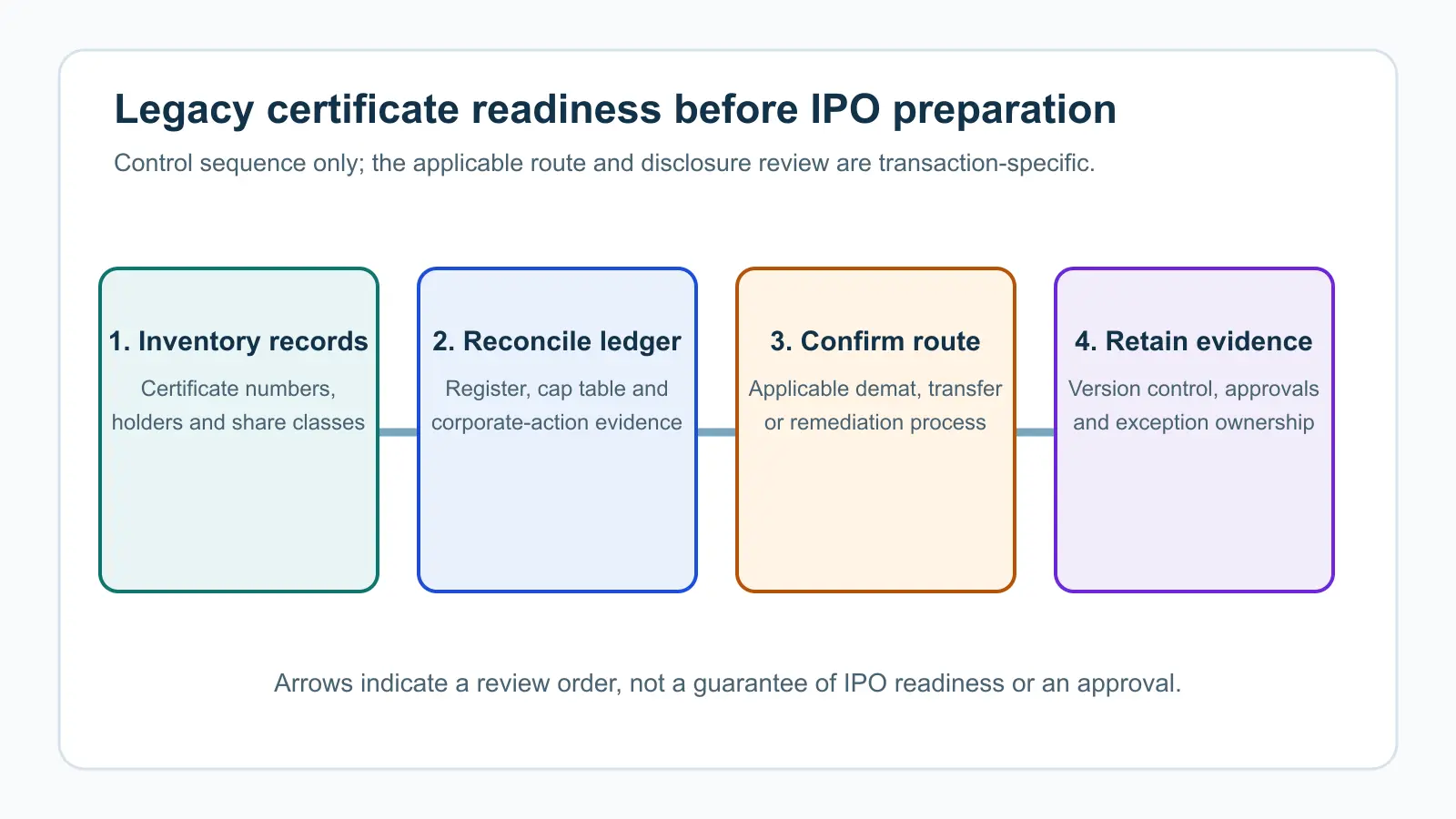
The workflow has no numeric axis: it is a review sequence, not a statutory timeline. It begins with a reliable inventory, then compares it with issuer records, identifies the applicable demat or remediation route, and retains evidence and approvals. The practical inference is that an unexplained mismatch should be resolved before a team relies on the corresponding cap-table or offer-document information.
Common causes of delay
- an old certificate number that does not map cleanly to the current register;
- corporate-action history that was not carried into every working file;
- a shareholder name or holding that needs evidence-based correction;
- separate security classes mixed into one schedule; or
- no clear owner for reconciling issuer, RTA and depository information.
How Abhipra can assist
Preparing for an SME IPO or main-board IPO and need a Registrar-to-an-Issue/RTA workstream? Contact Abhipra RTA Services at rtaservices@abhipra.com, call 011-42390783, or contact +91-9818080700. Share high-level company and issue details for an initial operational discussion. Do not send sensitive shareholder records until a secure submission channel is provided.
Official source links
- SEBI circular on the special window for transfer-cum-dematerialisation, 30 January 2026
- SEBI ICDR Regulations, consolidated through 21 March 2026
- NSE Emerge requirements and process
- NSE Emerge eligibility criteria
Disclaimer
This article is general educational information, not legal, investment, tax, transaction or merchant-banking advice. The status of a physical certificate and its relevance to an IPO depend on the documents, the security, the issuer’s facts and the current applicable framework. REQUIRES HUMAN LEGAL REVIEW for transaction-specific conclusions.