RTA’s Role in an SME IPO: Before, During and After the Issue
Reviewed on: 9 October 2026. Reviewed by Abhipra RTA Team.
In an SME IPO, the Registrar to an Issue supports controlled issue operations—application data, reconciliation, allotment records and handovers—within the roles defined by the applicable framework and agreements. The RTA does not decide issuer eligibility, approve the offer document, guarantee allotment or assure listing.

Keep the RTA role distinct from other issue responsibilities
SEBI’s RTA Regulations, 2025 and the Master Circular for RTAs provide the current intermediary framework. The public-issue requirements sit alongside the SEBI ICDR framework and the applicable exchange process. The issuer, lead manager, exchanges, depositories, bankers and other intermediaries retain separate responsibilities.
For an SME issue, the lead manager and issuer coordinate the overall transaction and applicable disclosures. The Registrar to an Issue commonly supports the operational control environment: issue setup, application/bid information, reconciliation, records supporting the basis-of-allotment process, allotment-related files and a controlled handover after the issue.
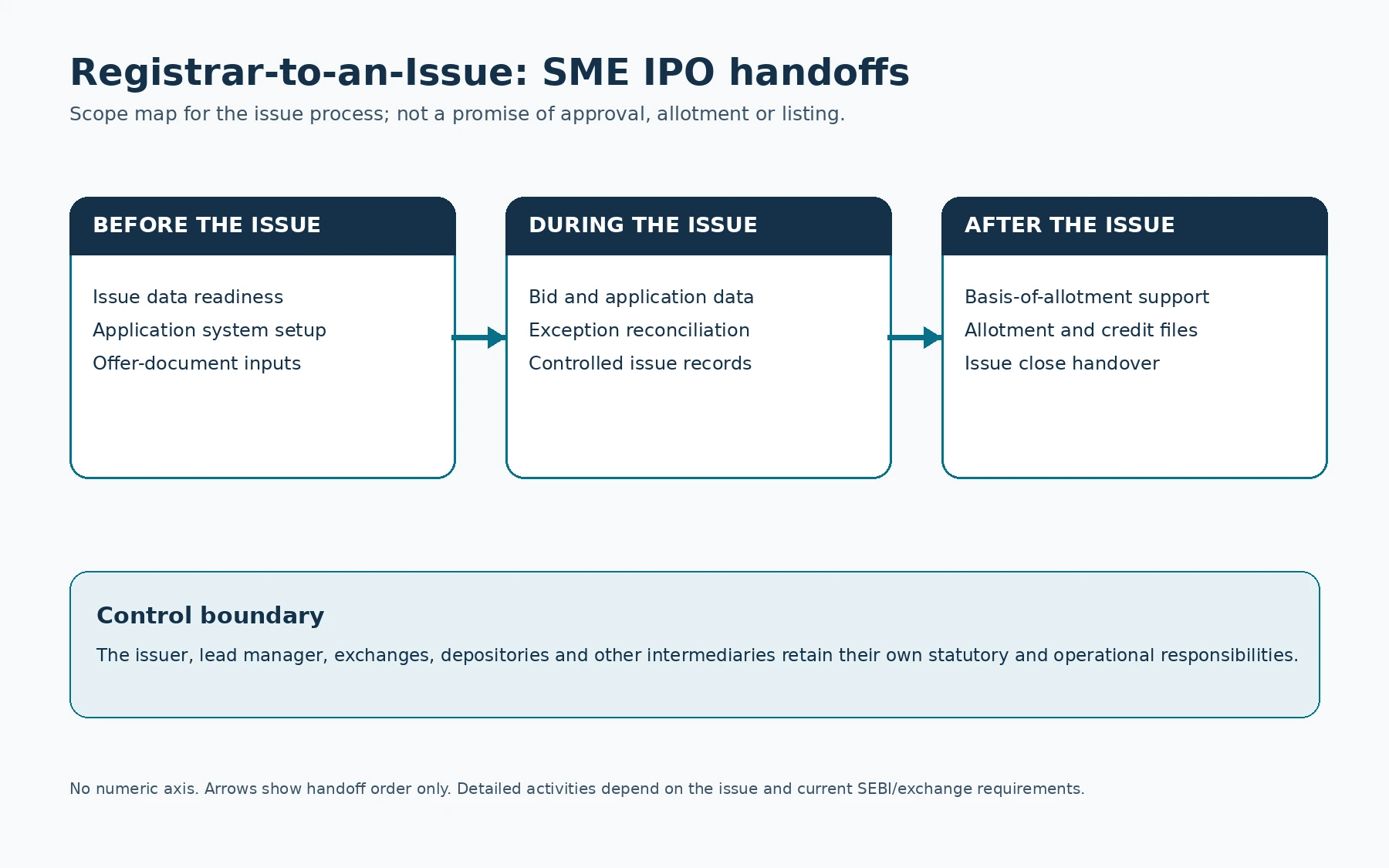
This role map has no numeric axis. Its three columns describe operational handoffs: data readiness before the issue, controlled application and exception records during the issue, and basis-of-allotment support plus closing records afterwards. The arrows show order only. They do not transfer legal responsibility or predict an issue outcome.
Before the issue: establish controlled data and interfaces
Before the issue opens, the RTA workstream should be aligned with the issuer’s capital data, ISIN/depository readiness, offer-document tables, issue timetable and approved operating instructions. A change to the cap table, application architecture or offer terms needs controlled communication and an auditable version trail.
Useful controls include reconciling issuer data with the depository/RTA records, defining secure data-exchange arrangements, documenting exception ownership, and agreeing the outputs expected by the lead manager and other authorised participants. These are operational safeguards; they do not replace merchant-banker due diligence or exchange review.
During the issue: reconcile, investigate and retain evidence
During the issue, the focus shifts to accurate application or bid data, prescribed reconciliation outputs, exception investigation and controlled records. The RTA should use approved access controls, preserve source data and escalation records, and avoid changing a material issue-data set without the authorised process.
The particular ASBA, UPI, bidding, category, lot, rejection and reconciliation mechanics depend on the current issue structure and applicable SEBI/exchange instructions. Do not assume that the mechanics of one SME IPO apply unchanged to another.
After the issue: support allotment records and handover
After the relevant reconciliations and authorised basis-of-allotment process, the RTA supports the issue records, allotted-security credit files and post-issue handover. The RTA’s role is not a substitute for the depository, the exchange, the issuer or the lead manager; each needs to complete its own part of the transaction and regulatory process.
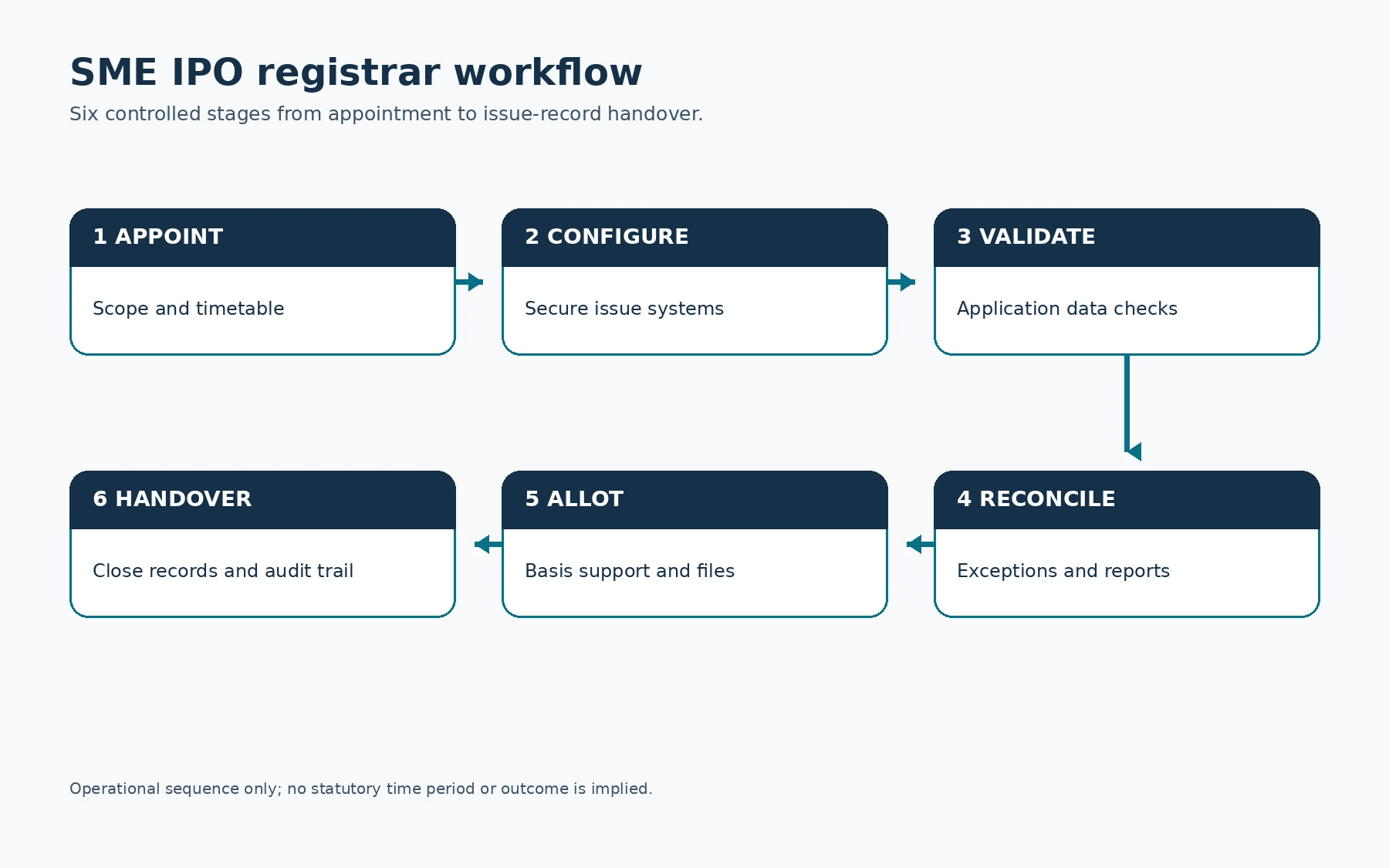
The workflow is a six-stage operational sequence with no numeric axis or statutory timetable. It starts with appointment and scope, then configuration, validation, reconciliation, allotment support and audit-trail handover. The appropriate evidence, approval points and timing remain issue-specific.
Avoidable RTA-workstream delays
- supplying different versions of capital, investor or offer data to different participants;
- treating an RTA appointment as evidence that the issuer meets every listing requirement;
- leaving exception ownership or escalation routes undocumented;
- transmitting sensitive applicant or shareholder information through uncontrolled channels; and
- omitting a final reconciliation and controlled record handover.
How Abhipra can assist
Preparing for an SME IPO or main-board IPO and need a Registrar-to-an-Issue/RTA workstream?
Contact Abhipra RTA Services at rtaservices@abhipra.com, call 011-42390783, or contact +91-9818080700.
Share the company name, current company type, proposed listing platform, latest audited financial year, capital structure, shareholder count, existing ISINs and target issue timeline for an initial operational discussion. Eligibility, merchant-banker advice and regulatory approvals remain subject to the applicable framework. Do not send sensitive KYC documents until a secure submission channel is provided.
Official source links
- SEBI RTA Regulations, 2025.
- SEBI Master Circular for RTAs, 6 February 2026.
- SEBI ICDR Regulations, 2018, consolidated through 21 March 2026.
- NSE Emerge requirements and process, updated 29 April 2026.
Disclaimer
This article is for general educational information and does not constitute legal, investment, tax, transaction or merchant-banking advice. The RTA’s precise role and the applicable issue process depend on the issuer, offer structure, current SEBI and exchange requirements, and authorised engagement terms.