
Trust, LLP, Company or Body Corporate: Choosing the Legal Form for an AIF
Reviewed on: 9 November 2026. Reviewed by Abhipra RTA Desk.
The SEBI AIF Regulations define an Alternative Investment Fund (AIF) as a privately pooled investment vehicle established or incorporated in India as a trust, company, limited liability partnership (LLP) or body corporate. The regulations permit these forms, but do not make one structure universally right. The choice must match the proposed category, governance, documents, tax/FEMA analysis, investors and operating model.

Begin with the enabling document, not a label
The application and source documents must show that the proposed entity can carry on AIF activity. For a trust, the governing instrument is a registered trust deed. For an LLP, the partnership deed and incorporation records matter. For a company, the memorandum and articles of association and incorporation records matter. For a body corporate, the enabling statute or other constitutive record must permit the activity.
The current Form A asks the applicant to identify whether it is a company, trust, LLP or body corporate. The AIF Regulations also set structure-specific eligibility conditions, including the registered-deed condition for a trust, incorporation/deed-filing condition for an LLP, and enabling-law condition for a body corporate. Treat these as baseline eligibility checks, not an exhaustive legal opinion.
Compare evidence and governance before selecting a structure
| Form | Core documentary focus | Governance question to resolve |
|---|---|---|
| Trust | Registered trust deed and its AIF activity/object provisions. | How trustee, manager and sponsor responsibilities are documented. |
| LLP | Incorporation and duly filed LLP/partnership deed. | How designated partners, manager, control and decisions are allocated. |
| Company | Certificate of incorporation plus memorandum and articles. | How board, shareholders, manager and investor-facing controls interact. |
| Body corporate | Constitutive statute or governing record and authority to carry on AIF activity. | Whether the enabling law and governance framework permit the proposed structure. |
Tax, stamp duty, FEMA, insolvency, investor contracting, control, custody and accounting consequences can differ materially by facts. Those questions need specialist advice; they are not answered by the AIF Regulations alone.
Documentation map before an AIF application
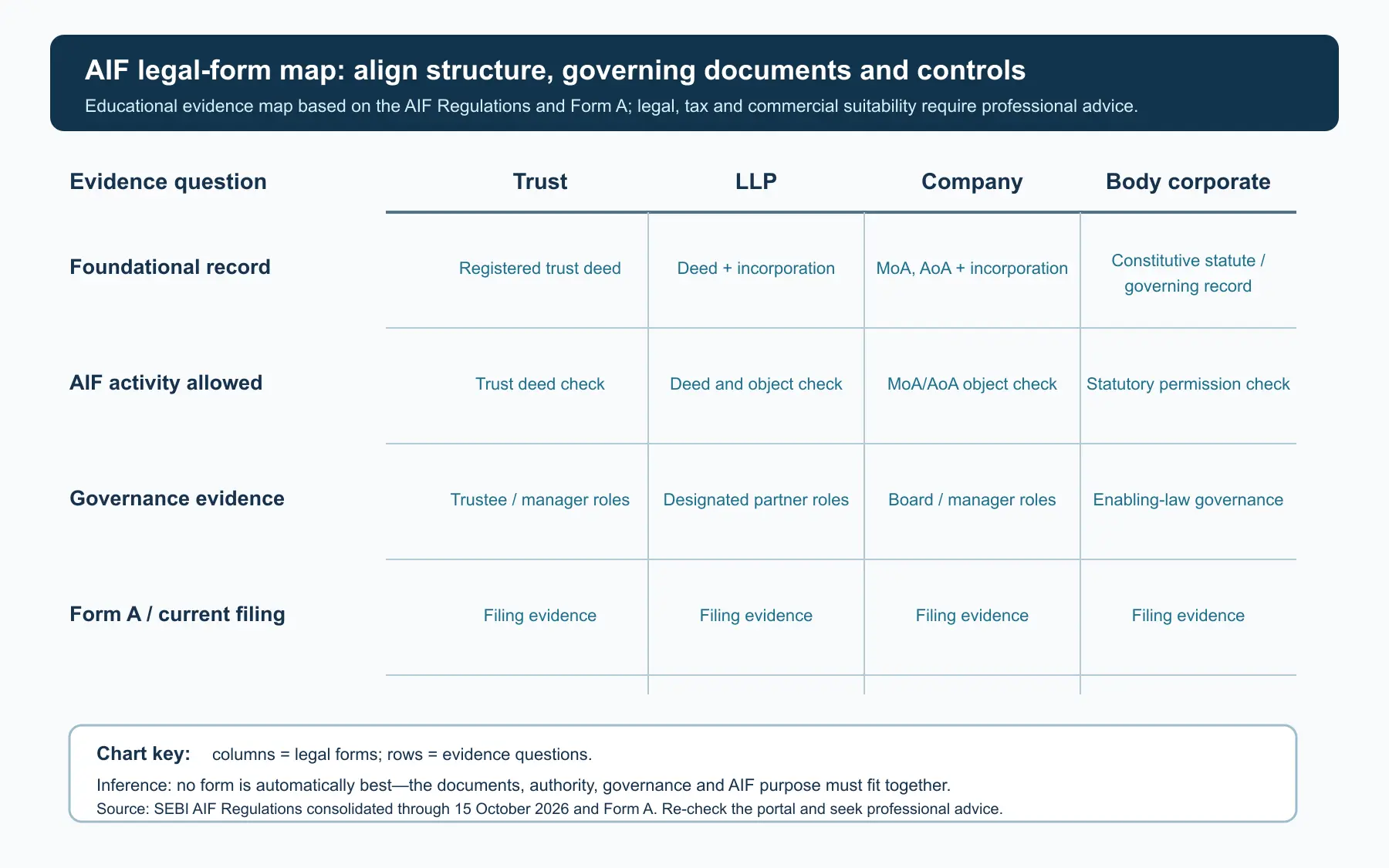
The horizontal axis lists the four legal forms named in the AIF definition. The vertical axis lists evidence questions rather than a numerical metric. The inference is that a structure choice should be tested against its governing document, authority to undertake AIF activity, governance evidence and the current filing requirements—not against a generic market preference.
Keep the service model aligned with the structure

Once a form is shortlisted, document the operational hand-offs: manager and sponsor roles, trustee or board oversight where relevant, authorised signatories, investment decisions, conflicts, compliance, unit-holder records, data access and escalation. Where an RTA is appointed, its scope should be defined in an engagement and control matrix. It does not replace the manager, sponsor, trustee, board, legal adviser or tax adviser.
Use role-based access and retained audit trails for formation and investor data. Do not email passwords, OTPs, unmasked PAN, bank details, signatures or sensitive KYC documents. Wait for a secure submission route authorised by the relevant provider.
Questions to put to the structure review team
- Does the governing document expressly support the proposed AIF activity and strategy?
- Who has authority to appoint or replace the manager, approve controls and authorise filings?
- Does the structure work with the proposed investor, tax, FEMA and custody arrangements?
- Which records evidence control, beneficial ownership, conflicts and authorised instructions?
- Does the planned PPM and scheme workflow match the legal form and current SEBI requirements?
How Abhipra can assist
Evaluating AIF operational readiness, RTA, dematerialised-unit, ISIN, depository or unit-holder servicing workflows after your professional structure review? Contact Abhipra RTA Services at rtaservices@abhipra.com, call 011-42390783, or contact +91-9818080700. Share only high-level, non-sensitive details until a secure submission route is confirmed.
Official sources
- SEBI AIF Regulations, 2012—consolidated through 15 October 2026
- SEBI AIF application document checklist and supporting-document requirements
- SEBI Form A for grant of AIF registration
Disclaimer
This is general regulatory education, not legal, tax, accounting, valuation, FEMA or investment advice. The appropriate legal form and its consequences depend on the current law, proposed AIF category, constitutional documents, investors, commercial arrangements and facts. Obtain professional advice before selecting a structure or filing.