
AIF Corpus, Minimum Investment and Continuing Interest: The Current Thresholds
Reviewed on: 12 November 2026. Reviewed by Abhipra RTA Desk.
An AIF's corpus, an investor's minimum commitment and the sponsor or manager's continuing interest are separate regulatory concepts. They should be mapped to the applicable AIF pathway before a fund is marketed, a commitment is accepted or an operating record is built. A ₹1 crore investor threshold, for example, does not describe every special pathway or every investor category.

Start with the applicable fund and investor pathway
Under Regulation 10 of the SEBI AIF Regulations, each AIF scheme generally needs a corpus of at least ₹20 crore. A social impact fund scheme has a minimum corpus of ₹5 crore. The Angel Fund chapter separately states a minimum corpus of ₹5 crore. Corpus means the total amount committed by investors through written contracts or other documents as of a particular date; it is not simply an informal target or an amount already deployed.
For a general AIF investment, Regulation 10 sets a minimum investor investment value of ₹1 crore. The regulation specifies ₹25 lakh for employees or directors of the AIF or of its manager. It also contains an accredited-investor exception. A social impact fund investing only in securities of not-for-profit organisations registered or listed on a social stock exchange has a ₹2 lakh minimum for an individual investor. Angel funds have their own investor and commitment provisions, including a ₹25 lakh minimum investment from an angel investor.
Do not apply an exception merely because an investor is sophisticated or an investment is commercial in nature. Confirm the current definition, evidence and fund-document terms before accepting a commitment.
Threshold map for corpus, commitments and alignment capital
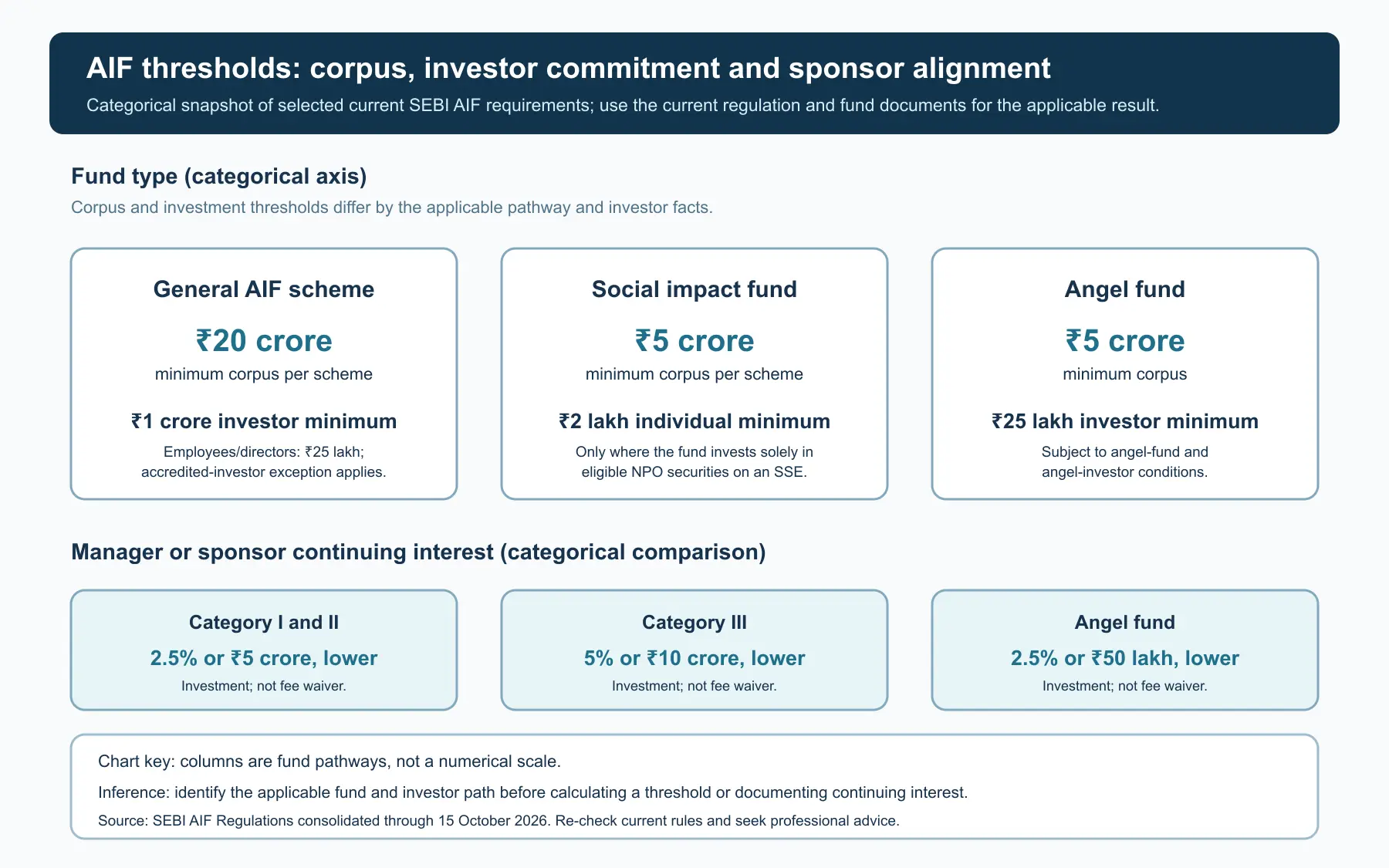
The horizontal axis is categorical: it groups the relevant fund pathways rather than measuring a continuous scale. The lower cards compare continuing-interest tests by category. The inference is that the applicable route must be identified before calculating a minimum, documenting a commitment or explaining sponsor/manager alignment capital. The chart is a compact reference; the current regulation and fund documents control.
Sponsor or manager continuing interest is an investment, not a fee waiver
For Category I and Category II AIFs, the manager or sponsor must maintain continuing interest of at least 2.5% of corpus or ₹5 crore, whichever is lower, in the form of investment in the AIF. For Category III AIFs, the test is at least 5% of corpus or ₹10 crore, whichever is lower. The regulation says this interest must not be through waiver of management fees, and the manager or sponsor must disclose its investment to investors.
For an angel fund, the manager or sponsor continuing-interest test is at least 2.5% of corpus or ₹50 lakh, whichever is lower, and it likewise cannot be met through waiver of management fees. These rules should be read alongside the category, sub-category, placement memorandum and current SEBI instructions.
| Question | Why it matters | Control owner to identify |
|---|---|---|
| Which fund pathway applies? | General, social-impact and angel-fund pathways have different conditions. | Manager legal and compliance teams |
| What is the documented corpus? | Corpus is based on written investor commitments, not a marketing estimate. | Manager, finance and authorised signatory |
| Which investor minimum applies? | Employee/director, accredited-investor, social-impact and angel-fund conditions may change the analysis. | Manager onboarding and compliance teams |
| How is continuing interest held and disclosed? | The investment form, calculation and investor disclosure need a clear evidence trail. | Sponsor/manager finance and compliance teams |
Build a controlled commitment record

Maintain versioned commitment agreements, investor-category evidence, approved exceptions, continuing-interest calculations, disclosures and reconciliations. Confirm that the placement memorandum, contribution documents, internal records and investor communications use the same current figures and definitions. An RTA may maintain agreed unit-holder and servicing records, but does not determine investor eligibility, fund suitability or the sponsor/manager's regulatory obligation.
Limit access to commitment records, PAN details, bank information, signatures and KYC materials to authorised roles. Do not send passwords, OTPs, unmasked PAN, bank details, signatures or sensitive KYC documents by email; wait for an authorised secure submission route.
Questions for the fund-readiness meeting
- Is the correct AIF, social-impact-fund or angel-fund pathway documented?
- What written records support the stated corpus on the relevant date?
- Which investor minimum applies to each prospective commitment, and why?
- How will sponsor/manager continuing interest be calculated, funded and disclosed?
- Do the placement memorandum, contribution documents and operating records use consistent current terminology?
How Abhipra can assist
Planning AIF unit-holder servicing, unit dematerialisation, ISIN, depository connectivity or RTA operating controls after professional fund-structure review? Contact Abhipra RTA Services at rtaservices@abhipra.com, call 011-42390783, or contact +91-9818080700. Share only high-level, non-sensitive details until a secure submission route is confirmed.
Official sources
- SEBI AIF Regulations, 2012—consolidated through 15 October 2026
- SEBI Master Circular for AIFs—issued 3 June 2026 and updated 16 June 2026
- SEBI AIF FAQ material on Regulation 10 and angel funds
Disclaimer
This is general regulatory education, not legal, tax, accounting, FEMA or investment advice. Applicable thresholds and exceptions depend on the current regulation, the AIF's category and structure, the investor's status, fund documents and facts. Obtain professional advice before accepting commitments, calculating continuing interest or making a regulatory disclosure.