SME IPO Readiness Assessment: 25 Questions for the Board
Reviewed on: 12 October 2026. Reviewed by Abhipra RTA Team.
An SME IPO is not ready merely because a company wants to raise capital. Before approving a filing workstream, the board should be able to see evidence on the listing route, capital structure, financial information, governance and execution controls. This 25-question assessment is a practical board agenda, not a legal eligibility certificate.

Start with the applicable route and current criteria
SEBI's ICDR Regulations apply to SME initial public offers, while the SME exchange's current criteria and process also matter. For example, NSE Emerge states that its criteria are assessed both when the public offer document is filed with NSE and when it is filed with the Registrar of Companies and SEBI. NSE Emerge currently lists a post-issue paid-up capital ceiling of ₹25 crore, track-record alternatives, operating-profit and positive-FCFE tests, plus other conditions. These are not the only considerations, and a company should obtain merchant-banker and legal advice on its actual facts.
The 25 board questions
1. Eligibility and listing route
- Is the proposed platform and post-issue capital range documented?
- Have the exchange's current entry conditions been checked at the relevant filing dates?
- Is there a clear record of the applicable track-record route?
- Have insolvency, winding-up, debarment and material regulatory-history checks been assigned?
- Is the merchant banker’s due-diligence plan aligned with the issuer’s timetable?
2. Capital, demat and shareholder records
- Do authorised, issued, subscribed and paid-up capital reconcile?
- Does every allotment, transfer, split, bonus issue or consolidation have traceable evidence?
- Are security classes, ISINs and depository/RTA records mapped to the current cap table?
- Have promoter holdings, pledges, encumbrances and lock-in implications been escalated for authorised review?
- Are legacy physical records or unexplained shareholder mismatches being remediated before they affect offer-document data?
3. Financial readiness
- Are restated financial statements and management explanations planned with named owners?
- Is the current operating-profit analysis tested against the relevant exchange requirement?
- Is positive free cash flow to equity assessed using the exchange’s applicable methodology and audited information?
- Is net worth supported by current audited records?
- Are use-of-proceeds assumptions, working-capital needs and related-party positions documented for review?
4. Governance and disclosures
- Are board and committee records complete, dated and consistent with the corporate record?
- Is there a controlled register of related parties, group companies, contracts, litigation and contingent liabilities?
- Are material risk disclosures backed by an evidence owner rather than a narrative assumption?
- Are policy, internal-control and approval gaps recorded with remediation dates?
- Does the data room preserve version history and access control for sensitive materials?
5. Issue execution
- Are the issuer, merchant banker, registrar, depositories, bankers and other intermediaries assigned distinct responsibilities?
- Is the draft-offer-document evidence checklist controlled and current?
- Are shareholder and application-data reconciliation controls designed before allotment work begins?
- Is there a documented escalation path for data exceptions, complaints and changes?
- Has the board agreed the decision gates, owners and evidence it needs before proceeding?
Five workstreams, one evidence trail
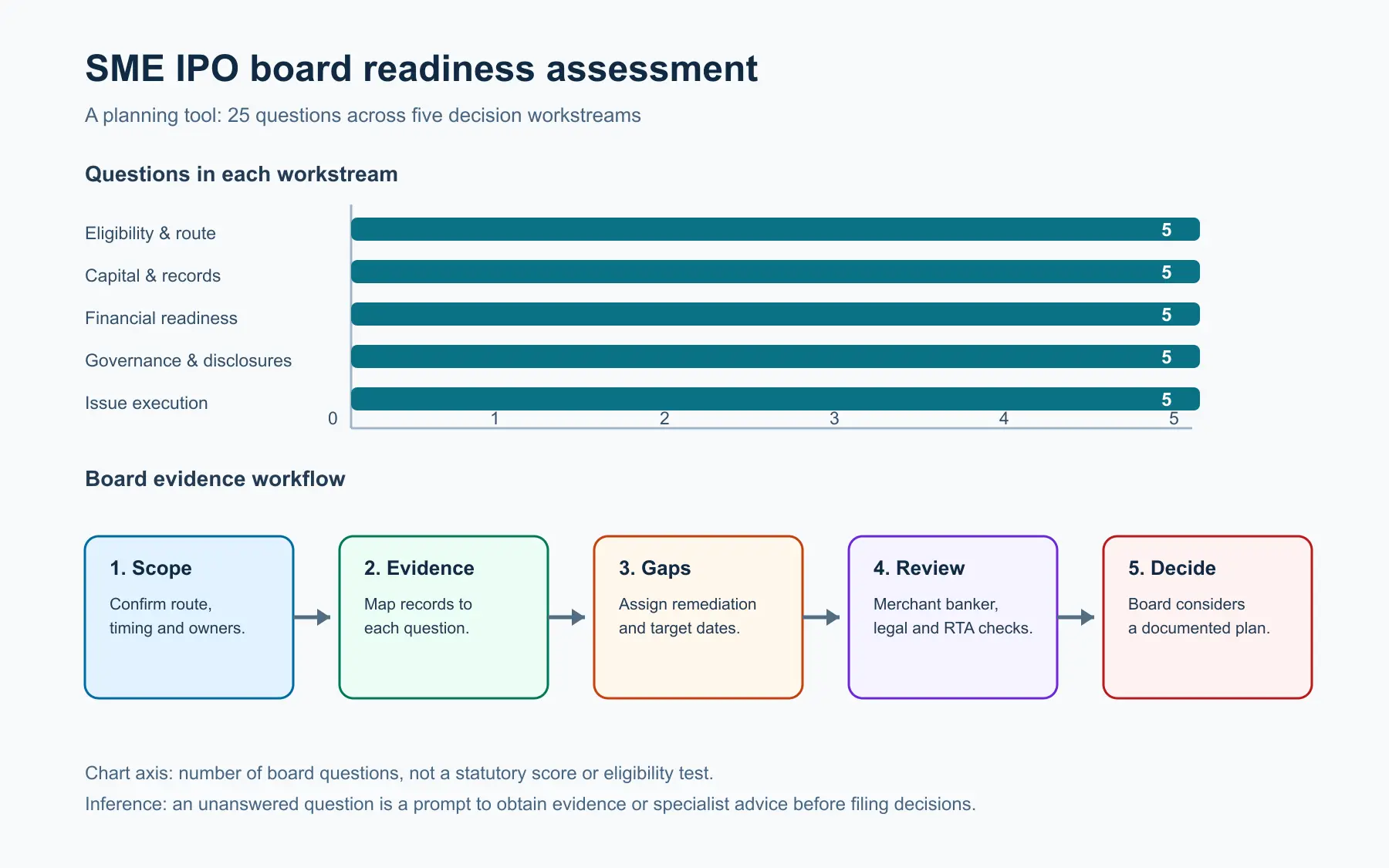
The chart’s horizontal axis is the number of questions in each workstream. Every bar is five because this is an assessment design, not a score, ranking or regulatory threshold. The workflow moves from scope to evidence, gap ownership, specialist review and a documented board decision. The useful inference is straightforward: an unanswered question should become a tracked evidence request or remediation task, not an assumption in a filing schedule.
Use the assessment without turning it into a promise
The assessment does not replace the ICDR Regulations, exchange requirements, offer-document due diligence, merchant-banker judgment or advice on the issuer’s facts. It is designed to make board oversight clearer: identify the responsible owner, the supporting document, the unresolved gap and the next review date for each question.
Do not send unmasked PAN, bank details, signatures, passwords, OTPs or shareholder KYC documents by ordinary email. Use a secure submission route only after the responsible intermediary confirms the needed documents and method.
How Abhipra can assist
Preparing for an SME IPO or main-board IPO and need a Registrar-to-an-Issue/RTA workstream? Contact Abhipra RTA Services at rtaservices@abhipra.com, call 011-42390783, or contact +91-9818080700. Share high-level company and issue details for an initial operational discussion. Do not send sensitive shareholder records until a secure submission channel is provided.
Official source links
- SEBI ICDR Regulations, consolidated through 21 March 2026
- SEBI Master Circular for ICDR, 9 February 2026
- NSE Emerge eligibility criteria
- NSE Emerge requirements and process
Disclaimer
This article is general educational information, not legal, investment, tax, transaction, listing or merchant-banking advice. SME IPO readiness and eligibility depend on the issuer’s facts, current law, exchange requirements and professional review. REQUIRES HUMAN LEGAL REVIEW for transaction-specific conclusions.