Pre-IPO Corporate Actions: Splits, Bonus Issues and Capital Reorganisation Before Filing
Reviewed on: 14 October 2026. Reviewed by Abhipra RTA Team.
A split, bonus issue, consolidation or other capital reorganisation can make the share record easier to administer, but it is not a cosmetic pre-IPO step. Before filing work relies on the resulting record, the issuer needs a controlled decision, the appropriate approvals, reconciled capital and holder data, and an evidence trail that advisers can validate.

Start with the transaction purpose and the current capital record
An issuer should first document why a corporate action is proposed, which security class is affected, and how it changes authorised, issued, subscribed and paid-up capital. A share split changes denomination and the number of shares; a consolidation does the reverse. A bonus issue capitalises eligible reserves subject to the applicable legal and regulatory conditions. A scheme-led merger, demerger or reconstruction has its own approval, record and disclosure consequences.
For a proposed SME IPO, NSE Emerge says an issuer files its draft prospectus with the documents in its IPO-vetting checklist. The exchange’s review is for listing-requirement purposes, not a blanket approval under every applicable law. The issuer, its board and advisers remain responsible for the underlying facts and disclosures.
The six controls that keep a capital action filing-ready
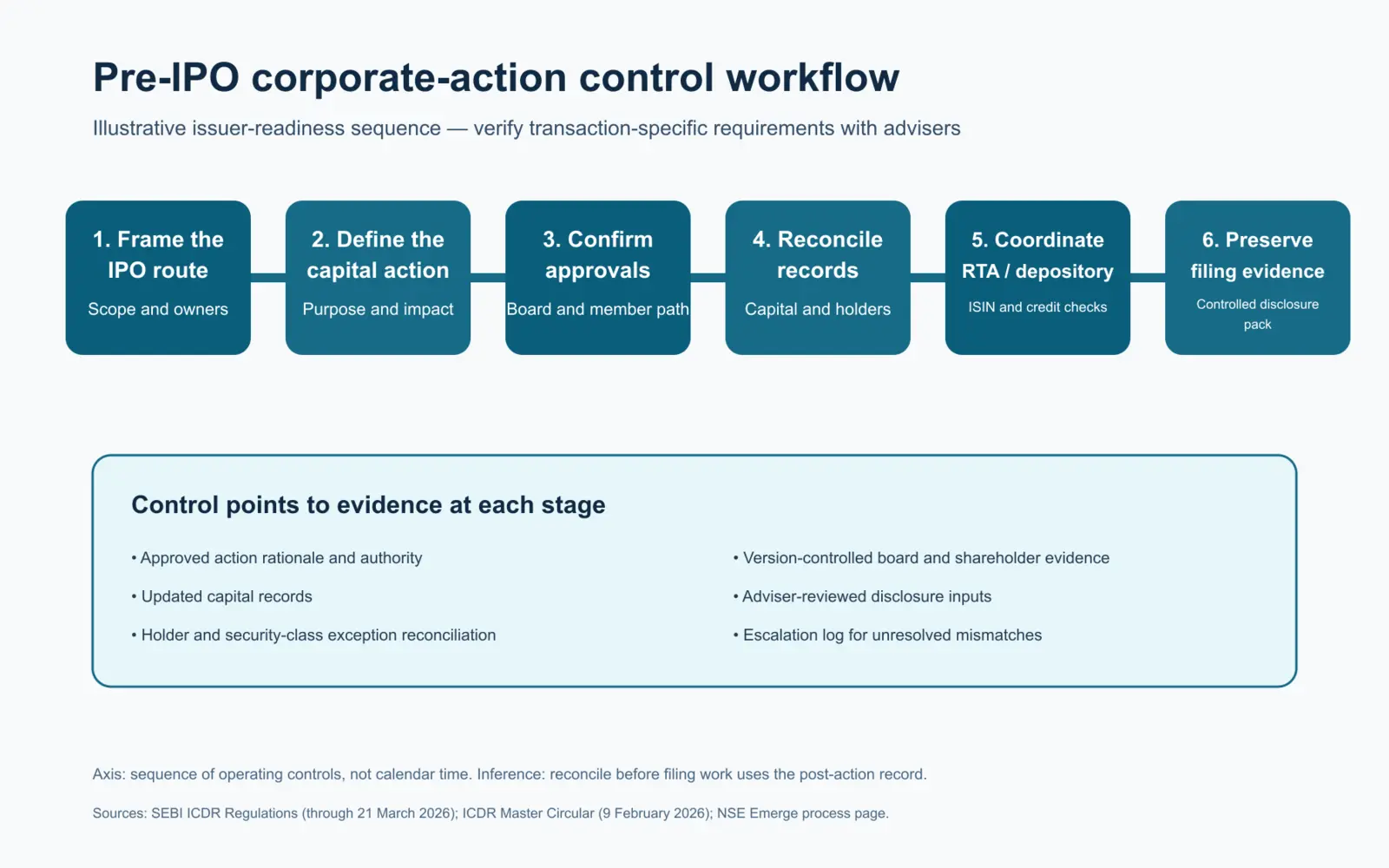
This is a process map, not a statutory timetable: the horizontal axis is the order of operating controls. Its practical inference is that reconciliations should be completed before filing work uses the post-action capital record. The issuer should keep approved versions, owners, exception notes and escalation decisions at every stage.
- Frame the route and owners. Confirm whether the proposed route, exchange platform and offer-document timetable are compatible with the action being considered.
- Define the action precisely. Record the affected class, ratio or denomination, record-date dependencies, expected post-action capital and every linked instrument or entitlement.
- Obtain and retain approvals. The necessary board, member, contractual, regulatory or judicial approvals depend on the action and facts. Do not assume one approval route fits every case.
- Reconcile the share register. Tie authorised, issued, subscribed and paid-up capital to the cap table, allotments, transfers, earlier corporate actions, security classes and any pending exceptions.
- Coordinate the operational record. Confirm the RTA, depository, ISIN and holder-data handling needed for the issuer’s facts. Resolve mismatches through controlled channels.
- Preserve disclosure evidence. Give advisers one controlled disclosure pack, with traceable source records rather than parallel spreadsheets or informal versions.
What the regulations make important to check
SEBI’s ICDR Regulations, 2018, consolidated through 21 March 2026, require offer-document disclosures to address material capital-structure information. The regulations include a requirement to disclose a proposal, intention, negotiation or consideration to alter capital structure through a split or consolidation, specified securities, bonus or rights issue, further public issue or QIP within six months from the opening date of the present issue, where applicable. The exact rule, issuer category and disclosure consequence require merchant-banker and legal confirmation.
The same consolidated framework contains separate bonus-issue conditions and completion provisions for listed issuers. Those provisions should not be applied mechanically to an unlisted IPO candidate: company-law requirements, the issuer’s articles, the proposed listing route, exchange procedures and transaction documents must be reviewed together.
For listed securities, NSE’s corporate-action adjustment methodology explains that bonus issues, stock splits and consolidations can require adjustments to open derivative positions. That methodology is not a pre-IPO eligibility test, but it illustrates why a capital change affects more than the face value or number of shares.
A simple control matrix for the board pack
| Record or question | Why it matters before filing work uses it | Evidence owner |
|---|---|---|
| Approved action rationale and authority | Connects the action to a valid corporate purpose and approval route | Company secretarial team with legal advisers |
| Pre- and post-action capital reconciliation | Prevents inconsistencies between the register, cap table and disclosure inputs | Finance, secretarial and RTA teams |
| Holder, instrument and restriction review | Identifies options, convertibles, pledges, lock-in or transfer restrictions needing review | Secretarial team and transaction advisers |
| Depository and ISIN operational plan | Helps manage security-class and credit-record dependencies | RTA / depository coordination team |
| Version-controlled disclosure pack | Lets advisers trace a prospectus statement back to approved evidence | Issuer with merchant banker and counsel |
Common failure patterns
- Using a post-action cap table without retaining the bridge from the prior capital structure.
- Treating a split ratio or bonus ratio as a substitute for a full security-class reconciliation.
- Leaving old allotments, transfers, options, convertibles or holder-name mismatches for the issue-period timetable.
- Confusing exchange process review with legal, tax, accounting, company-law or merchant-banking clearance.
- Sending shareholder records, PAN, bank details, signatures, passwords or OTPs through ordinary email.
How Abhipra can assist
Planning an SME IPO or main-board IPO and need controlled RTA, share-register or depository coordination? Contact Abhipra RTA Services at rtaservices@abhipra.com, call 011-42390783, or contact +91-9818080700. Share high-level company and transaction details for an initial operational discussion. Do not send sensitive shareholder records until a secure submission channel is provided.
Official source links
- SEBI ICDR Regulations, 2018 — consolidated through 21 March 2026
- SEBI Master Circular for ICDR, 9 February 2026
- NSE Emerge requirements and process
- NSE corporate-action adjustment methodology
Disclaimer
This article is general educational information, not legal, investment, tax, accounting, transaction, listing or merchant-banking advice. The action, sequence, approvals, disclosures and timing depend on current rules, transaction documents and the issuer’s facts. REQUIRES HUMAN LEGAL REVIEW for transaction-specific conclusions.