
Technical Rejections in IPO Applications: Common Data and Process Errors
Reviewed on: 19 October 2026. Reviewed by Abhipra RTA Desk.
An IPO application can fail before allotment even when an investor intends to apply for a valid quantity. A technical rejection usually arises when the bid, payment-blocking instruction and depository identity data do not meet the applicable issue requirements. The issue’s offer document, the live exchange instructions and the intermediary’s acknowledgement remain the controlling references for that application.

Why the application route matters
For public issues, the payment route is ASBA; an eligible UPI route is part of the ASBA process for the investors and application sizes for which it is permitted. The SEBI investor ASBA guide describes the sequence: bid details are uploaded, a blocking request is sent, and funds are debited only after allotment to the applicable extent. NSE’s live issue-information page also states that investors must use ASBA for payments.
The practical point is simple: a successful screen submission is not the same as a confirmed, eligible bid. The identity details, payment instruction and upload must all be valid for the particular issue.
Data and process errors that can lead to technical rejection
The final list and wording are issue-specific. Recent SEBI-hosted offer documents and the applicable General Information Document commonly identify the following controls.
| Control to check | Avoidable error | Safer action before the issue closes |
|---|---|---|
| PAN and demat record | DP ID, Client ID or PAN does not match an active, verifiable beneficiary account | Copy the identifiers from the demat account record; do not guess or reuse old details. |
| Payment ownership | A third-party bank account or third-party-linked UPI ID is used | Use the applicant’s own eligible bank account or linked UPI ID, as applicable. |
| UPI mandate / ASBA block | The mandate is not approved in time, funds are insufficient, or the block cannot be confirmed | Read the mandate attachment, approve only through the official app and keep adequate cleared balance. |
| Eligible route and timing | An ineligible app/handle/channel is used, or the bid is not uploaded during the permitted window | Use the live official list and submit early; do not rely on a prior issue’s timing. |
| Bid information | Required bid, bank, UPI or applicant fields are incomplete or inconsistent | Recheck the acknowledgement and the details shown in the mandate request. |
| Revisions | A revised bid is not submitted through the required channel or the revised mandate is not approved | Follow the issue document’s revision process and keep the revised acknowledgement. |
SEBI’s investor guide specifically warns that third-party UPI IDs or third-party bank accounts will not be considered for allocation. It also directs applicants to eligible SCSBs, listed apps/handles and authorised submission channels. A SEBI-hosted offer document gives further examples: missing bank or bid details, failure to instruct full blocking, unmatched demat/PAN details, insufficient funds, late upload and an incorrect UPI handle may make a bid liable to rejection. These are examples, not a substitute for the relevant offer document.
Application validation workflow before allotment
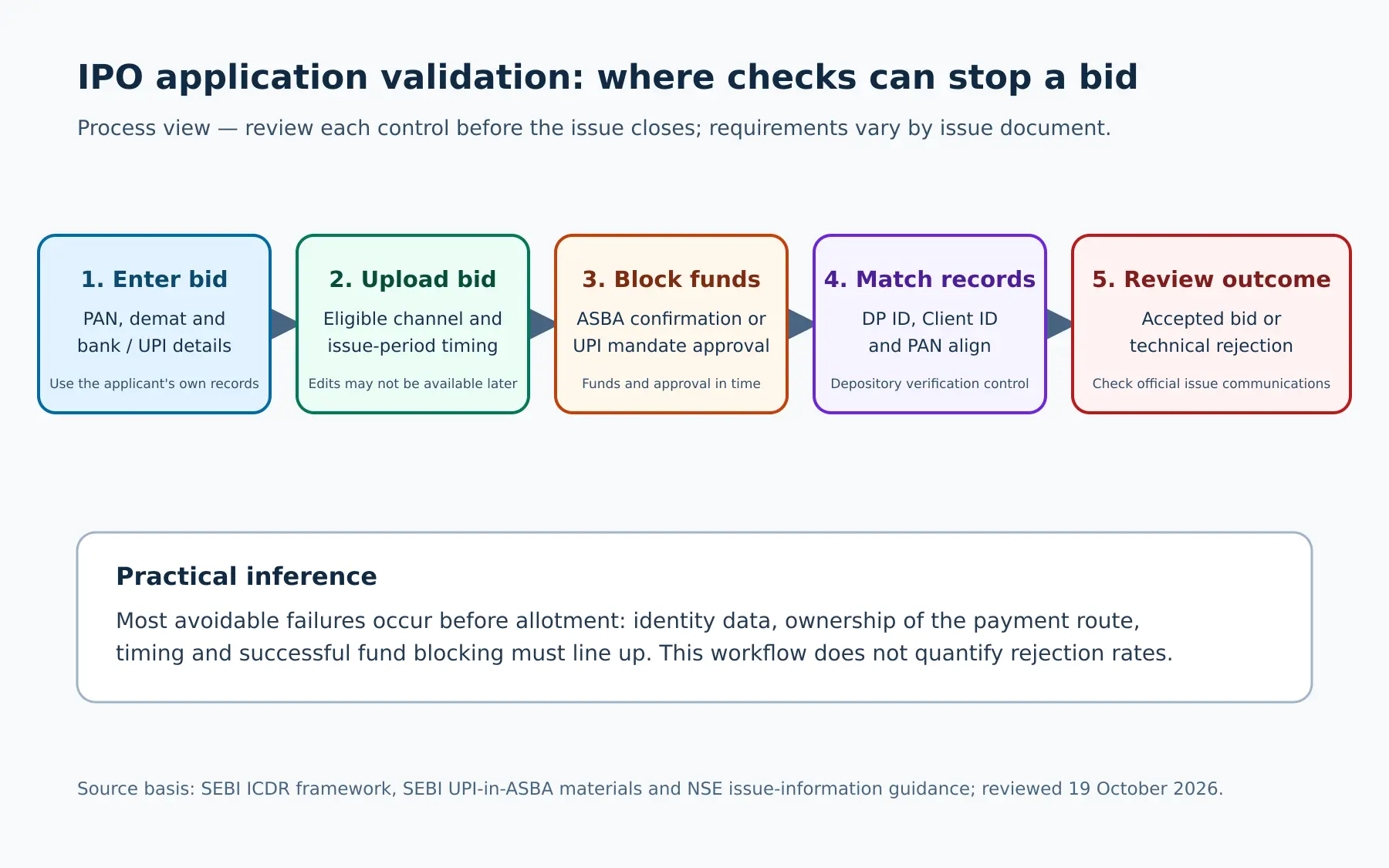
The workflow has five controls, read left to right: enter the bid with PAN, demat and payment details; upload it through an eligible route during the issue period; complete ASBA/UPI fund blocking; match DP ID, Client ID and PAN to the depository record; then check the official outcome. It has no numeric axis or rejection-rate data. Its inference is operational: avoidable failures tend to arise where identity, payment ownership, timing and fund blocking do not line up.
A careful investor and issuer checklist
- Use only the application channel, UPI handle and bank eligibility stated for the live issue.
- Confirm the exact DP ID, Client ID and PAN shown in the depository record. An active demat account is required for demat allotment.
- Keep sufficient available balance for the full bid amount and act on the block request within the time stated for that issue.
- Review the mandate attachment before authorising it with the UPI PIN. Never share the PIN, OTP, bank password or unmasked account details with a person claiming to assist with an IPO.
- Retain the acknowledgement, but use the issue’s official status, registrar communications and authorised intermediary support channel if a discrepancy appears.
- For corporate, trust, power-of-attorney, non-resident or other specialised applications, obtain transaction-specific professional guidance and follow the document requirements stated in the offer materials.

How Abhipra can assist issuers and intermediaries
Abhipra’s RTA team can help issuers and their professional advisers design application-data, reconciliation and investor-communication controls for a public-issue workstream. This does not replace the role of the merchant banker, stock exchange, sponsor bank, depository participant or the issue-specific registrar process. Please use a secure, approved channel before sharing any shareholder, KYC or application material; never send OTPs, PINs, passwords or unmasked bank data by email or chat.
Source links
- SEBI investor guide: Apply in IPO through ASBA — checked 19 October 2026.
- SEBI circular: Streamlining IPOs with UPI in ASBA and investor-grievance redressal — checked 19 October 2026.
- NSE Issue Information — checked 19 October 2026; consult the live page for issue-specific timing and operational notices.
- SEBI-hosted offer-document example covering technical-rejection grounds — an illustrative disclosure source, not a replacement for the current issue’s documents.
Disclaimer
This article is general educational information, not investment, legal, tax, banking or transaction advice. IPO eligibility, timings, category rules and rejection grounds can differ by issue and may change. Read the applicable offer document and official exchange/registrar communications, and obtain advice from appropriately qualified professionals where needed. Investing in securities involves market risk.