IPO Bid and Application Reconciliation: How Registrars Identify Mismatches Before Allotment
Reviewed on: 17 October 2026. Reviewed by Abhipra RTA Desk.
Before an IPO allotment basis can be prepared, the registrar must align the final electronic bid data with the applicable bank and ASBA evidence, validate key application fields, and apply the prescribed treatment for technical or multiple applications. A submitted bid is therefore not, by itself, a final allotment input.

Why reconciliation happens after issue closure
The registrar-to-the-issue receives the final bid file from the exchanges, validates it and coordinates with banks for final collection certificates, schedules or equivalent applicable funds evidence. NSE’s investor FAQ describes this reconciliation before the basis of allotment is prepared in consultation with the book running lead managers (BRLMs) and issuer and submitted to the stock exchange for approval.
This is a control process, not a prediction of whether an investor will receive shares. The applicable offer document, SEBI framework and exchange process determine what is accepted, rejected or corrected for that issue.
Six reconciliation gates before allotment
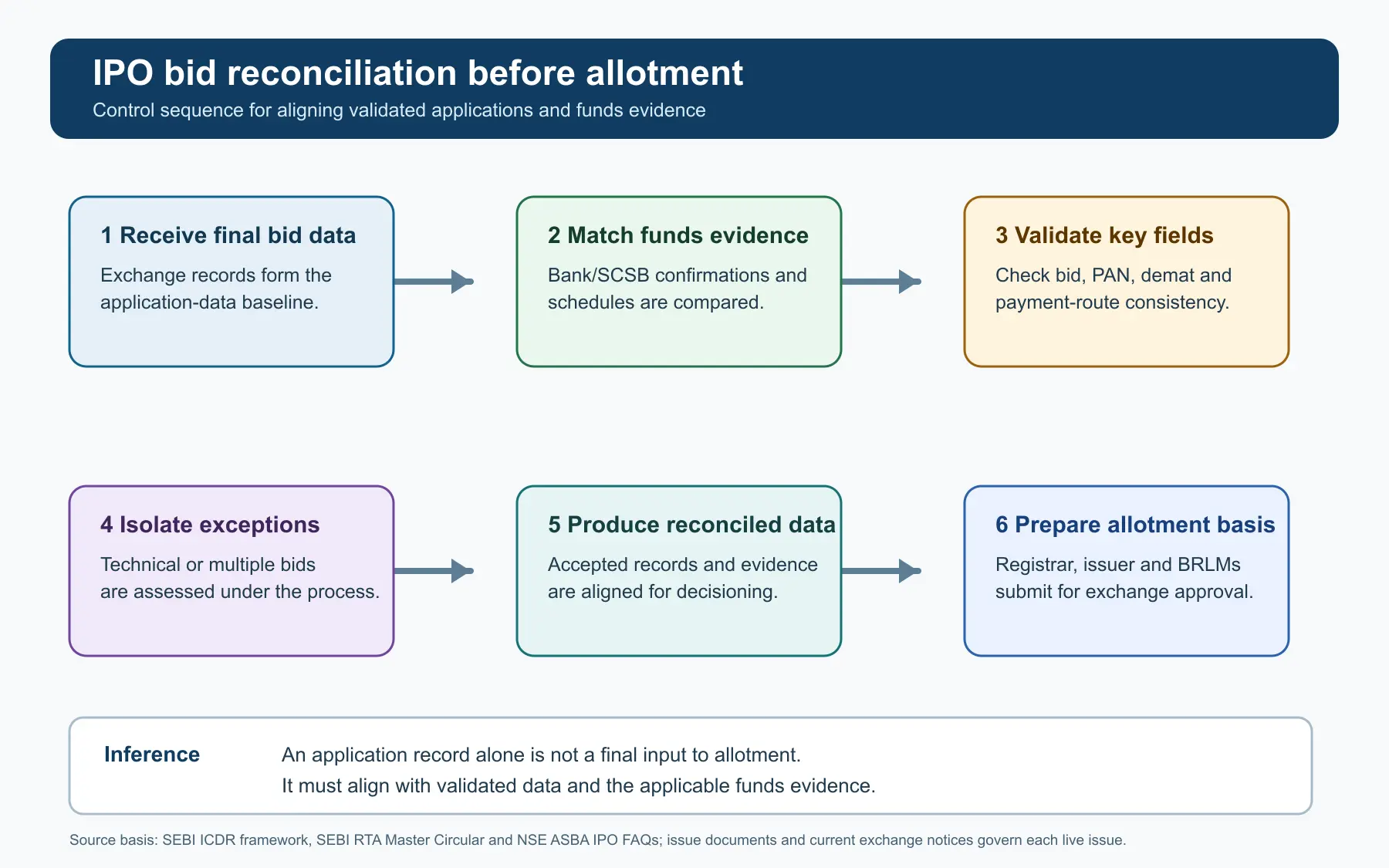
- Final bid records are received from the electronic exchange platform.
- The registrar compares applicable bank/SCSB confirmations and schedules with those records.
- Key data such as bid details, PAN, demat details and payment-route information is validated under the relevant process.
- Technical and multiple-application exceptions are identified and assessed.
- Accepted records and supporting evidence become the reconciled data set.
- The registrar prepares the basis of allotment with the issuer and BRLMs for designated-exchange approval.
The workflow is a sequence rather than a numeric chart because official guidance describes interdependent control events, not one universal error rate or processing duration. Its inference is that a bid requires both validated application information and the required supporting funds evidence before it can move into the reconciled decision set.
Examples of records that need investigation
| Reconciliation area | Why it matters | Operational response |
|---|---|---|
| Bid versus funds evidence | A bid record must align with the applicable ASBA/banking evidence. | Reconcile through the authorised reports and escalation path. |
| PAN and demat details | Incorrect or inconsistent details can affect validation or credit processing. | Apply the issue process and permitted correction rules. |
| Duplicate or multiple applications | The framework requires appropriate treatment of multiple applications. | Identify and process exceptions consistently; retain evidence. |
| Bid price, quantity or lot | A bid must comply with the disclosed price band and lot conditions. | Validate against offer terms before the allotment basis is finalised. |
| UPI/ASBA status | Where relevant, a block/mandate status is part of the funding-control chain. | Use current sponsor-bank/SCSB and exchange records; do not rely on screenshots or informal messages. |

Roles and audit trail
The registrar coordinates the operational reconciliation. The issuer and BRLMs participate in preparing the allotment basis, while the designated stock exchange approves it under the applicable process. Banks, SCSBs, sponsor-bank routes, depositories and permitted intermediaries each contribute controlled records at different stages. SEBI’s ICDR framework also assigns post-issue merchant bankers a coordination role with registrars and other intermediaries until issue formalities and listing-related steps are complete.
For a strong audit trail, the workstream should preserve source-file versions, exception reasons, the decision owner, timestamps, reconciliation outputs and approved downstream files. Those controls help address enquiries without exposing investor data in operational discussions.
Avoidable issuer and investor errors
- Treating a preliminary bid count as a final subscription or allotment result.
- Using unverified screenshots instead of authorised reports and system records.
- Assuming a blocked amount guarantees allotment.
- Sending sensitive identifiers, bank credentials, OTPs or UPI PINs through ordinary email or chat.
- Changing application data outside the allowed issue window.
Investors should use only official issue channels and contact the authorised intermediary, SCSB or registrar route identified in the offer documents for an application-specific query. Issuers should agree exception ownership, escalation timing and evidence retention before the issue opens.
How Abhipra can assist issuers and issue teams
Abhipra RTA Services can support registrar-to-an-issue operational readiness, controlled data-reconciliation planning and issue-period coordination, subject to the engagement, offer documentation and applicable regulatory framework.
Preparing for an SME IPO or main-board IPO and need a Registrar-to-an-Issue/RTA workstream? Contact Abhipra RTA Services at rtaservices@abhipra.com, call 011-42390783, or contact +91-9818080700. Share the company name, current company type, proposed listing platform, latest audited financial year, capital structure, shareholder count, existing ISINs and target issue timeline for an initial operational discussion. Eligibility, merchant-banker advice and regulatory approvals remain subject to the applicable framework.
Source links
- SEBI Master Circular for Registrars to an Issue and Share Transfer Agents, 6 February 2026
- SEBI ICDR framework: post-issue coordination and reporting
- NSE FAQs on ASBA IPO for investors: registrar role
- NSE issue information and current public-issue notices
Disclaimer
This article is general educational information, not investment, legal, banking or transaction advice. Each public issue is governed by its current offer document, the applicable SEBI/exchange framework and authorised intermediary instructions. Abhipra does not ask readers to send passwords, OTPs, UPI PINs, full bank details, signatures or unmasked PAN by email or message.